DONALD KEYHOE
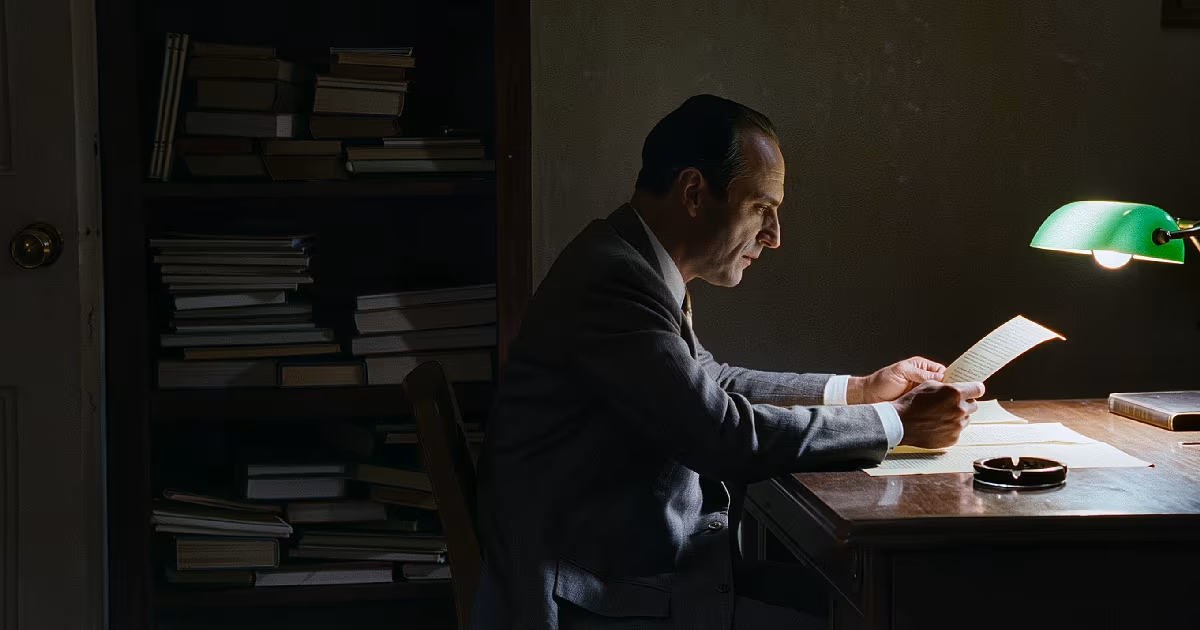
A man in a grey suit reads a letter under a desk lamp.
Illustration, not a photograph.

Opening
Donald E. Keyhoe was a Naval Academy graduate, former Marine Corps aviator and professional aviation writer who did more than anyone else in the 1950s to turn flying saucers into a public argument with the Air Force. His magazine article "Flying Saucers Are Real", in the January 1950 issue of True, argued that the objects were real and that the Air Force knew it. The book of the same name followed within months. He went on to direct NICAP, the National Investigations Committee On Aerial Phenomena, for more than a decade, and wrote five books on the subject.
His campaign outlasted most of his specific claims. He spent nearly twenty years pressing for open congressional hearings with civilian witnesses, and never got the kind he wanted. Whether the Air Force was concealing what it knew is the question he left behind.
Timeline
20 June 1897Keyhoe is born in Ottumwa, Iowa.
1919He graduates from the US Naval Academy and is commissioned a second lieutenant in the Marine Corps, later training as a pilot.
1922 to 1923He injures his arm in an aircraft crash on Guam. The injury keeps troubling him, and he leaves the Corps in 1923.
1927Working for the Commerce Department's aeronautics branch, he manages Charles Lindbergh's national tour after the transatlantic flight.
1928Flying With Lindbergh is published. Through the 1930s he writes for magazines and the pulps, including aviation adventure fiction.
Second World WarHe returns to active duty in a Naval Aviation Training Division and retires again as a major.
26 December 1949The January 1950 issue of True goes on sale with his article. It is one of the most-read magazine pieces of its day.
1950 to 1960Four books follow: The Flying Saucers Are Real (1950), Flying Saucers from Outer Space (1953), The Flying Saucer Conspiracy (1955) and Flying Saucers: Top Secret (1960).
October 1956NICAP is founded in Washington. Its first director is the physicist Thomas Townsend Brown.
January 1957Keyhoe replaces Brown as director.
22 January 1958On the CBS programme Armstrong Circle Theatre, Keyhoe departs from his cleared script to say that UFOs are real machines under intelligent control. CBS cuts his microphone. The network says the script had been cleared for security reasons, and the episode becomes a lasting grievance among his supporters.
March 1966After a wave of sightings in Michigan and the Air Force's "swamp gas" explanation, House Republican leader Gerald Ford, a Michigan congressman, calls for hearings.
5 April 1966The House Armed Services Committee, chaired by Mendel Rivers, holds a short open hearing. The witnesses are Air Force Secretary Harold Brown, Blue Book chief Major Hector Quintanilla and the astronomer J. Allen Hynek. No civilian group testifies. The hearing leads to the University of Colorado study under Edward Condon.
1968Keyhoe publicises the "trick memo", an internal note by the Condon project's coordinator that suggested the study would present itself as objective while expecting a negative result.
December 1969After what accounts describe as a stormy meeting, the NICAP board forces Keyhoe to retire as director. The same month, the Air Force closes Project Blue Book.
1973His fifth UFO book, Aliens from Space, is published.
29 November 1988He dies in New Market, Virginia, aged 91. A memorial record gives 2 December, but 29 November is the date in the standard biographical references.
Key figures
Charles Lindbergh gave Keyhoe his first public profile. Thomas Townsend Brown founded NICAP and handed it to him within months. Gerald Ford and Mendel Rivers produced the 1966 hearing, the closest Keyhoe came to his goal. Edward Condon led the study that followed and concluded in 1969 that further UFO research was unlikely to advance science. Leonard Stringfield, a friend from 1953, served as NICAP's public relations adviser under him. At its peak in the 1960s NICAP had several thousand members, and the most-quoted figure is around 14,000.
Physical and documentary trail
His books and articles are the main record of his claims, and they are dated and easy to check. The CIA's reading room holds documents from the 1950s and 1960s that mention NICAP and Keyhoe, and the Robertson Panel's 1953 report, declassified in stages, recommended that civilian saucer groups be watched for their potential influence. The 1966 hearing transcript is public. Most of Keyhoe's strongest claims rest on unnamed sources inside the Air Force and the Pentagon, and because he did not name them, those claims cannot be tested.
His case material passed to NICAP, and when NICAP was dissolved in 1980 its files went to the Center for UFO Studies. That collection is where a researcher would go to check his sources.
Things you might not know
- He was a pulp writer before he was a saucer writer. Keyhoe wrote aviation adventure stories for the pulps in the 1930s, a fact his critics liked to mention and his supporters thought irrelevant.
- CBS turned off his microphone on live television. The 1958 Armstrong Circle Theatre broadcast is one of the best-known moments in early UFO history.
- The hearing he fought for left him out. The 1966 House session heard only Air Force witnesses.
- The Robertson Panel had groups like his in mind. Its 1953 report recommended that civilian UFO groups be watched, though NICAP did not exist yet.
- NICAP outlived his leadership by only a decade. He was forced out in 1969, and the organisation was dissolved in 1980.
- A full biography appeared in 2023. Linda Powell's Against the Odds: Major Donald E. Keyhoe and His Battle to End UFO Secrecy is the most detailed account of his campaign.
Competing explanations
An advocate who was right about the secrecy. The Robertson Panel did recommend a public education campaign to reduce interest in UFOs, and documents released since show the Air Force and the CIA were more concerned with the subject than they said in public. On this reading Keyhoe saw the shape of the policy accurately, even without the papers to prove it.
An advocate who mistook secrecy for knowledge. The Air Force kept a great deal secret in the 1950s, from radar capabilities to reconnaissance programmes. A concealed programme of balloons or spy planes would produce the same official evasions Keyhoe read as concealment of alien craft. His central claim was that the Air Force knew the objects were real, and the released documents show an Air Force that wanted the subject to go away, which is not the same thing.
A writer whose sources cannot be checked. Keyhoe relied heavily on unnamed officers. Some of his case accounts were later shown to differ from the underlying reports, which is the risk in any account that cannot name its sources.
Later life of the case
Keyhoe's demand for open hearings with credible witnesses is now ordinary. Congressional UAP hearings since 2023 have heard from former military officers, which is the kind of session he spent two decades asking for. His argument that official secrecy itself was the problem shaped much of what followed, including the push for disclosure legislation.
Finding
Keyhoe was the most effective advocate the UFO subject had in its first two decades. He set the terms of the argument with the Air Force and built the largest civilian research group of its time. His central claim, that the Air Force knew the objects were real and concealed it, remains unproven. The released documents show a government that wanted public interest reduced, which fits his suspicion of a cover-up but not his specific conclusion about what was being covered.
What still will not resolve: who his unnamed Air Force sources were, and whether any of them can be traced in the NICAP papers now held by the Center for UFO Studies.
You decide · DONALD KEYHOE
What do you think happened?
One vote per case, anonymous. You'll see how other readers voted once you've voted.