REX HEFLIN
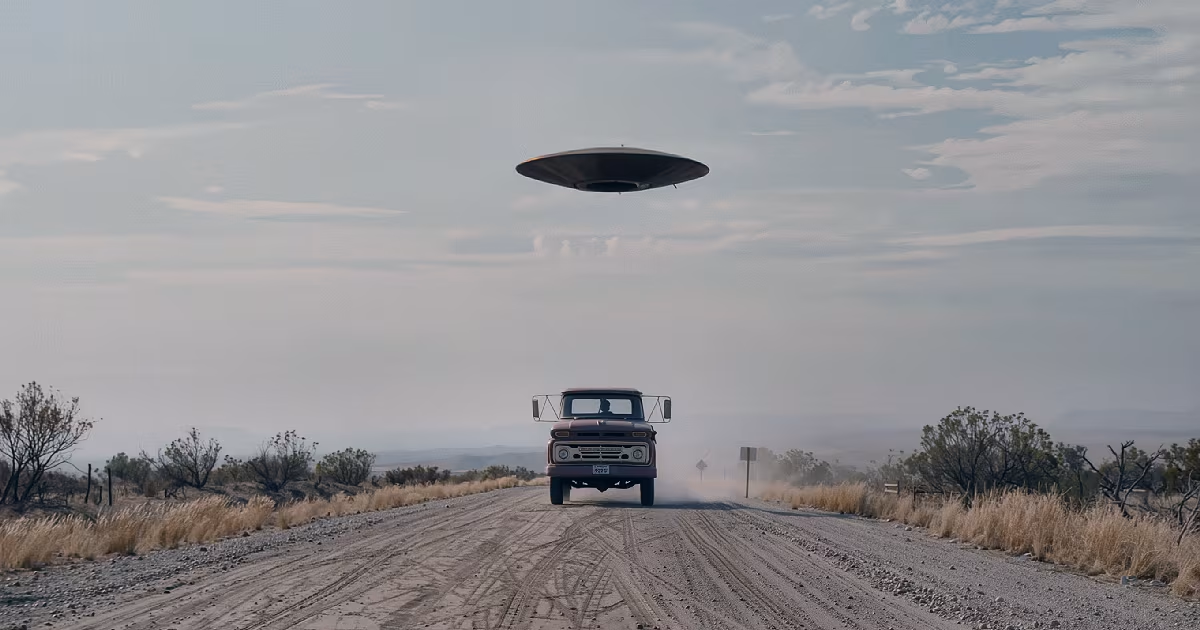
A hovering disc over a dusty road, a small truck below.
Illustration, not a photograph.

Opening
In the late summer of 1965 a county highway worker in southern California stopped his county vehicle near Santa Ana at about noon and photographed a low-flying, hat-shaped object through the window. Rex Heflin took three Polaroid pictures in quick succession and a fourth as the object moved away. He said his truck radio failed while it was near and worked again once it had gone. The photographs ran in the Santa Ana Register on 20 September 1965 and in The New York Times two days later.
It is one of the best-known still-photograph cases of the 1960s, and it is a case with a hole in the middle of it: the original Polaroids were gone for nearly thirty years, and almost everything said about the images was said about copies.
Timeline
3 August 1965Heflin makes the photographs near Myford Road and Walnut Avenue, Santa Ana. He is 38, according to one account, and the object is in view for about fifteen seconds. Another source places the spot in Tustin. A newspaper later says radar operators at a nearby Marine base reported no unidentified object that day.
Weeks afterHeflin says that men claiming to represent NORAD took three of the four originals. NORAD and the Air Force denied any contact or interest. An Air Force letter did mention a report of a civilian-dressed man claiming to be from NORAD who had obtained a private citizen's photographs.
20 September 1965One photograph is published in the Santa Ana Register. Wire services carry it, and The New York Times runs it on 22 September.
1965 and afterUPI photographic specialists test the camera and call the pictures genuine. The NICAP Los Angeles subcommittee investigates. Robert Nathan at the Jet Propulsion Laboratory enhances first-generation prints and copy negatives by computer. The Air Force declares the photographs a hoax.
1993Heflin's original Polaroids reach him again. Accounts say they arrived unannounced and anonymously, and a team led by Robert Wood and Ann Druffel resumes the analysis from them. MUFON photoanalyst Jeffrey Sainio rejects a claim by Bill Spaulding of Ground Saucer Watch that a support string is visible above the object.
Key figures
Rex Heflin worked for a county highway body. One source calls him a highway accident investigator for Los Angeles County, another a highway maintenance engineer for Orange County, so the sources disagree. He carried a Polaroid Model 101 camera, with a 114 mm lens and a built-in light meter, loaded with Type 107 black-and-white film rated at ASA 3000, to record obstructions on the roads. He stood by the photographs, and in 1965 he offered to take a lie-detector test for anyone who claimed they were trick photography.
Idabel Epperson headed the NICAP Los Angeles subcommittee, which checked Heflin's character and background, visited the site, and had the engineer John Gray take measurements. Richard Hall of NICAP called the case highly credible and thoroughly investigated. Robert Nathan did the JPL enhancement. Bill Spaulding of Ground Saucer Watch argued that a small model had been used. A physicist named McDonald, one account says, remained doubtful. Later reanalyses include one by Druffel, Wood and Kelson in the Journal of Scientific Exploration and one by Bruce Maccabee. A NORAD document from Lieutenant General Wheless addressed the possibility of impostors collecting photographs from witnesses.
Physical and documentary trail
The record: four Polaroid pictures, the newspaper prints, first-generation prints, copy negatives and the investigators' reports. Heflin handed the originals over, or had them taken, depending on whose account is followed, and for nearly three decades every analysis worked from copies. In 1993 the originals reappeared, reportedly sent to him without a name, and later work by Wood and Druffel used them. I could not confirm how many of the four came back or who sent them. NICAP says Nathan's enhancement confirmed a faint light beam under the object, and describes a swirl of material below it in the first frame. Spaulding said a thin line above the object was a support string. Sainio, a MUFON analyst, found that line to be a product of multi-generation copying or a deliberate mark. Nathan, the newspaper and NICAP found no such line in the prints they handled. Spaulding also said the copy negatives were obtained from Heflin under false pretences.
What is missing is anyone who can say where the originals were between 1965 and 1993, or who returned them. The Air Force called the pictures a hoax. I found no published analysis that demonstrated one. Hoax suggestions, including a jar lid hung by a thread from a board across the cab, are readings of the copies, not findings.
Things you might not know
- The camera was a work tool. Heflin used the Polaroid to record road hazards for his job.
- He offered a lie-detector test. He did so in 1965, for sceptics who claimed trick photography.
- The film was fast. Type 107 was rated at ASA 3000.
- Four photographs, one object. The fourth showed a ring-like trail as the object left.
- The radio failed. Heflin said it would not work until the object had gone.
- Other photographs surfaced the same season. Pictures reported from Tulsa, Sherman, Texas, and Beaver Falls, Pennsylvania, show objects that do not resemble one another.
- The Air Force and NICAP split. The Air Force said hoax. NICAP said strongly otherwise.
Competing explanations
A genuine photograph of an unidentified object. The witness is steady over decades, the investigators found nothing against him, and the UPI camera tests and NICAP site work did not break the account. The case for it rests on the person and on the originals that came back in 1993.
A small model or prop. Spaulding's reading, and the jar-lid idea. A small disc-like prop is easy to build and hang. The support-string evidence is disputed, and the originals were out of reach for nearly thirty years, so early analyses ran on copies.
A lost chain of custody. A third possibility is that the pictures are what Heflin said, but that the years the originals spent out of his hands, whether taken by strangers or lost to carelessness, damaged the chain of custody beyond repair.
Later life of the case
The Heflin pictures are reproduced in most books on 1960s photographic cases, and the argument over the line above the object has never been closed. It sits alongside McMinnville, the other classic pair of ground-level photographs, which also depends on the credibility of one witness and a camera.
Finding
The Heflin photographs show something, and the sources agree on little beyond that. The witness has never wavered and no hoax has been demonstrated. The Air Force called it a hoax and gave no evidence I could find. The best that can be said is that the images neither prove an unknown craft nor are shown to be a model.
What still will not resolve: who held the originals for those twenty-eight years and why they were returned, since the man, or men, who took them have never been identified.
Evidence signature
2/9 Thin
- Witnesses
- one person, or a tradition
- Instruments
- photo, film or physical traces
- Paper
- nothing on record
How well documented the case is, not whether it's true. A strong record can still have an ordinary answer, and a thin one can still be real.
You decide · REX HEFLIN
What do you think happened?
One vote per case, anonymous. You'll see how other readers voted once you've voted.