MCMINNVILLE
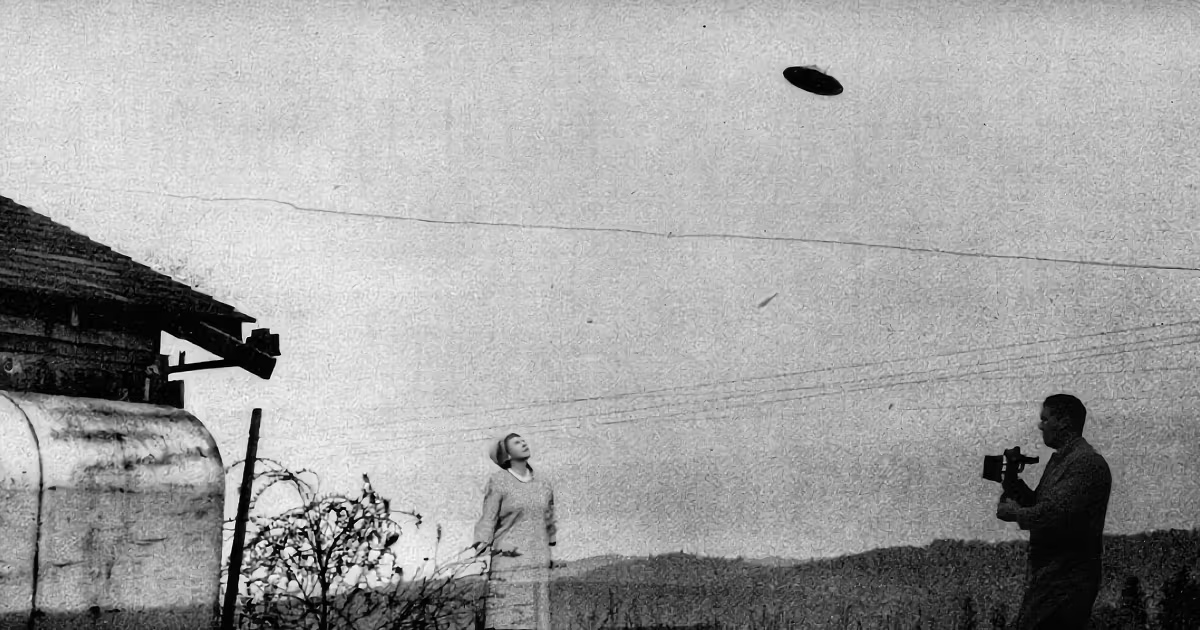
Oregon farm yard. Rabbit hutches, evening, and empty sky.
Illustration, not a period photograph.
Opening
At around 7:30 p.m. on 11 May 1950, Evelyn Trent, walking back to her farmhouse near Sheridan, Oregon, after feeding the rabbits, said she saw a large, slow-moving, metallic disk approaching from the northeast. She called her husband Paul, who ran inside for a loaded camera and took two photographs before the object accelerated away to the west. Those two images, soon dubbed the McMinnville photographs after the nearest larger town, would become some of the most scrutinized UFO photographs ever taken, reprinted in Life magazine, formally studied by the U.S. Air Force's own Condon Committee, and still argued over by photo analysts more than seventy years later.
This is a rare case where the government's own official 1969 scientific study, commissioned specifically to find grounds for dismissing UFO reports, could not rule the photographs a hoax, and said so plainly in print.
Timeline
11 May 1950, 7:30 p.m. Evelyn Trent sees the object first and calls out to Paul; he retrieves the camera already loaded with film and takes two exposures roughly thirty seconds apart as the object first appeared stationary, then began moving off. Paul's father, present on the farm, briefly glimpses the object before it departs.
Following weeks. The Trents do not immediately publicize the photographs; the film sits undeveloped and the negatives are not examined by any independent party until weeks after the event, a gap later analysts on both sides of the debate treat as significant, either as an innocent product of rural farm life's unhurried pace, or as time that would have allowed a staged photograph to be prepared and the story to be refined before public telling.
8 June 1950. The Trents give an account of the sighting to the McMinnville newspaper, the Telephone Register, in which Evelyn states both she and Paul saw the object at the same time from the backyard.
10 June 1950. A second, notably different version of events runs in The Oregonian, based on an interview with radio station KMCM, in which the sequence of who first saw the object and who went inside for the camera differs somewhat from the account given two days earlier, a discrepancy that later skeptical analysts, including Robert Sheaffer, cite directly as a credibility concern.
Shortly after. Local reporter Bill Powell borrows the original negatives from the Trents; the photographs are subsequently published locally and then picked up nationally, appearing in Life magazine within weeks.
1968-1969. The photographs are submitted as Case 46 to the Condon Committee, the University of Colorado's Air Force-funded UFO study led by physicist Edward Condon. Astronomer William K. Hartmann conducts the case's formal photogrammetric analysis, visiting the farm, examining the negatives, and modeling the geometry of the two exposures against the surrounding terrain and power lines.
1969, published finding. The Condon Report concludes, in language notably favorable given the study's broader skeptical mandate, that this is "one of the few UFO reports in which all factors investigated, geometric, psychological, and physical, appear to be consistent with the assertion that an extraordinary flying object, silvery, metallic, disk-shaped, tens of meters in diameter, and evidently artificial, flew within sight of two witnesses." The report does not rule out the possibility of a small model suspended from one of the overhead wires visible in the photographs, a specific alternative Hartmann's own analysis considered directly given the wires' proximity to the camera position.
Following decades. UFO skeptic Philip J. Klass argues the photographs show evidence consistent with a small suspended model rather than a large distant object, a position photo analyst Dr. Bruce Maccabee subsequently disputes in detailed published rebuttal, and the argument over shadow direction, wire tension, and object scale continues across UFO and skeptic literature for decades without either side fully persuading the other.
2013. The French imaging analysis firm IPACO conducts a fresh digital re-examination of the original negatives and concludes the object is consistent with a small model suspended from a wire close to the camera, rather than a large distant craft, the most technically detailed skeptical finding to date, though this conclusion has itself been contested by other researchers using different methodologies on the same source material.
1997 and 1998. Evelyn and then Paul Trent die, having maintained the truthfulness of their account without variation for the rest of their lives.
Key figures
Evelyn and Paul Trent are the case's sole witnesses, described consistently by neighbors and contemporaries as ordinary, credible farming-community residents with no evident motive or history suggesting a hoax, a characterization that has lent the case unusual staying power even as technical analysis of the photographs themselves has remained genuinely contested.
Hartmann is the case's key formal investigator, the same astronomer whose careful, physics-first approach also characterized his Condon Committee work on the Fort Belvoir photographs, and whose McMinnville analysis explicitly considered and did not rule out the suspended-model explanation even while finding the photographs' other factors consistent with the Trents' account.
Klass and Maccabee represent the case's longest-running technical dispute, a skeptic and a photo analyst independently reaching different conclusions from the same negatives using period-appropriate photogrammetric methods, a disagreement that has never been definitively settled by either side to the other's satisfaction.
IPACO's 2013 analysis represents the most recent serious attempt to apply modern digital imaging techniques to the original source material, reaching a conclusion favoring the suspended-model explanation, though without producing the kind of unanimous consensus that would formally close the case even among technically minded researchers.
Physical and documentary trail
On the paper, this file has the original negatives, examined directly by multiple independent analysts across more than seven decades using progressively more sophisticated techniques, a formal government scientific study explicitly declining to dismiss the photographs, and two witnesses who maintained an unchanging account for the rest of their lives despite decades of public scrutiny and skeptical challenge.
Against that sits a genuine, unresolved discrepancy between the Trents' own two earliest newspaper accounts, given just two days apart, on a basic sequence-of-events detail, and the weeks-long gap before the negatives were examined independently, both of which leave room for the suspended-model explanation that Hartmann's own Condon-era analysis, Klass's later argument, and IPACO's 2013 digital re-analysis have each, independently, found plausible.
This is one of the few UFO reports in which all factors investigated, geometric, psychological, and physical, appear to be consistent with the assertion that an extraordinary flying object... flew within sight of two witnesses.
Competing explanations
A small model suspended from a nearby overhead wire, photographed close to the camera rather than at a great distance. This reading, developed by Klass and given its most technically detailed support by IPACO's 2013 digital analysis, directly addresses the case's central ambiguity: without an independent object of known size in frame, distance and scale cannot be established from the photographs alone, and the visible wires in the background provide a plausible, mundane rigging point.
A genuine large, distant, unconventional object, as the Trents described and as Hartmann's Condon-era geometric analysis found consistent with the available evidence. This reading is strengthened by the witnesses' lifelong, unwavering account and by the Condon Report's own notably cautious, non-dismissive language, unusual for a study generally read as skeptically inclined overall.
An honest account complicated by ordinary memory drift between the two earliest newspaper interviews. The specific sequence discrepancy Sheaffer identifies, who saw the object first, who retrieved the camera, is exactly the kind of detail that shifts slightly across retellings of a genuine, startling event without indicating fabrication, though it remains fair game for skeptical scrutiny given how much of the case's evidentiary weight rests on witness reliability in the absence of a third party's account.
Later life of the case
McMinnville remains one of the most frequently cited "hard" UFO photograph cases specifically because of the Condon Report's own favorable-leaning language, a genuinely unusual outcome for a government-funded study broadly understood to have been aimed at closing the book on UFO investigation. The Klass-Maccabee dispute and IPACO's later digital re-analysis illustrate how even sustained, technically sophisticated re-examination of a fixed, unchanging piece of photographic evidence can fail to produce lasting consensus.
Finding
Two long-credible witnesses produced two photographs that a formal, skeptically inclined government study could not dismiss as fabricated, and that study's own investigator explicitly weighed and did not rule out a suspended-model explanation even while finding the photographs otherwise consistent with a genuine large object. Later technical re-analysis, most recently in 2013, has favored the model explanation without achieving the kind of unanimous technical consensus that would definitively close the case.
What still will not resolve: definitive scale and distance for the photographed object, a measurement no amount of digital re-analysis of a single, uncorroborated pair of photographs, with no independent reference object in frame, can fully supply. Until a piece of evidence beyond the negatives themselves surfaces, this case rests exactly where the Condon Report left it: not proven, and not disproven either.