FORT BELVOIR
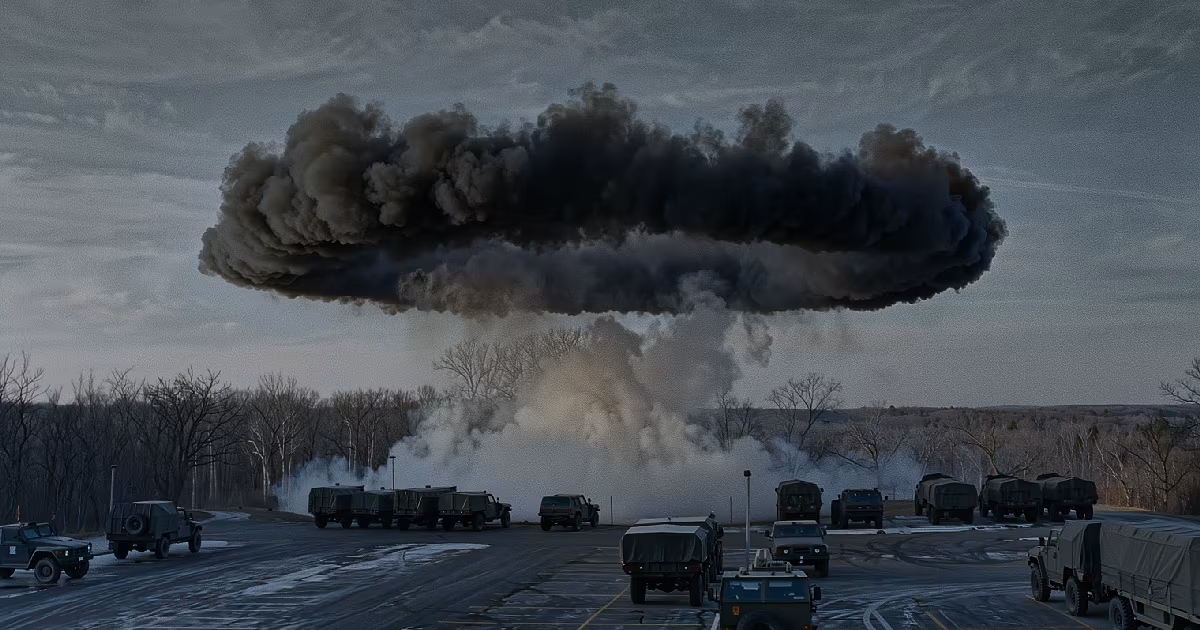
Virginia army post fence. Parade ground and empty.
Illustration, not a period photograph.
Opening
On a September morning in 1957, at approximately 9 a.m., a young Army private working as a draftsman at Fort Belvoir, Virginia, stepped into a parking lot with a group of coworkers to watch a dark, ring-shaped object drift in from the north below the cloud layer. He ran to his car for his Kodak Brownie camera and took six photographs in under five minutes. Partway through, the black ring was engulfed by an expanding white cloud. About fifteen men watched it happen. At least two took pictures. Nobody reported it to anyone on base that day.
This is one of the rare UFO photograph sets subjected to serious quantitative analysis, because it eventually reached the U.S. Air Force-funded Condon Committee at the University of Colorado nearly a decade later, and the astronomer who examined it did the geometry before he did the folklore.
Timeline
September 1957. The sighting occurs at Fort Belvoir, an Army engineering post in Virginia. The exact date was never established; the witness, identified in the Condon Report only as Pvt. X, did not record it and weather records could not later pin it down.
Same day. Pvt. X does not develop the film. He later explained his reasoning plainly: he suspected the object was connected to some kind of secret test, worried that photographing it might get him in trouble as a low-ranking soldier, and told no one on base what he had seen or done.
About one month later. Pvt. X has the film developed only after returning home, away from the base. He shows the resulting prints to friends over the following years, mostly met with a mix of curiosity and mockery.
Spring 1966. Nearly nine years after the sighting, a friend of Pvt. X's sends the photographs to the National Investigations Committee on Aerial Phenomena (NICAP) with an inquiry.
Mid-1966. Atmospheric physicist James McDonald, then active in UFO research, takes an interest in the case and flags it to the newly forming University of Colorado UFO study, chaired by physicist Edward Condon and generally known afterward as the Condon Committee.
1966-1968. Astronomer William K. Hartmann, working for the Condon Committee, conducts a detailed photographic and geometric analysis of all six frames and separately tracks down the physical explanation for the ring itself.
1968. The Condon Report is published, listing the Fort Belvoir case (Case 50) as photographically consistent with a real, physical, ring-shaped cloud and identifying its likely cause as an Army pyrotechnic demonstration.
Key figures
Pvt. X is the case's only witness who left a detailed account, though roughly fifteen other men on base saw the same event and at least one other photographed it; none of those additional witnesses were ever located. His own explanation for his silence, fear of consequences for photographing what might have been a classified test, is treated in the Condon Report as sincere and consistent across three separate interviews conducted years apart.
Hartmann is the case's central investigator, and his work here is a model of the kind: rather than assuming either a hoax or an anomaly, he tested the photographs against measurable physical constraints, cloud parallax, geometric consistency between the object's apparent inclination and its estimated altitude across all six frames, and the spacing of exposures against a plausible human reaction to a fast-moving event.
McDonald is the connective figure who pulled a decade-old amateur photo set out of obscurity and into a funded scientific investigation, consistent with his broader role pushing the Condon Committee to take a smaller number of high-quality cases seriously rather than triaging by volume alone.
An unnamed Fort Belvoir sergeant-major, quoted in later UFO literature drawing on the case, described the standard technique behind the base's demonstration explosions: five 55-gallon drums of gasoline, diesel fuel, TNT, and white phosphorus arranged in a circle and detonated together, typically for visiting officials or military cadets.
Physical and documentary trail
On the paper, this file has an unusually strong tier of primary material for a case this age: six original photographs (Plates 32-37 in the Condon Report), a detailed geometric analysis table plotting the ring's inclination against its apparent altitude across all six exposures, and a mosaic reconstruction tracking both the object's and the background clouds' motion frame to frame.
The geometric analysis found the ring's inclination angle and altitude angle tracked each other closely across five of the six frames, consistent with a real, roughly horizontal ring-shaped object photographed from a single fixed position, and inconsistent with a simple sketched-on fabrication, which the investigators noted would have required an implausible level of technical sophistication from a hoaxer to fake correctly across six separate frames.
The identifying explanation came from outside the photographs themselves: Fort Belvoir personnel described a standard pyrotechnic demonstration technique used on base, arranging drums of gasoline, diesel fuel, TNT, and white phosphorus in a circle and detonating them together. The blast produces a rising fireball wrapped in black smoke; the top of that mushroom cloud can stabilize briefly into a vortex ring, the diesel fuel producing the dark ring itself and the white phosphorus producing the pale smoke that expands to engulf it, matching Pvt. X's photographed sequence step for step.
There is no surviving negative; Pvt. X's original negatives were lost across several house moves, leaving only the developed prints. There is no dated after-action report from Fort Belvoir confirming a demonstration on the specific morning in question, since no one at the base was told about the sighting or the photographs at the time.
I was only a private in the Army... I didn't want to get in trouble so when I came home I had the pictures developed then.
Competing explanations
An Army pyrotechnic ring demonstration. This is the explanation the Condon Report settled on, based on a named technique, an on-base source describing it, and a photographic sequence that matches the technique's known visual signature. Its only real gap is the missing same-day confirmation from Fort Belvoir itself, a gap created entirely by the witness's decision to stay silent rather than by any conflict in the evidence.
Deliberate photographic hoax. The Condon investigators tested this directly and found it a poor fit: faking consistent inclination-to-altitude geometry across six frames, while also getting the background cloud motion and exposure timing to line up naturally, would have required a level of planning well beyond what a bored draftsman with a Brownie camera was likely bringing to a parking lot that morning.
Genuine unconventional aerial object. Given how well the demonstration explanation fits both the visual sequence and an independently sourced on-base technique, this reading does not have much left to stand on in this specific case, though it remains the default reading for anyone encountering the photographs without the sergeant-major's account attached.
Later life of the case
The Fort Belvoir photographs turned out not to be unique. Near-identical "ringed cloud" photographs surfaced from Denmark in 1978 and the Netherlands in later years, both eventually traced by local investigators to the same style of military pyrotechnic demonstration at nearby bases, using the same drum-and-detonation method. The recurrence of visually identical smoke-ring UFO photographs across different countries, each independently traced back to a nearly identical mundane cause, is one of the stronger pattern-level arguments in the broader UFO photograph literature for caution before assuming an unfamiliar-looking cloud formation is anomalous.
The case remains a frequently cited example, within skeptical UFO literature specifically, of a photograph set solid enough to reward real analysis rather than dismissal, precisely because that analysis converged cleanly on an identified cause rather than staying open.
Finding
Six photographs, geometrically consistent with a single real object photographed from one position, document a black ring engulfed by white smoke over Fort Belvoir in September 1957. An Army demonstration technique using drummed fuel, explosives, and white phosphorus produces exactly that visual sequence, and a source on base described that technique independently of the photographs themselves.
What still will not resolve: same-day paperwork from Fort Belvoir confirming a demonstration was staged that specific morning, made permanently unrecoverable by Pvt. X's decision not to report what he had seen or photographed at the time. Given how well the physical case fits everything else on record, that missing confirmation is a gap in the file's completeness, not a live question about what the ring actually was.