FORT ITAIPU
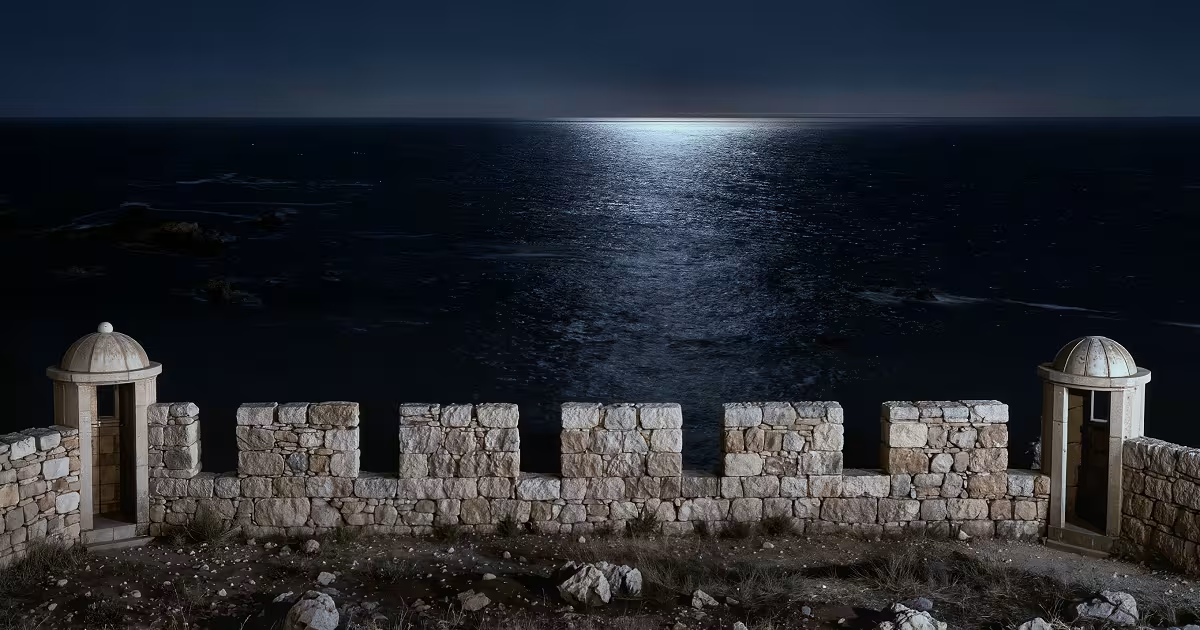
Coastal fort wall night. Atlantic dark and two empty posts.
Illustration, not a period photograph.
Opening
In the early hours of either 3 or 4 November 1957 (sources disagree on the exact date), two sentries standing watch at Fort Itaipu, a coastal artillery installation in Praia Grande, São Paulo, saw a star-like point of light approach fast from over the sea, resolve into an orange, disc-shaped object roughly thirty meters across, and come to a stop about three hundred meters from the fort. The object began emitting an intense hum and a wave of heat strong enough to burn the sentries' clothing and skin. One man collapsed unconscious; the other, badly frightened, shouted for help. Other soldiers, arriving in response, saw the object rise and depart before anyone could identify it.
This is one of a cluster of Brazilian military-witnessed UFO cases from the mid-to-late 1950s, alongside the Barra da Tijuca photographs and the Ubatuba magnesium fragments, that reached international ufology circles chiefly through Dr. Olavo Fontes, a Rio de Janeiro physician who served as the Brazilian representative for the American group APRO (Aerial Phenomena Research Organization) during this period.
Timeline
Early November 1957, approximately 2 a.m. (date given variously as 3 or 4 November across sources). Sentries at Fort Itaipu spot the approaching light, which some accounts describe as first appearing star-like before growing rapidly as it closed distance, passing at speed on a course some retellings place between Sugar Loaf-type coastal landmarks before arriving at the fort.
Same night. The object stops roughly three hundred meters from the installation. Sentries report an intense buzzing or humming sound and a wave of heat directed toward them, without any visible flame. Their uniforms are burned; one sentry loses consciousness from the heat, the other calls for help while attempting to shield himself.
Same night, minutes later. Believing the fort under attack, the garrison mobilizes. Responding soldiers arrive in time to see an orange light rising from near the fort and departing across the sky, but not in time to observe the object at close range themselves.
Following period. The injured sentries are treated and recover. According to later Brazilian press retrospectives, the case draws enough official attention that the Brazilian Army is said to have consulted the United States Embassy given greater assumed American familiarity with the subject, and American military personnel are reported to have visited Fort Itaipu as part of the inquiry, though this search did not locate a primary document confirming that visit independently of later retrospective reporting.
Following years. The case circulates through Brazilian ufology channels and reaches the American APRO Bulletin via Fontes, the physician who served as APRO's main conduit for Brazilian cases throughout the 1950s and 1960s, placing it alongside his coverage of the Barra da Tijuca and Ubatuba cases from the same general period.
Key figures
The two sentries are the case's sole direct witnesses; neither is consistently named across the sources located in this search, an unusual gap for a case this well-circulated and one worth flagging plainly rather than smoothing over with invented detail.
Fontes is the case's principal chronicler and the figure most responsible for its reaching an international audience, a working gastroenterologist whose parallel career investigating and reporting Brazilian UFO cases for APRO makes him the connecting thread across nearly every major Brazilian case of this decade, Barra da Tijuca, Ubatuba, and this one alike.
The responding garrison soldiers are secondary witnesses to the object's departure only; none of the located accounts credit them with observing the close-range encounter itself, meaning the case's central claims, the heat, the humming, the burns, rest on the two original sentries alone.
Physical and documentary trail
On the paper, this file has real, physically documented injuries: burned uniforms and burns to the sentries' skin, treated and recovered from, which is more physical evidence than the majority of UFO reports from this era carry. It has a real, still-standing military installation whose history (built in 1902, active through the 1932 Constitutionalist Revolution and the Second World War) is independently documented, giving the case a stable, verifiable physical setting.
What it does not have is a named primary witness, a contemporary written incident report from the fort itself, or independent confirmation of the American military involvement some retrospectives describe. The date discrepancy between sources, 3 versus 4 November, is itself a minor but real sign that this case, like many from the period, reached wider circulation through secondhand retelling rather than a single, well-preserved original document.
Competing explanations
A genuine unidentified object producing real thermal injury. This reading is supported by the one piece of hard evidence in the file, the treated burns, which are hard to explain as pure fabrication without positing a considerable and pointless act of self-harm by two soldiers on duty.
A military exercise or equipment malfunction misidentified under the stress of a night watch. Coastal defense installations in this era ran flare, searchlight, and ordnance exercises that could plausibly produce an unexpected light and heat source at night; this reading requires no exotic explanation but also is not independently confirmed by any located exercise record from the fort that night.
Exaggeration or embellishment through decades of retelling in Brazilian ufology and press retrospectives. Given the missing names, the date discrepancy, and the unconfirmed American-involvement detail, some of this case's specifics have likely accreted through retelling the same way Berwyn Mountain's military-cordon detail did, without this necessarily meaning the core burn injuries were invented.
Later life of the case
Fort Itaipu remains an active Brazilian Army installation, now also open to the public as a historical site on limited visiting days, its 1957 case a minor but recurring entry in Brazilian roundups of the country's most notable UFO incidents alongside Villas-Boas and Trindade. It has not, as far as this search located, been the subject of a dedicated modern investigation comparable to Chris Rutkowski's decades of work on Falcon Lake.
Finding
Two sentries at a real, still-standing military fort were burned on a specific night in November 1957, an injury documented well enough at the time to be treated and to survive in the historical record. Everything surrounding that core fact, the object's precise nature, the witnesses' names, and the extent of any American military involvement, rests on secondhand Brazilian press and ufology retelling rather than a preserved primary incident report.
What still will not resolve: the sentries' names, a contemporary written report from Fort Itaipu itself, and confirmation of the American Embassy or military involvement some retrospectives describe. Until a primary document surfaces, this case's real physical core, the burns, stays better documented than its surrounding story.