COYAME
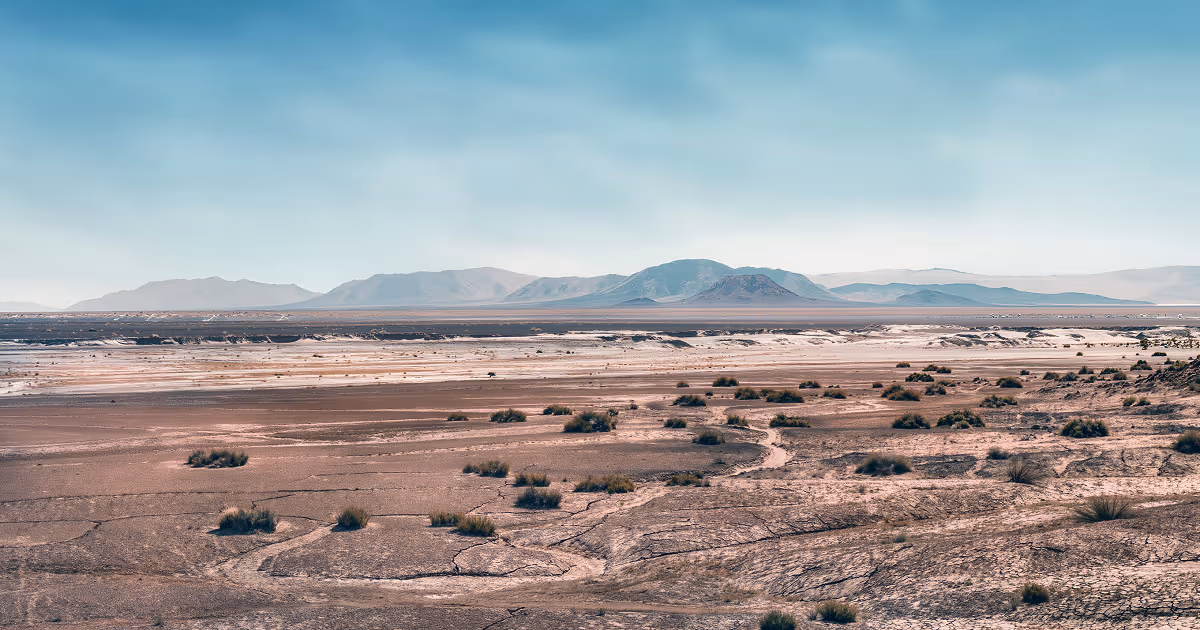
Chihuahua desert. Empty wash, no wreck.
Illustration, not a period photograph.
Opening
On the night of 25 August 1974, according to a story that has circulated in UFO literature since the early 1990s, U.S. Air Defense radar tracked an unidentified object descending from the Gulf of Mexico in a series of controlled altitude steps before it collided with a small civilian aircraft near the remote desert town of Coyame, Chihuahua, just south of the Texas border. Mexican and American military convoys are said to have raced to the crash site, only for the Mexican soldiers to be found dead, the wreckage of both craft, including a disc roughly sixteen feet across, hauled away by unmarked American helicopters, and every trace of the incident subsequently destroyed. It has been called "the Mexican Roswell" ever since. The case's actual documentary foundation, once traced back, turns out to be considerably thinner than its dramatic retelling suggests, and Mexico's own aviation history offers a specific, far more mundane candidate event from the same year and general region.
Timeline
25 August 1974, per the circulating story, 2207 hours. U.S. Air Defense radar detects an unknown object approaching from the Gulf of Mexico at roughly 75,000 feet and 2,200 knots, initially suspected to be a meteor, on a course that would bring it toward U.S. airspace southwest of Corpus Christi, Texas.
Same account, roughly sixty seconds later. The object reportedly decelerates to approximately 1,700 knots and begins a slow, controlled descent in a heading change, executed in discrete altitude steps of roughly five minutes each rather than a continuous descent, a pattern the account specifically cites as ruling out a natural meteor.
Same account, continuing. The object levels off at 20,000 feet, crosses into Mexican airspace, and is tracked roughly 500 miles before disappearing near Coyame. Around the same general time, a small plane that had departed El Paso for Mexico City is separately tracked by radar and reportedly vanishes at approximately the same location.
Following day, per the account. News of a "high speed" crash involving the departed civilian aircraft and a second, disc-shaped object is reported. The U.S. Army offers assistance recovering the wreckage; Mexico declines, though a team from Fort Bliss reportedly proceeds regardless and finds a Mexican military convoy stopped at the site, its soldiers dead, alongside the plane wreckage and a disc approximately sixteen feet across. Fearing biological or radiological contamination, the account states the Americans destroy the site and remove the disc itself by helicopter to an undisclosed U.S. location.
27 October 1974, a genuinely dated contemporary source. The newspaper El Heraldo de Chihuahua reportedly runs an article referencing a group of Mexican soldiers who died "during a military transport," a real, if vague and unelaborated, period press mention that predates the story's fuller circulation by close to two decades.
1992. The detailed narrative as now generally told first reaches wider UFO research circles through an anonymous document titled "Research Findings on the Chihuahua Disk Crash," circulated to a number of UFO researchers via the pre-internet Bulletin Board Service networks of the period, a specific documentary origin point researchers have since traced directly.
Structural pattern, per comparative UFO-hoax research. Anonymous "UFO crash list" documents circulating through this exact BBS-era channel have a separately documented history of originating from a small number of known serial hoaxers, including one figure, Willard F. McIntyre, whose self-created "Mutual Anomaly Research Center and Evaluation Network" (MARCEN) has been directly tied to several comparable, since-debunked crash claims from the same general period and format, a pattern researchers cite as broadly relevant context for evaluating any single-source, anonymously circulated crash narrative from this specific era regardless of whether McIntyre himself was personally involved in this particular case.
Later retellings, largely unchanged from the 1992 document's own specific radar figures and timeline, continue circulating through UFO literature, television documentaries including History's UFO Hunters (2008), and dedicated podcast coverage marking the story's various anniversaries.
2010s onward, historians' assessment, per Wikipedia's own summary of the broader scholarly position on Mexican UFO reports generally. Rather than an alien craft, historians examining the case suggest the local reports of a mid-air collision and military recovery operation near Coyame were more likely prompted by a real, documented 1974 crash and military recovery of a Cessna aircraft involved in drug trafficking in the same general border region, a specific, mundane candidate event consistent with the era's genuine, ongoing counter-narcotics military activity along the Texas-Chihuahua border.
2007. Author Ruben Uriarte publishes a full-length book on the case, extending its circulation into conventional print publishing alongside its ongoing internet and documentary presence.
Key figures
The unnamed anonymous author of the 1992 "Research Findings" document is the case's actual, sole traceable origin point for its now-standard detailed narrative, specific radar figures, and timeline, a status the story's own decades of retelling rarely acknowledge or examine.
McIntyre and his self-created MARCEN organization represent a documented, comparable pattern from the same general era and format, real, separately confirmed cases of anonymous BBS-era "crash list" hoaxing, offered here as relevant context for how this specific kind of unsourced document historically originated within UFO research circles, not as a direct, confirmed link to the Coyame document itself.
The unnamed Mexican soldiers reportedly killed are the case's actual human cost if any part of the underlying story is accurate, and the specific, genuinely dated October 1974 Heraldo de Chihuahua reference to soldiers dying "during a military transport" is the closest thing to a contemporary primary source this file has, though it is vague enough to be consistent with numerous mundane explanations beyond a UFO collision.
The historians cited in later scholarly review represent the case's most direct mundane counter-explanation, connecting the story's origin to a real, separately documented narcotics-related Cessna crash and military recovery operation from the same year and region.
Physical and documentary trail
On the paper, this file has one vague, genuinely dated 1974 newspaper reference to Mexican soldiers dying during a military transport, and one detailed, specific narrative that did not enter public circulation until 1992, eighteen years after the claimed event, sourced entirely to an anonymous document with no confirmed author, no verifiable radar log, and no named witness present at either the claimed crash site or the claimed U.S. military recovery operation.
What it lacks is any confirmed connection between the vague 1974 press item and the much more elaborate 1992 narrative that later absorbed and built upon it; no named soldier, pilot, or American serviceman has ever come forward publicly to confirm any specific detail of the widely repeated account, and no independent radar record has ever been produced beyond the anonymous document's own stated figures.
Historians say that such "UFO reports" were likely prompted by the 1974 crash and military recovery of a Cessna aircraft involved in drug trafficking.
Competing explanations
A misidentified or exaggerated account of a real, documented 1974 drug-trafficking Cessna crash and its associated military recovery operation, per the historians' assessment, with the specific "UFO" and "disc" details added or amplified either through local rumor at the time or through the 1992 document's own dramatic elaboration of a real but far more mundane underlying event.
An anonymous hoax constructed specifically for BBS-era UFO circulation, consistent with the documented pattern of comparable crash-list fabrications from named hoaxers operating in exactly this format during the same general period, requiring no real underlying military incident at all beyond the vague, separately dated 1974 press item that any hoaxer with access to period newspaper archives could have built upon.
A genuine incident substantially as described, exactly as the story's own continued proponents and at least one dedicated book maintain, a reading that requires accepting the 1992 anonymous document's specific, detailed radar and recovery narrative despite its complete absence from public record for eighteen years and the total absence of any named corroborating witness in the decades since.
Later life of the case
Coyame remains a recurring fixture of UFO crash-retrieval literature specifically because of its Roswell-parallel structure, a real border region, a genuine vague period press reference, and a dramatically detailed later narrative, while receiving considerably less scrutiny of its actual 1992 documentary origin than the comparison to Roswell might suggest it deserves. Its continued television and podcast coverage generally repeats the 1992 document's own specific figures without examining that document's own anonymous, unverified origin.
Finding
This case's actual documentary foundation consists of one vague, genuinely dated 1974 newspaper item and one much more elaborate narrative that first appeared publicly eighteen years later, through an anonymous document with no confirmed author or verifiable source, circulated in a format with a separately documented history of comparable hoaxing by named individuals from the same general era. Historians examining the broader pattern of Mexican UFO reports from this period point to a real, mundane, and well-documented alternative: a genuine narcotics-related aircraft crash and military recovery operation in the same border region and year.
What still will not resolve: the specific relationship, if any, between the vague 1974 Heraldo de Chihuahua item and the far more detailed 1992 narrative that followed it, and the actual authorship of the anonymous "Research Findings" document that remains the sole source for nearly every specific detail in the now-standard telling. Given how thin and late-arriving that sourcing actually is once traced back, this file treats Coyame as a case built substantially on an unverified secondary document rather than as a genuinely open primary-source mystery.