RB-47
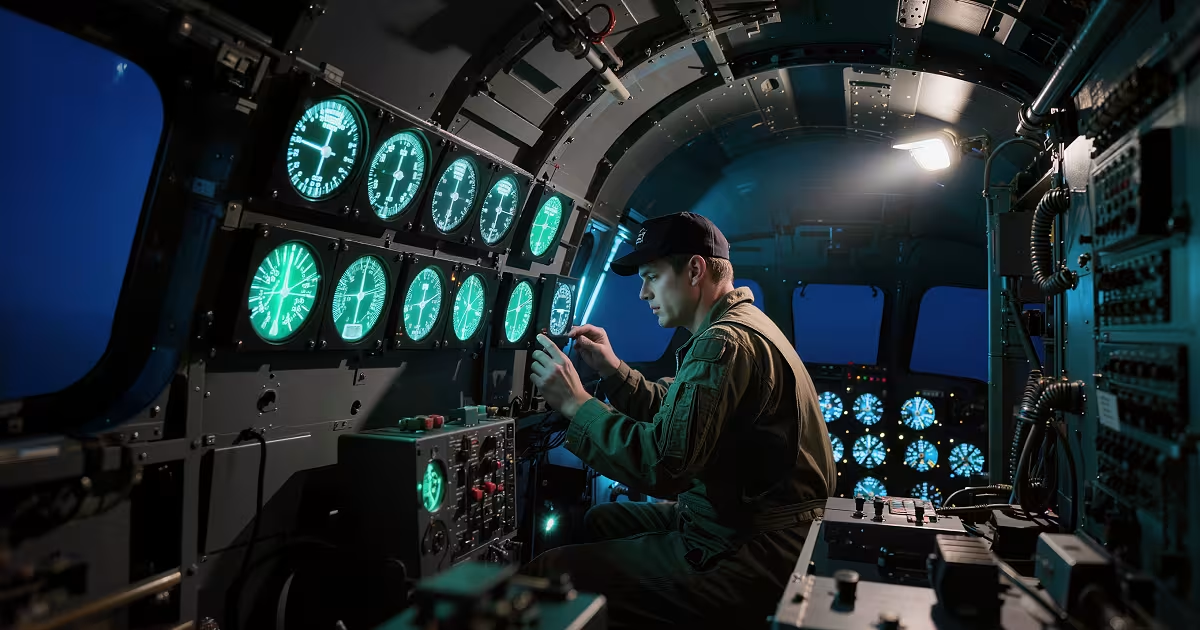
1950s recon aircraft interior. Scopes at a night window.
Illustration, not a period photograph.
Opening
In the pre-dawn hours of 17 July 1957, an RB-47H reconnaissance jet, tail number 53-4299, of the 55th Strategic Reconnaissance Wing, flying a training mission with sophisticated electronic countermeasures gear aboard, picked up an unidentified radar signal over Mississippi at around 4 a.m. Over the following ninety minutes and more than 700 miles, as the aircraft crossed Louisiana, Texas, and into Oklahoma, the object was detected, at various overlapping points, by the crew's direct visual observation of an intensely bright light, by the aircraft's own electronic countermeasures receiver picking up a powerful, unexplained radar-like signal, and by an independent ground radar station near Duncanville, Texas.
What makes this case distinctive within the UFO literature is not any single observation but the layering: three physically separate detection methods, sight, onboard signal intelligence, and independent ground radar, reportedly correlating with each other at multiple points along a single sustained pursuit, involving a six-man crew of trained Air Force officers rather than a single startled witness.
Timeline
17 July 1957, around 4 a.m. Flying over Mississippi on a composite training mission that included electronic countermeasures exercises, the RB-47H crew detects an unusual radar-type signal. Navigator Captain John J. Provenzano and the aircraft's electronic warfare officers identify it as resembling a ground-based radar emission but behaving as if airborne and in motion, an anomaly given the signal characteristics ordinary aircraft do not typically produce or carry equipment capable of generating.
Same early morning, over the following roughly ninety minutes. The crew continues detecting the signal intermittently on their electronic countermeasures equipment across multiple separate instances, ruling out a simple equipment malfunction given the pattern's consistency and mobility.
Same period, main incident, roughly 5:30-6:00 a.m., over the Fort Worth, Texas, area. The crew visually observes an intensely bright light behaving in ways matching the electronic signal's movements, at times moving ahead of the aircraft, then circling around it, apparently far more maneuverable and faster than the RB-47 itself.
Same window. The crew alerts the Duncanville, Texas, Air Force ground radar station, which independently begins tracking an object at the same reported location. Per the 55th Strategic Reconnaissance Wing's own later intelligence report, the wing's director of intelligence stated he had "no doubt the electronic D/F's coincided exactly with visual observations by a/c numerous times," treating the correlation between the crew's own instruments and their eyes as strong internal confirmation.
Same period, specific detail. At approximately 4:50 a.m. (in the earlier Mississippi-to-Louisiana portion of the timeline, per some reconstructions), ground radar shows the tracked object abruptly stopping as the RB-47 passes beneath it, then disappearing from the scope within seconds, a maneuver inconsistent with any known 1957-era aircraft's flight characteristics.
Same overall pursuit. On at least two occasions, the object visually disappears from the crew's sight at approximately the same moments the electronic signal and, at times, the ground radar also lose contact, and on at least one occasion the object visually reappears at roughly the same time ground radar regains tracking, a pattern of correlated appearance and disappearance across independent channels that forms the case's central and most-cited piece of evidence.
Continuing. The RB-47 crew attempts to shake the object through changes in speed and altitude without success before losing contact with it entirely near Oklahoma City, ending the pursuit.
Same day, contemporaneous reporting. The Duncanville ground radar station reportedly confirms independently tracking an unidentified object at the same reported location and time as the RB-47 crew's observations, though the station later attempts to walk back or deny this confirmation in a subsequent unclassified message to the Air Technical Intelligence Center, a documented internal inconsistency in how the case's own supporting evidence was handled by different Air Force elements.
25 October 1957, over two months later. Air Defense Command forwards summary information on the incident to Project Blue Book, a substantial reporting delay for a case involving reconnaissance aircraft and classified electronic intelligence equipment.
1967, roughly a decade after the event. The Condon Committee, investigating the case for its 1969 report, conducts detailed interviews with the six crew members, since no contemporaneous 1957 written crew report or wing intelligence document has been located to work from directly. Physicist Gordon David Thayer reconstructs the case's detailed timeline substantially from this decade-later crew recollection rather than from surviving primary documentation.
1969. The Condon Report is published. Thayer's own assessment directly and explicitly rejects the Air Force's informal later characterization of the object as a misidentified commercial airliner, calling that explanation "literally ridiculous" given the reported multi-sensor correlation and the object's described flight characteristics.
Key figures
The six-man RB-47 crew, including Provenzano and the aircraft's electronic warfare officers, are the case's central witnesses, trained military intelligence personnel whose professional expertise in exactly the kind of electronic signal analysis at issue gives their account unusual technical weight, though their most detailed testimony was gathered a full decade after the event, and per later documented review, the crew's own recollections of some specifics, including the pursuit's exact endpoint, varied from one another by the time of that 1967 reconstruction.
Thayer is the case's most consequential formal investigator, and his direct, sharply worded rejection of the airliner explanation, delivered within an otherwise broadly skeptical government-funded study, is one of the more notable instances of an official UFO investigator explicitly declining to accept a conventional explanation on the record.
The Duncanville ground radar station personnel represent the case's most internally inconsistent evidentiary thread: an initial confirmation of independent tracking followed by an apparent later attempt to retract or deny that confirmation in official correspondence, a discrepancy that cuts against treating the ground radar corroboration as fully settled.
Physical and documentary trail
On the paper, this file has a genuinely rare combination for a UFO case: professional military crew testimony, a technically detailed electronic signal analysis (the case's own investigators estimated a signal power output around 40 kilowatts, based on the received signal strength and distance, well beyond what a standard aircraft-mounted system of the period would plausibly carry, "an antenna bigger than the airplane" as one crew member put it), and a claimed independent ground radar correlation.
What it lacks is contemporaneous primary documentation of most of these details: no original 1957 crew report or wing intelligence document survives, and the Condon Committee's detailed reconstruction rests substantially on crew interviews conducted a decade later, with acknowledged variation between crew members on specific points by that time. The Duncanville ground radar's own later apparent retraction further complicates treating that corroboration as fully independent and unshaken.
[The wing's director of intelligence] has no doubt the electronic D/F's coincided exactly with visual observations by a/c numerous times thus indicating positively the object being the signal source.
Competing explanations
A misidentified commercial airliner. This was the Air Force's later informal public characterization of the object, and Thayer's own Condon Committee assessment rejected it outright as "literally ridiculous," given that a commercial airliner does not produce the described high-power radar-like emission, does not maneuver in the reported manner, and would not plausibly correlate across three independent detection channels the way the reported object did.
Ground-based or otherwise conventional radar signal interference, misattributed to an airborne source. This reading would explain the electronic countermeasures detection without requiring an actual airborne object, but does not account for the crew's direct visual sighting of a moving, maneuvering light matching the signal's reported behavior, nor for the independent ground radar's own reported tracking of a discrete moving object.
A genuine, highly capable aircraft or object exhibiting technical characteristics well beyond 1957-era conventional aviation. This reading is best supported by the case's central evidentiary claim, correlated detection across three physically independent channels, sight, onboard signal intelligence, and ground radar, at multiple points during a sustained, hour-and-a-half pursuit, a pattern that is difficult to produce through coincidental error across three unrelated systems simultaneously.
Reconstruction artifact: a real but more mundane event, amplified into a more dramatic unified narrative by the ten-year gap between the incident and its detailed documentation. Given that no contemporaneous written report survives and the case's central timeline rests on 1967 crew interviews showing some internal disagreement on specifics, it remains possible some of the reported cross-channel correlation reflects retrospective narrative-smoothing across separately real but originally less tightly linked observations.
Later life of the case
The RB-47 case is frequently cited within serious UFO research as among the strongest documented instances of multi-sensor correlation involving trained military observers, precisely because it does not rest on civilian testimony alone. Its central weakness, acknowledged even by researchers sympathetic to the case, is the decade-long gap between the event and its detailed reconstruction, a genuine methodological limitation that later, more contemporaneously documented cases like Alderney do not share.
Finding
A trained six-man Air Force crew, operating sophisticated electronic countermeasures equipment, reported a sustained pursuit involving correlated detection across visual observation, onboard signal intelligence, and independent ground radar, over more than 700 miles and ninety minutes. The Condon Committee's own investigator explicitly and sharply rejected the Air Force's informal airliner explanation as inadequate to the evidence. The case's real limitation is documentary rather than conceptual: its most detailed account rests on crew interviews conducted a full decade after the event, with acknowledged variation between crew members by that point, and the ground radar station's own confirmation was later apparently walked back in official correspondence.
What still will not resolve: any surviving 1957 primary document, crew report, wing intelligence file, or original radar log, that would allow the case's central multi-sensor correlation claim to be checked against contemporaneous rather than decade-later reconstructed evidence. Until one surfaces, the RB-47 incident remains one of the best-argued but least contemporaneously documented cases in the file.