LAKENHEATH-BENTWATERS
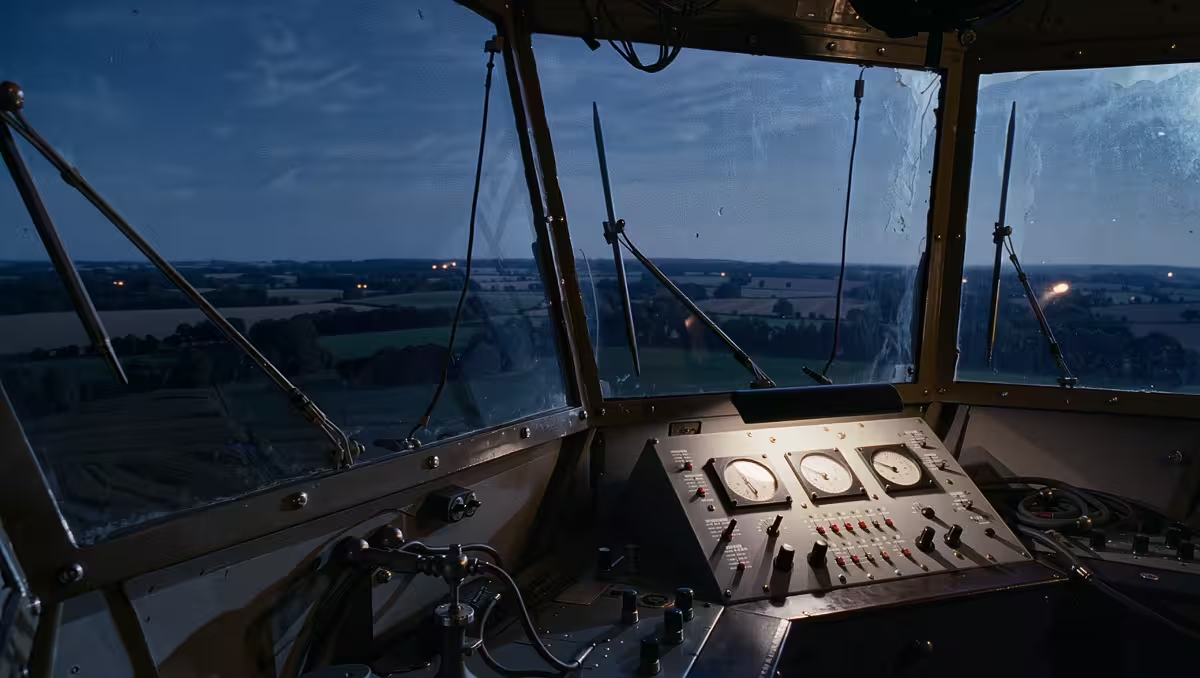
RAF night fighter over Suffolk. Scope glow in a cabin.
Illustration, not a period photograph.
Opening
On the night of 13-14 August 1956 radar stations in East Anglia began painting objects that did not behave like the traffic they knew. Lakenheath and Bentwaters, American-run RAF fields, and GCI at Lakenheath worked the plots. A Venom night fighter was scrambled. Crew and ground later described a lock, a target that sat and then moved, lights seen from the cockpit. The official file travelled to Blue Book and into the Condon study as one of the nights a committee would not laugh off.
Dates and exact station names slide a little in later retellings. The core does not: multiple radars, a fighter, a night over Suffolk and the fens when the board was not empty of strange traffic.
The spine of the file is a chase on glass and in a cockpit. Lakenheath-Bentwaters is a lock that did not become a wreck. It is not a parked craft on an East Anglian hardstand.
Timeline
13 August 1956 into the 14th. Bentwaters radar first in some versions, then Lakenheath. Operators mark returns that stop, jump, and look solid. Ground people see lights in the same hours. This is not a single blip on a tired scope. It is more than one station talking to another.
A Venom night fighter is scrambled from a nearby unit. Pilot and navigator work the intercept. Ground hears a lock. The target does not come to a landing and does not become a friendly that morning identifies. The crew recover and write.
The night does not make the next day's papers in any large way. It becomes famous later, when the Condon team print it among the radar-visual cases they will not tidy. Blue Book paper travels with it.
Researchers still argue which minute belongs to which scope. That argument is later. The scramble is 1956.
Key figures
The radar operators are the first file. Their ordinary job already included real bombers and weather.
The Venom crew own the airborne lock and the light in the cockpit.
Duty officers at Lakenheath and Bentwaters own the decision to send a fighter up.
Condon's people own the later stamp that this night would not close cleanly.
Physical and documentary trail
On the paper, 13-14 August 1956 give you four hard objects and no airframe.
One: multiple ground-radar plots of uncorrelated targets over East Anglia.
Two: ground visual lights tied to those plots in the same hours.
Three: the Venom scramble, lock, and crew report.
Four: the USAF and later Condon file. USAF and project documentation of the Lakenheath-Bentwaters events, August 1956, is the official tray.
There is no gun-camera still everyone accepts. There is no wreck. There is no named aircraft that the scopes were told, after the fact, they had been painting all along.
We are locked on.
Competing explanations
Unknown targets worked by several radars and a fighter. This is the reading Condon left standing. It has glass and a cockpit. It has no type.
Anomalous propagation and a confused night over the fens. Possible. Has to carry a lock the crew believed they had.
Friendly traffic misidentified. Always the first mundane door. The operators' job was not to panic at a Canberra.
Hybrid caution. Scopes painted something. A Venom went after it. Morning had no guest on the pan.
Later life of the case
Radar-visual textbooks. I keep the later minute-by-minute reconstructions on the later-life shelf. The scramble stays first.
Finding
East Anglia radars painted odd targets on 13-14 August 1956, a Venom was sent, and the crew worked a lock on something they did not bring home. Believe the scopes and the cockpit. A night-fighter crew does not invent a lock for a GCI that can see the same glass.
What still will not resolve: a frame from that Venom, or a named track that accounts for every plot. Either one would finish the chase. The proving object is still the target on the scope, held by a camera that was not rolling.