TRANS-EN-PROVENCE
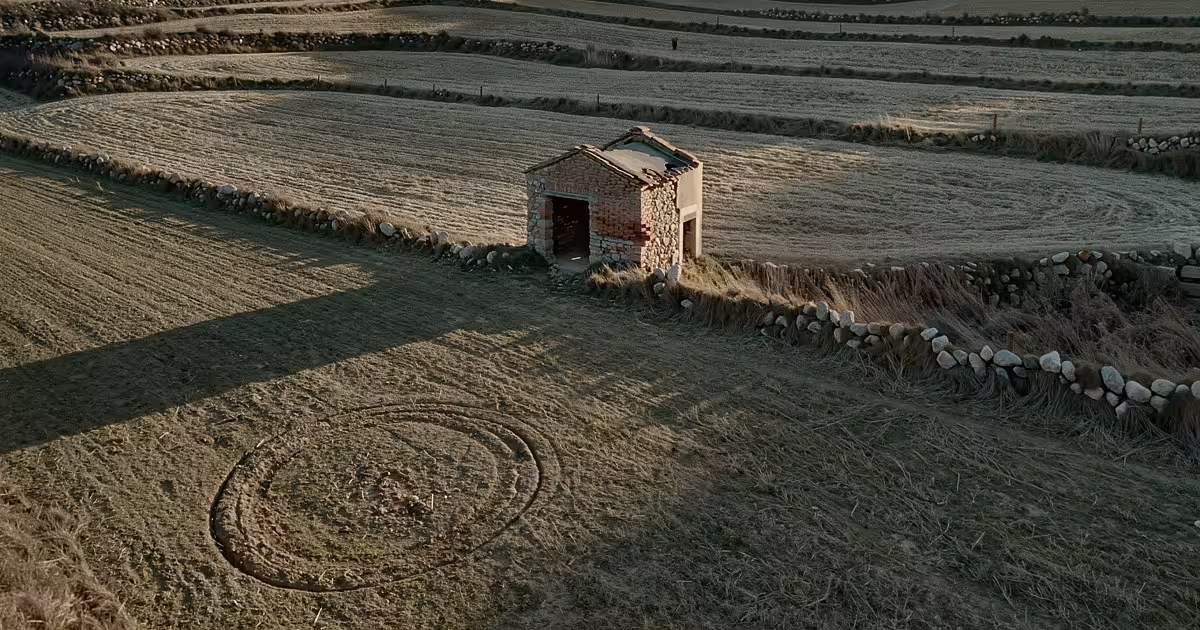
Provençal terrace. Two-metre ring in dry soil.
Illustration, not a period photograph.
Opening
On the afternoon of 8 January 1981 Renato Nicolai, a farmer at Trans-en-Provence in the Var, heard a whistle and saw a lead-coloured disc come down on his property. It sat briefly on the ground, lifted, and left. He found a circle on the packed earth, traces on plants, and called the gendarmerie. GEPAN, the French official study group, sent investigators. They sampled soil and vegetation. The lab paper said the ground had been compressed and heated in a way they did not shrug off as a tyre.
France treated this as a physical-trace case, not as a club night. Nicolai was not a lecturer. The circle was measured. The file became the showpiece of GEPAN's early work because something had been done to the dirt.
The spine of the file is a farmer and a sampled ring. Trans-en-Provence is a landing mark with a lab number. It is not a disc in a hangar at Istres.
Timeline
8 January 1981, about 17:00. Nicolai on his own ground near the house. A whistle. A dark disc, two metres or so across in his first telling, stand-like parts underneath, down onto packed earth and up again in seconds. He waits. He walks over. A circle. Plants looking wrong. He calls the gendarmes rather than a newspaper.
Gendarmerie the same day or the next. Photographs. Measurements. A ring a couple of metres across, soil compacted, vegetation affected in and around the mark. They treat it as a scene, not a joke.
GEPAN follows. Samples leave for labs. Through 1981-83 the technical notes describe mechanical pressure and heat, pigment changes in plants, a pattern they will not file as a tractor prank. Critics later argue contamination and over-read chemistry. That fight is later. The ring is 8 January.
The case becomes the physical-trace card French official study shows first. Nicolai stays a farmer. The disc does not come back for a second sitting.
Key figures
Renato Nicolai is the witness. A man on his own land, not a television booking.
The gendarmes own the first official look at the circle and the first photographs.
GEPAN investigators and the contracted labs own the soil paper that made the case famous.
Later sceptics own the chemistry argument. They do not own the afternoon mark.
Physical and documentary trail
On the paper, 8 January 1981 gives you four hard objects and no disc.
One: Nicolai's account of a whistle, a descent, a short sit, a lift.
Two: the circular ground trace photographed and measured by gendarmes.
Three: plant damage in and around the ring.
Four: GEPAN laboratory notes on compaction and heat. GEPAN technical reports on Trans-en-Provence, 1981-1983, are the official tray.
There is no photograph of the disc on the soil. There is no fragment with a serial. There is no second farmer who filmed the descent.
It came down on the ground and then it went up again.
Competing explanations
A landed device that left heat and weight in the dirt. This is GEPAN's working tone. It has samples. It has no machine.
A vehicle or a prank that the labs over-read. Possible. Has to live with official chemists who would not call it a tyre.
A meteoritic or mundane heat scar mis-seen. Poor fit for a farmer who watched a descent.
Hybrid caution. Something sat on that ground. Labs said the dirt had been punished. The object did not wait for the cameras.
Later life of the case
GEPAN histories and internet chemistry wars. I keep those on the later-life shelf. The circle and Nicolai's afternoon stay first.
Finding
Renato Nicolai saw a disc sit on his land at Trans-en-Provence on 8 January 1981, the gendarmes measured a ring, and GEPAN's labs wrote that the soil had been compressed and heated. Believe the farmer. A man on his own dirt does not invent a circle for Paris.
What still will not resolve: a photograph of the disc on that ring, or a fragment with an 8 January chain. Either one would pin the chemistry to a machine. The proving object is still the thing that sat, held by someone who was not Nicolai.