BERWYN
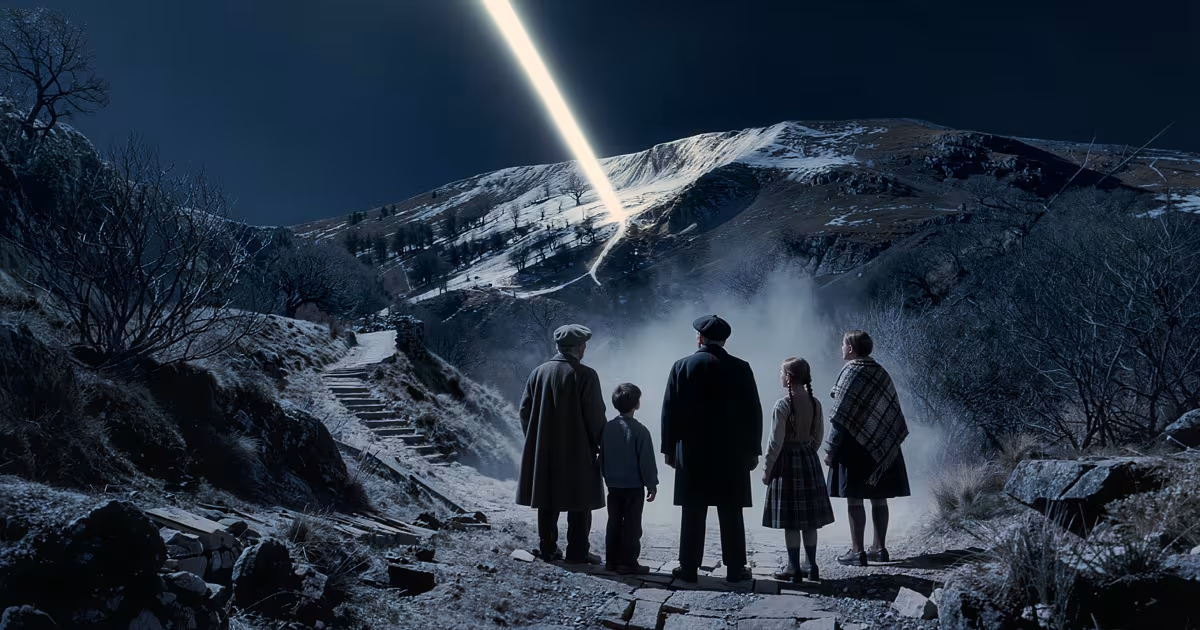
Welsh mountain slope at night. Empty, no wreckage.
Illustration, not a period photograph.
Opening
At 8:38 p.m. on 23 January 1974, a magnitude-3.5 earthquake, centered near Bala Lake in the Berwyn range of northern Wales, shook villages across the region and was felt as far as Liverpool. Earthquakes of any size are rare enough in Britain that many residents assumed something else had happened, especially once witnesses began reporting bright lights on the mountainside the same night. Within hours the story had become a UFO crash; within years it had acquired a name, "the Welsh Roswell," and a body count.
This is a case where the mundane explanation is unusually well documented and the sensational version is unusually well traceable to specific, named distortions, misquotation, one under-sourced UFO magazine claim, and a genuine but explainable sighting by the case's single most credible witness.
Timeline
23 January 1974, approximately 8:30-8:38 p.m. Residents of Llandrillo, Llandderfel, Corwen, and Bala report a loud bang, described by one witness as "like a lorry running into a house," followed by several seconds of ground tremor. The British Geological Survey (then the Institute of Geological Sciences) later confirms this as a magnitude-3.5 earthquake with an epicenter at Bala Lake.
Same evening, shortly after. Gwynedd Police are inundated with 999 calls reporting explosions and a fire or glow on the mountainside. Police logs from the night record officers "receiving 999 calls of UFO" and describe a caller stating there is "a large fire in the mountainside." Three officers are dispatched to investigate, commandeering a Land Rover from a local farm partway up the mountain track.
Same evening. Pat Evans, a retired nurse living at the foot of the mountain, hears the bang and, assuming a plane crash, drives toward the site with her two daughters, both St John Ambulance volunteers, intending to help. Along the B4391 she sees a large, pulsating, perfectly circular sphere of light on the slopes of Cadair Berwyn, shifting between red, yellow, and white, with smaller lights moving beneath it.
Same night, following days. A police and, according to some contemporary press, military presence is reported in the area; the road is said to be closed and farmers barred from nearby land. Searches are conducted; officially, nothing is found on the mountainside.
Following days. The Ministry of Defence logs five additional unrelated UFO reports from elsewhere in Britain the same night, from the Home Counties, Sussex, and Lincolnshire, unconnected to the Berwyn event beyond calendar coincidence.
Later 1970s-1980s. The case circulates in UFO literature as a crashed-craft cover-up story, gaining the "Welsh Roswell" and "Roswelsh" nicknames from press coverage explicitly drawing the New Mexico comparison.
Some years later. UFO Magazine researcher Tony Dodd publishes a claim, sourced to an anonymous military informant, that soldiers were sent to collect two large boxes near the crash site and deliver them to the government science facility at Porton Down in Wiltshire, where the boxes were opened to reveal two skeletally thin humanoid bodies roughly five to six feet tall, with the informant's unit later told colleagues had transported similar cargo alive.
2010. The Ministry of Defence releases a report concluding the event was the coincidental combination of the earthquake and an unusually bright meteor, or bolide, independently recorded as visible over the area that night by the Astronomy Department at Leicester University.
Later interviews. Pat Evans states directly, on record, that contemporary and later reports claiming she was stopped by armed police or military on the road that night were false: "we didn't see anybody on the road even though there were various reports that we were told to go away by armed police and military etc, which was all totally untrue."
Key figures
Evans is the case's most credible and most misrepresented witness. Her account of a genuine, describable light on the mountainside is not in dispute; what later researchers added to her story, an armed military cordon turning her away, is something she has explicitly and repeatedly denied happened.
The three Gwynedd Police officers who actually responded are a useful corrective to later claims of a large military and police presence: contemporary logs show a modest, ordinary response, not a cordon-and-recovery operation, and the "large presence" claim traces to a single contemporary newspaper article in the Border Counties Advertiser rather than to police records.
The local poachers on the mountainside that night are, per the accepted mundane reconstruction, the probable source of the light Evans saw: a car-battery-powered lamp of the kind used for night poaching, with the "fairy lights" she described beneath it plausibly the torches of the searching police officers working their way up the same slope at roughly the same time.
Dodd is the sole source for the alien-bodies claim, and his account rests entirely on one anonymous informant's secondhand story, never independently corroborated, named, or supported by any other witness, document, or leak in the fifty years since.
Porton Down itself has issued a direct, standing public denial: its official position states plainly that no aliens, living or dead, have ever been taken there.
Physical and documentary trail
On the paper, this file has real seismological data (a confirmed, dated, located, magnitude-3.5 earthquake), real astronomical data (independently logged bright meteor activity over the region that night from a university astronomy department), real contemporary police logs (showing a routine three-officer response, not a military operation), and a direct, on-record correction from the case's central named witness disavowing the story's most dramatic embellishment.
Against that sits exactly one uncorroborated secondhand claim, Dodd's Porton Down account, with no named source, no document, and a flat denial from the facility itself. There is no crater, consistent with a meteor that burned up in the atmosphere rather than making ground impact, and no recovered wreckage of any kind despite searches.
We didn't see anybody on the road even though there were various reports that we were told to go away by armed police and military etc, which was all totally untrue.
Competing explanations
Coincidental earthquake and meteor. This is the Ministry of Defence's 2010 formal conclusion, and it is the best-evidenced reading available: a real, dated, located earthquake explains the bang and tremor, and an independently logged bright meteor explains the light seen by numerous witnesses simultaneously, an unusual but not impossible coincidence given both events shared a single dramatic evening rather than requiring a single unified physical cause.
A poacher's lamp and searching officers' torches, explaining Evans's specific sighting. This is the most granular explanation in the file, and it accounts well for details, a perfectly circular, color-shifting light with smaller moving lights beneath it, that a meteor alone does not obviously produce. It requires accepting that Evans, driving and stopping repeatedly along a dark mountain road at some distance, was observing two different mundane light sources without being able to separate them at the time.
A genuine crashed craft with recovered alien remains. This reading rests entirely on Dodd's single anonymous-source account, unsupported by any of the case's other, better-documented evidence, and directly denied by the facility named as the remains' destination. It also requires dismissing the confirmed earthquake and meteor data as either fabricated or coincidental cover, rather than as the straightforward explanation they appear to be.
Exaggeration through retelling. Comparing the earliest police logs and Evans's own later corrections to the fuller "Welsh Roswell" narrative that developed over subsequent years shows a clear pattern of accretion: a modest three-officer response became a military cordon, a single newspaper article became "large police and military presence," and one uncorroborated tip became a body count. This pattern, not a cover-up, is the best-documented mechanism by which this case grew in the telling.
Later life of the case
The case has remained a fixture of British paranormal television and UFO retrospectives, including a dedicated episode of Britain's Closest Encounters in 2008 and continued coverage decades on, generally repeating the crashed-craft framing with varying degrees of skepticism attached. The 2010 MoD report and the accumulated corrections from Evans and from contemporary police records represent the most serious documented pushback, though they have not displaced the "Welsh Roswell" nickname or the story's continued popularity.
Finding
A real earthquake and a real, independently recorded meteor together explain the bang, the tremor, and the widely seen light on the night of 23 January 1974. The case's single named credible witness has explicitly and repeatedly disavowed the military-cordon detail that gives the story its cover-up flavor, and its sole source for recovered alien remains is one anonymous secondhand claim, denied by the institution it names.
What still will not resolve: full confirmation of the poacher's-lamp explanation for Evans's specific sighting, since the lamp itself was never recovered or independently confirmed present that night beyond the timing coincidence with the police's own account of moving a poachers' vehicle on the mountain track. That is a genuine small gap in an otherwise unusually well-explained file, not an opening for the crashed-craft reading it is sometimes used to support.