ILKLEY MOOR
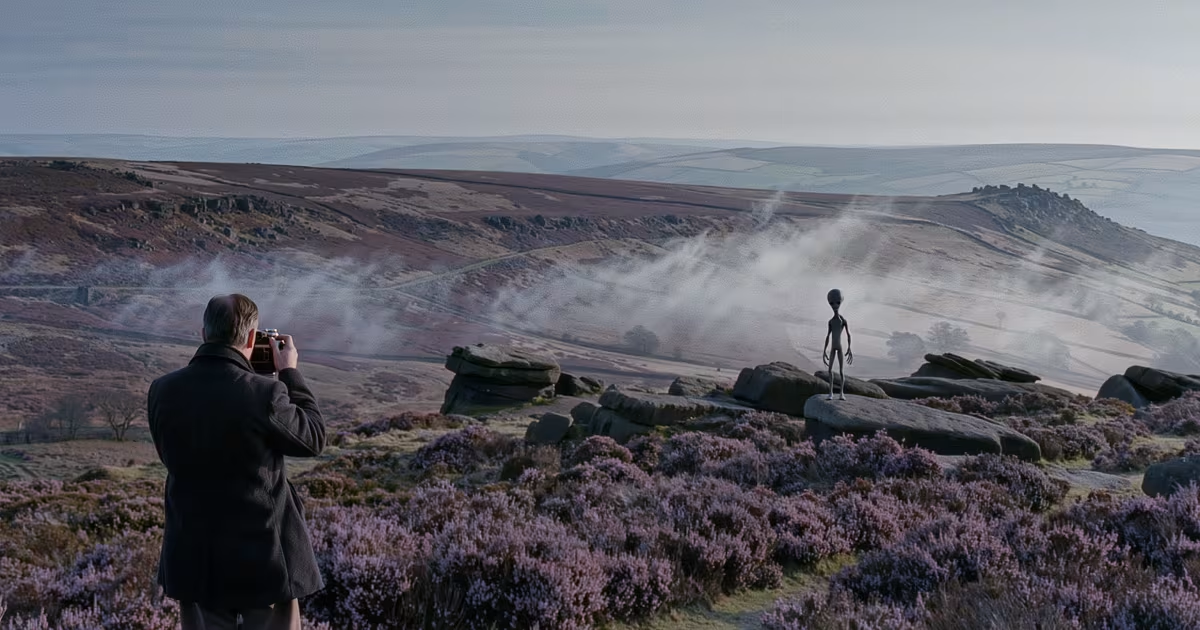
A man photographing a small grey figure on the rocks of a moor.
Illustration, not a period photograph.

Opening
At approximately 7:15 a.m. on 1 December 1987, a retired Metropolitan Police officer, walking across Ilkley Moor in West Yorkshire in dense fog on his way to his father-in-law's home in East Morton, saw a small, green, long-armed figure roughly four feet tall standing near an old excavation. He photographed it before it fled toward a hollow in the hillside, followed it, and reported glimpsing a dome-topped craft rising from the moor and disappearing into the sky.
He arrived at his destination believing barely a few minutes had passed; the village clock read an hour later than it should have. The resulting photograph, examined by Kodak and found free of tampering, became one of the most widely reproduced alleged alien images in British UFO history, and the case's aftermath included a visit from two men claiming Royal Air Force intelligence credentials who left empty-handed when they learned the print had already been passed to an investigator.
Timeline
Prior to 1987The witness, publicly identified only by the pseudonym "Philip Spencer" at his own request (a name suggested by investigator Peter Hough specifically to protect his identity, since he sought no publicity or financial benefit from the case), had spent four years as a Metropolitan Police officer in London before relocating with his wife and infant child to West Yorkshire to be closer to her family.
1 December 1987, approximately 7:15 a.mSpencer says goodbye to his wife and sets out across Ilkley Moor toward East Morton, navigating by compass through dense fog and carrying a camera loaded with ultra-light-sensitive film, hoping to photograph early morning light conditions on the moor.
Same morning, moments laterNear an old excavation site, Spencer sees a small, green-skinned, overlong-armed humanoid figure, roughly four feet in height, standing nearby. He photographs it as it turns and runs toward a hollow in the hillside; the creature, per his account, waves one arm at him in what he interpreted as a signal not to approach.
Same morning, continuingSpencer follows the figure and reports glimpsing a craft with a domed top rising from the moor before it shoots away into the sky at high speed.
Same morning, arrivalSpencer estimates the entire encounter, from first sighting to the craft's departure, took no more than a few minutes. On reaching his destination, he finds the village clock reading a full hour ahead of where his own sense of elapsed time placed it, an unexplained discrepancy later cited by UFO researchers as consistent with a "missing time" abduction pattern.
Following the encounterSpencer's film, with only five exposures remaining on the roll after his single shot of the creature, is developed and examined; no additional photographs of the figure exist, a detail investigators noted as inconsistent with someone staging and test-shooting a model under different lighting or poses before selecting a final image to submit.
Same periodThe photograph is sent to Kodak's laboratory in Hemel Hempstead for technical examination, which finds no evidence of tampering or double exposure and confirms the figure appears as a genuine solid form within the frame rather than a smudge or film artifact.
Same periodSpencer reportedly undergoes hypnotic regression, during which he recalls additional memories consistent with what investigators characterize as a classic abduction scenario, details beyond his own initially reported, consciously recalled account.
Approximately six weeks into Hough's investigation. Two men arrive at Spencer's home, presenting identification cards and identifying themselves as Royal Air Force Intelligence officers named Jefferson and Davis, stating their purpose is to recover the photograph he had taken on the moor. Spencer had already given his print to Hough; the two men leave without obtaining anything.
Following publicationThe case draws significant press coverage, and the photograph becomes one of the most widely reproduced images associated with British UFO and alien-encounter claims of its era.
2011The Daily Telegraph includes the Ilkley Moor incident in its published list of the "Top 10 UFO incidents in the UK," reflecting the case's lasting prominence within British popular UFO culture more than two decades after the event.
OngoingThe specific identity of "Jefferson and Davis," including whether they were genuine RAF Intelligence personnel, impersonators, or a fabricated detail added to the case's later retelling, has never been independently confirmed by any surfaced military record.
Key figures
Spencer is the case's sole direct witness, and several specific details work in favor of his credibility as a sincere reporter rather than a hoaxer: his own former career in law enforcement, his explicit request for anonymity and lack of interest in publicity or profit, and the absence of any additional test photographs on his film that a staged hoax would more plausibly have produced.
Hough is the case's principal investigator, credited with suggesting the "Philip Spencer" pseudonym specifically to protect a witness who had shown no interest in public attention, and the person to whom Spencer had already given his print by the time the alleged RAF officers arrived seeking it.
The Kodak laboratory technicians represent the case's most concrete independent physical examination, confirming the photograph's technical authenticity, that it had not been tampered with or double-exposed, without that finding by itself confirming what the photographed figure actually was.
"Jefferson and Davis," the two men claiming RAF Intelligence credentials, represent the case's most classically "Men in Black"-styled element, an unverified but specifically named and dated visit that neither confirms nor denies any genuine military interest in the case, since no independent record of their identity or mission has ever surfaced.
Physical and documentary trail
The record has a formally examined photograph with a documented Kodak laboratory finding of no tampering, a witness with a stable, professionally credible background and no evident motive for hoaxing, a specific and dated account of an unusual post-encounter visit by men claiming military credentials, and a hypnotic regression session adding further recalled detail beyond the witness's own initial account.
What it lacks is any independent verification of the "missing hour" beyond Spencer's own estimate against the village clock, any confirmation of Jefferson and Davis's actual identity or organizational affiliation, and, as with any hypnotically recovered testimony, independent confirmation that the additional abduction-scenario details recalled under regression reflect literal memory rather than confabulation shaped by the technique's own well-documented suggestive limitations.
Things you might not know
- Two ufologists heard first. In the days after the encounter, Spencer contacted the researchers Jenny Randles and Peter Hough, and later handed Hough the copyright of the photograph.
- Hough started out sceptical. He said he was "extremely sceptical" at first, and came round to believing Spencer only after meeting him.
- An optics expert called it too grainy. Bruce Maccabee, a US Navy optical physicist and ufologist, concluded the photograph was too grainy for proper testing.
- The hypnosis came three months later. The regression session was run by Jim Singleton on 16 March 1988, and Singleton described what Spencer recalled as genuine recall.
- A former MoD man ranked it. Nick Pope, who once handled UFO reports at the Ministry of Defence, put it in his "Top 10 UFO incidents in the UK" for the Daily Telegraph on 29 June 2011.
- Sceptics point at the neighbours. RAF Menwith Hill and Leeds Bradford Airport are both near the moor, which sceptics offer as one reason the area produces so many reports.
Competing explanations
A hoax involving a costumed accomplice or staged prop, a reading complicated by the absence of any additional test photographs on Spencer's film, a detail investigators specifically noted as inconsistent with the careful staging and reshooting a fabricated image would typically require to get right on a single attempt.
A genuine misperception of an ordinary figure or animal under difficult foggy, low-light conditions, later elaborated through the suggestive influence of hypnotic regression and the broader cultural template of abduction narratives already well established in popular UFO literature by 1987.
A deliberate, elaborate psychological operation or intelligence test, given the specific, dated visit from men claiming RAF Intelligence credentials, though this reading requires accepting an otherwise unverified detail as accurate rather than as an embellishment added to the case's later retelling.
A genuine unconventional encounter, exactly as Spencer described and as the photograph's clean Kodak examination is consistent with, supported by his own credible professional background and lack of any evident motive to fabricate a story he actively tried to keep out of the press.
Later life of the case
The Ilkley Moor photograph remains one of the most recognizable British alien-encounter images, its continued inclusion in retrospective "best UK UFO cases" lists decades later reflecting both its visual distinctiveness and the case's combination of a credible-seeming witness, a technically clean photograph, and a genuinely unresolved missing-time element rarely found together in a single British case.
Finding
A former police officer with no evident motive for fabrication photographed what he described as a small, green humanoid figure on Ilkley Moor at dawn, and the resulting image survived formal laboratory examination without evidence of tampering. An unexplained hour of missing time and a later, unverified visit from men claiming military intelligence credentials add further genuinely puzzling detail without any of it being independently confirmed beyond the witness's and investigators' own accounts.
What still will not resolve: any independent verification of the missing time discrepancy, confirmation of Jefferson and Davis's actual identity, and full reconciliation between Spencer's initial conscious account and the additional details later recovered under hypnosis, a technique whose general reliability for recovering literal memory remains scientifically contested. Until any of these resolve, Ilkley Moor stays a case built on one credible-seeming witness and one technically clean photograph, with everything beyond that resting on testimony alone.
Evidence signature
6/9 Solid
- Witnesses
- trained, independent witnesses
- Instruments
- photo, film or physical traces
- Paper
- official records at the time
How well documented the case is, not whether it's true. A strong record can still have an ordinary answer, and a thin one can still be real.
You decide · ILKLEY MOOR
What do you think happened?
One vote per case, anonymous. You'll see how other readers voted once you've voted.