RENDLESHAM FOREST
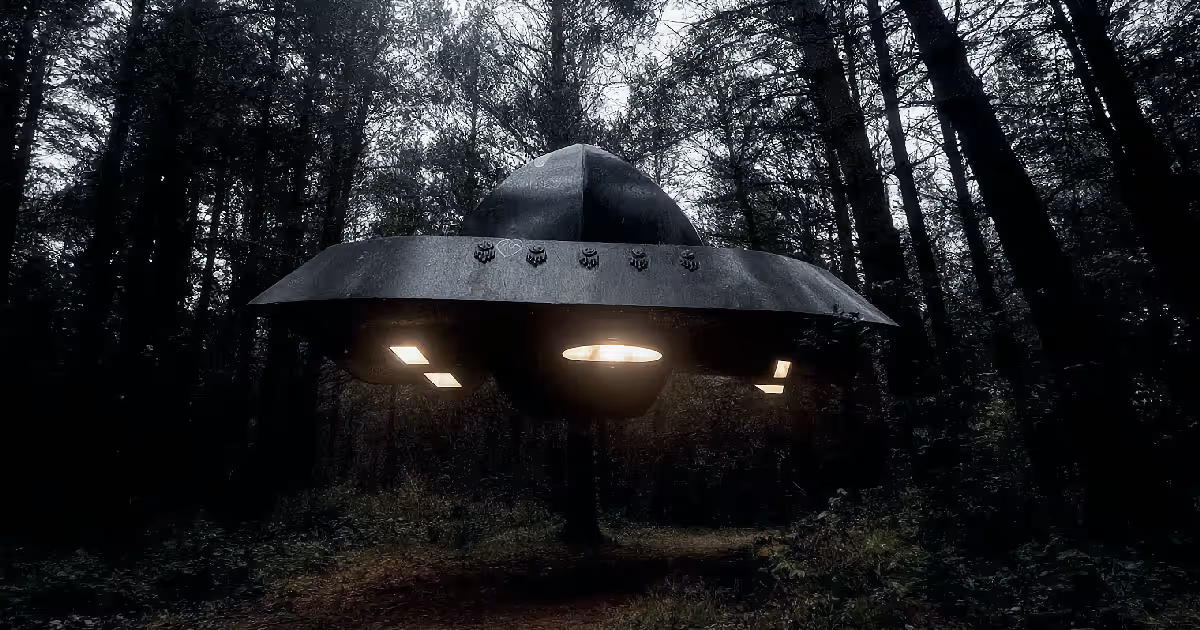
Rendlesham Forest landing site.
Illustration, not a period photograph.
Opening
In the early hours of 26 December 1980, security police at RAF Woodbridge, a United States Air Force twin of nearby RAF Bentwaters in Suffolk, saw lights east of the East Gate in Rendlesham Forest. Staff Sgt. Jim Penniston, A1C John Burroughs, and A1C Ed Cabansag went into the trees on a suspected crash. What they wrote in the next days was lights among the pines, a clearing, and, in some statements, a small angular object that moved off through the trees.
Two nights later Lt. Col. Charles I. Halt, deputy base commander, left a delayed Christmas party and walked the same ground with a cassette recorder running. He talks, on tape, about a glowing object, beams, and lights in the sky. On 13 January 1981 he types a one-page memo titled “Unexplained Lights” and sends it toward the Ministry of Defence. That page is why Rendlesham is not only a ready-room story.
The spine of the file is the split between the first-night patrol paper and the later craft-and-binary story. Halt’s memo and tape are 1980-81 documents. Penniston’s notebook of ones and zeros is a much later object. They do not weigh the same.
Timeline
26 December 1980, about 03:00. Lights are called in from the Woodbridge back gate. Penniston, Burroughs, and Cabansag go out. Contemporary statements describe a bright white light and colored flashes in the trees. Some mention a triangular or angular shape on legs. Cabansag’s early paper is thinner on a landed craft than later television is.
26 December, after the patrol. The men come back. No wreckage is logged onto the ramp. Indentations and scrape marks in a clearing are later pointed out. Local police and forestry people will argue for years whether those marks are a craft or a forest floor.
27-28 December, after midnight. Lights again. Halt goes out with Lt. Bruce Englund and others. The Halt tape is the real-time document from this second night: officers talking to each other about a glowing thing in the trees and lights that appear to throw down beams, including toward Woodbridge and toward the farming side of the forest.
13 January 1981. Halt writes “Unexplained Lights.” He dates the first night as 27 December, which is the wrong calendar day. He later says he wrote from memory. The memo still exists. It is the official short form of both nights.
1983-84. The memo surfaces in the United States through Citizens Against UFO Secrecy after the Air Force copy has been disposed of under ordinary records rules. Britain’s copy is what comes back.
2010 onward. Penniston produces a notebook with binary, later decoded by television researchers into coordinates and a line about origin year 8100. Burroughs, in later comments, says Penniston did not have time that night to walk a craft for forty-five minutes and sketch it. The notebook date reads 27 December.
Key figures
Jim Penniston is the first-night sergeant who becomes the contact witness. His 1980 statements are lights and a possible object. His later book and notebook are a download, lost time, and binary. Those are two Pennistons. The memo does not carry the notebook.
John Burroughs is the airman who goes in with him. His early paper is lights, noise, a scream that later gets called a muntjac. He is also the man who later pushes back on the long walk-around.
Ed Cabansag is the third name on the first patrol. His statement is useful because it is less theatrical.
Charles Halt is the officer who leaves a party, walks the woods, records a tape, and types a memo to the Ministry. He is not a patrolman inventing a night. He is also not a physicist. The tape is what he sounded like while he was cold and looking up.
Ian Ridpath and other UK skeptics work the Orfordness lighthouse and bright stars against Halt’s sky lights. They are later life as method. They were not on the Halt party.
Physical and documentary trail
On the paper, December 1980 and January 1981 give you four hard objects.
One: the first-night witness statements Halt collected for the memo. Lights outside the East Gate. Patrol into the trees. No recovered hardware on a workbench.
Two: the Halt tape from the second night. It is contemporaneous speech, not a 2010 reconstruction. You can hear the men work a light they cannot name.
Three: the 13 January 1981 memo. One page. “Unexplained Lights.” Sent up the British chain. Wrong date on the first night. Still the best official summary.
Four: ground marks in a clearing, measured and photographed in the following days by some of the men. Forestry and lighthouse readings sit in the opposing stack. Neither stack produced a serial-numbered part.
There is no gun-camera still from 26 December. There is no MOD file that says “craft, ours” or “craft, other.” There is no 1980 binary page in the Halt packet. Radiation-meter stories attach to the second night in later tellings. The memo does not hang the case on a rad count.
The object was described as being metallic in appearance and triangular in shape, approximately two to three meters across the base and approximately two meters high. It illuminated the entire forest with a white light.
Competing explanations
Lighthouse and sky. Orfordness lighthouse sweeps that coast. Sirius and other bright objects sit where tired eyes put them. This reading is strongest on Halt’s distant beams and weakest on a patrol that says it stood in a clearing with a structured object a few meters across.
Aircraft or poacher lights. A night forest next to two busy NATO bases produces traffic. It accounts for a call at the East Gate. It does not account for Halt taking a recorder into the trees two nights running and then typing a memo for London.
Secret hardware. A test over a US-tenanted RAF wood would explain silence from both ministries. It would also require a triangular two-meter object to sit in front of a deputy base commander and then vanish from every inventory. Possible. Not shown.
Landed unknown. This is the reading Penniston later enlarges and that Halt’s memo already flirts with: metallic, triangular, on legs, white light in the pines. It holds only if the first-night statements and the memo’s paragraph describe a machine and not a light through trees. The binary notebook does not help that test. It arrives too late.
Later life of the case
The memo’s American afterlife in the mid-1980s is what names Rendlesham “Britain’s Roswell.” Books and a History special do the rest. I use them for who said what after 1983. I do not use them as 26 December paper.
Penniston’s binary, decoded into Giza and Nazca and a year 8100, belongs on the later-life shelf with the television that found it in a notebook. Burroughs’s pushback is part of that shelf too. It is a disagreement between two men who were both in the trees.
MOD releases in later decades show a thin official interest, not a hidden crash wagon. If a 1980 gun-camera frame appears, the finding moves. The public file is still a memo, a tape, and a forest.
Finding
Lights in Rendlesham Forest pulled Penniston, Burroughs and Cabansag east of the East Gate in the first hours of 26 December 1980. They wrote of a clearing and, in some of those first statements, a small angular object among the pines. Halt walked the same woods two nights later and put a memo on deputy commander paper. Believe the patrol. USAF security police do not invent a crash in the trees for sport, not on a base that already had enough real work.
What still will not resolve: Halt's tape synced to a named object, or the original landing-trace measurements kept as a chain and not as a later argument. A frame from the clearing on the 26th, or a radiation log that a lab still accepts, would take Rendlesham off the lighthouse debate and put a machine in the pines.