NIMITZ TIC TAC EVENT
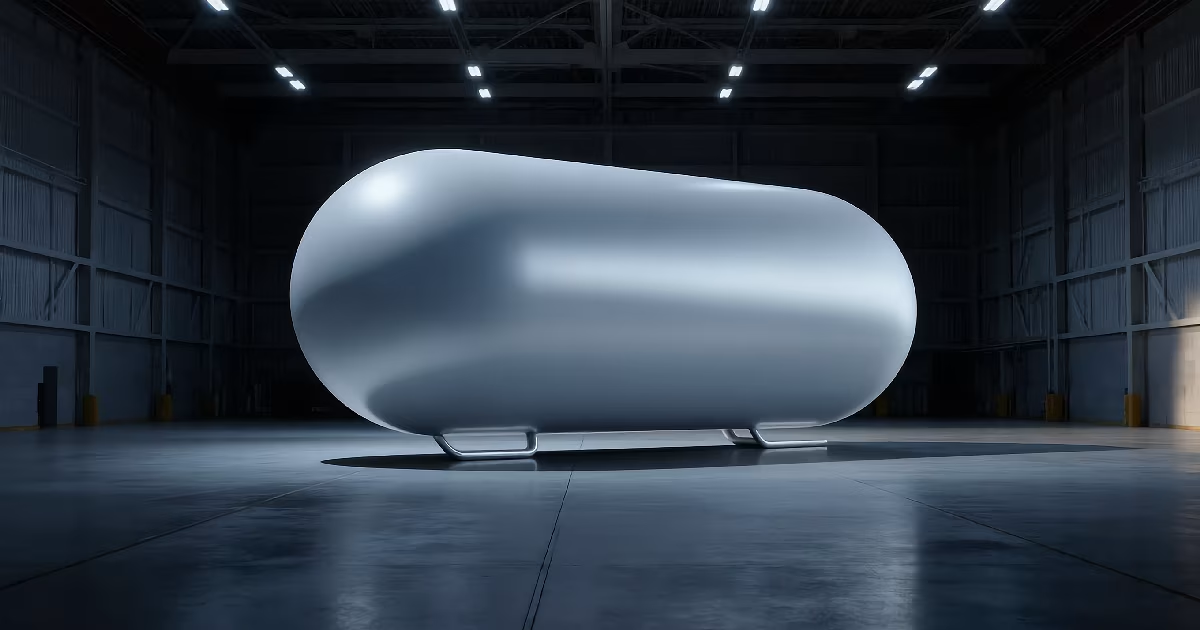
Nimitz Tic Tac FLIR footage, reconstructed.
Illustration, not a period photograph.
Opening
On 14 November 2004 two F/A-18F Super Hornets from Strike Fighter Squadron 41, the Black Aces, were pulled off a training hop and sent to look at a real-world contact. The carrier was USS Nimitz. The controller was on USS Princeton, a Ticonderoga-class cruiser with an AN/SPY-1 radar. The water was off southern California, on the order of a hundred miles from San Diego, during workups before a deployment.
The lead jet was flown by Cdr. David Fravor, squadron commanding officer. His wingman was then-Lt. Alex Dietrich. Each jet had a weapons systems officer in the back. What the four of them later described over a disturbed patch of ocean was a white, oblong, wingless object about the size of a fighter, with no rotors and no exhaust they could see. Fravor dropped toward it. The object moved with him, then left. Later that day another VFA-41 crew, with Lt. Chad Underwood on the airplane that carried an ATFLIR pod, recorded the infrared clip now called FLIR1.
The spine of the file is the split. Radar tracks on Princeton, a visual intercept by four aviators, and a separate infrared tape from a later sortie are three channels. They are not one merged, released mission record. Argument after 2017 is mostly about whether those channels describe the same object, and what the tape actually shows.
Timeline
Early November 2004. Princeton operators, among them Kevin Day in later interviews, report intermittent contacts during the strike group’s training period. The later public version is that tracks appeared high, dropped toward 20,000 feet, and hung. The ship’s people say they treated the radar as possibly sick, then as not sick. The raw SPY-1 take from those days is not on the public desk.
14 November, late morning. Princeton has another contact and vectors the airborne VFA-41 section. Fravor and Dietrich leave the training script. They arrive over a patch of water that looks chopped on an otherwise quieter sea. They see a white oblong shape above it.
14 November, the intercept. Fravor spirals down. He later says the object mirrors the descent, then accelerates out of sight. He later says it was then called near the combat air patrol point about sixty miles away. Dietrich, holding high, describes the same white shape and the same reaction to Fravor’s move. Neither jet is armed for a shooting problem. They return to Nimitz.
14 November, early afternoon. A follow-on section launches. Underwood’s aircraft has the ATFLIR. He records a short infrared sequence of a distant target, on the order of seventy-six seconds in the clip that later leaks. That clip is not Fravor’s intercept. It is a later attempt to find something with a targeting pod.
2007 onward. Copies of Navy UAP videos begin to circulate without authorization, according to later Defense statements. The 2004 tape is in that set.
16 December 2017. The New York Times puts the program and the videos on the national desk. Luis Elizondo, Christopher Mellon, and the To The Stars vehicle are in that rollout. The public name “Tic Tac” is already the aircrew nickname. It now becomes the case name.
27 April 2020. The Department of Defense authorizes release of three Navy videos, including FLIR1, and says they are real Navy recordings of unidentified aerial phenomena. Authentication of the file is not the same as an identification of the target.
May 2021. Fravor and Dietrich sit with 60 Minutes. Dietrich becomes the first woman from that section to describe the visual on camera.
26 July 2023. Fravor testifies under oath before the House Oversight Committee and restates the white Tic Tac, the water disturbance, the lack of control surfaces, and the CAP-point call.
Key figures
David Fravor is the intercept pilot and the main public speaker. In 2004 he is a squadron CO with a long flying record. In 2023 he is a retiree under oath. Those two Fravors agree on the shape and the move. He has also said the radar tape from his own jet was never released.
Alex Dietrich is the wingman. In 2004 she is a lieutenant junior grade. She watches from above while Fravor goes down. She has been careful in later interviews not to name the object as alien hardware. She has also said the event still bothers her because she cannot put a type on it.
Chad Underwood is the tape pilot, not the visual intercept pilot. In a 2019 New York magazine interview he is cooler than the later internet. The pod saw a target. He does not carry Fravor’s water-hovering description for the clip itself.
Kevin Day is the Princeton radar voice in later interviews. He is important and he is not a released log. The ship’s tracks are still a witness claim plus a career on Aegis, not a public plot file.
The 2017 intermediaries (Elizondo, Mellon, the newspaper) change who hears the case. They do not add a 2004 cockpit DVD. Skeptical analysts, Mick West among them, work the FLIR clip as glare, zoom artifacts, and a distant jet. They are part of the later file. They were not in the 2004 briefing.
Physical and documentary trail
On the paper, 2004-plus gives you four hard objects.
One: four named aviators on the same section, two jets, describing a white wingless oblong over disturbed water on 14 November. That is a visual claim with rank and a training date attached. It is not a photograph from Fravor’s canopy.
Two: FLIR1. A real Navy ATFLIR clip, later acknowledged by the Department of Defense, shot the same day by a different crew. Passive infrared. Short. No released cockpit audio on the public version. Underwood has not treated the clip as proof of the water hover.
Three: the 2020 Pentagon release letter and the 2017 New York Times package. They fix the videos as Navy property and put the case in Congress. They do not publish the Princeton SPY-1 files.
Four: Fravor’s 2023 written and spoken testimony. Sworn. Specific. Still a memory of an intercept, not the missing radar reel.
There is no public, time-aligned merge of Princeton tracks, Fravor’s APG-73, Dietrich’s view, and the ATFLIR file. There is no released mission report with lat-long, fuel, and range that a stranger can audit. There is no 2004 photograph of the object against the water. The CAP-point reappearance is a radio call in later speech. The raw call is not in a posted tape.
I consider myself a pretty rational person, and it still bothers me that I have no idea what I saw that day.
Competing explanations
Ordinary traffic plus a bad merge. A distant aircraft, a balloon, or a glare in the pod can explain FLIR1 if that clip is treated alone. This reading is strongest on the tape and weakest on the four-person visual over a specific water disturbance, which the tape does not show.
Radar artifact. Aegis can be wrong. Day and others say they checked that and kept seeing tracks. Without the take, this remains a possible and an untested possible. Reset stories are part of the later interviews, not part of a released diagnostic sheet.
Advanced human system. A classified test in a Navy workup box would account for performance and for silence. It would also require someone to fly a wingless white shape in front of a squadron CO and then leave no program office willing to say “ours” twenty years later. Possible. Not shown.
Unknown craft. This is the reading that makes the case famous. It asks that the visual, the ship tracks, and the CAP-point call be one object with performance outside the Super Hornet. It holds only if those channels are the same event. The public file does not prove the merge. It also does not give you a wreckage tray.
Later life of the case
From 2004 to 2016 the event is ready-room talk and a leaked clip. The 2017 newspaper package is what changes the file’s later life: AATIP as a brand, three videos as a set, Congress as an audience. Ryan Graves and other Navy pilots add a climate of “this was not rare.” Graves was not in Fravor’s cockpit.
The 2020 authentication and the 2021-2023 hearings keep the Tic Tac on the desk. They still do not drop the Princeton tapes. Skeptical frame-by-frame work on FLIR1 is now part of the public argument and should stay there. It addresses the clip. It does not interview Dietrich out of the visual.
I do not treat later “archive release” marketing as a substitute for a posted radar file. If the tracks go public, the finding changes. Until then the later life is testimony and a pod video.
Finding
Princeton sent two Super Hornets after a real contact, and David Fravor and Alex Dietrich looked down on a white wingless oblong over disturbed water that did not fly like a jet. Another crew that same day recorded the ATFLIR clip the Department of Defense later put its name on. Believe the section. Four aviators were not writing a book in the cockpit. Something was off the Nimitz that morning that the training hop was not supposed to meet.
What still will not resolve: the Princeton tracks from the prior two weeks, released as a continuous radar file, or a demonstration that FLIR1 is the same object Fravor circled. Either one would lock the intercept to a machine the Navy already had on glass. Until that tape or that identity sits in public, the proving object is still the ship’s own picture of what it told the jets to find.