LUIS ELIZONDO
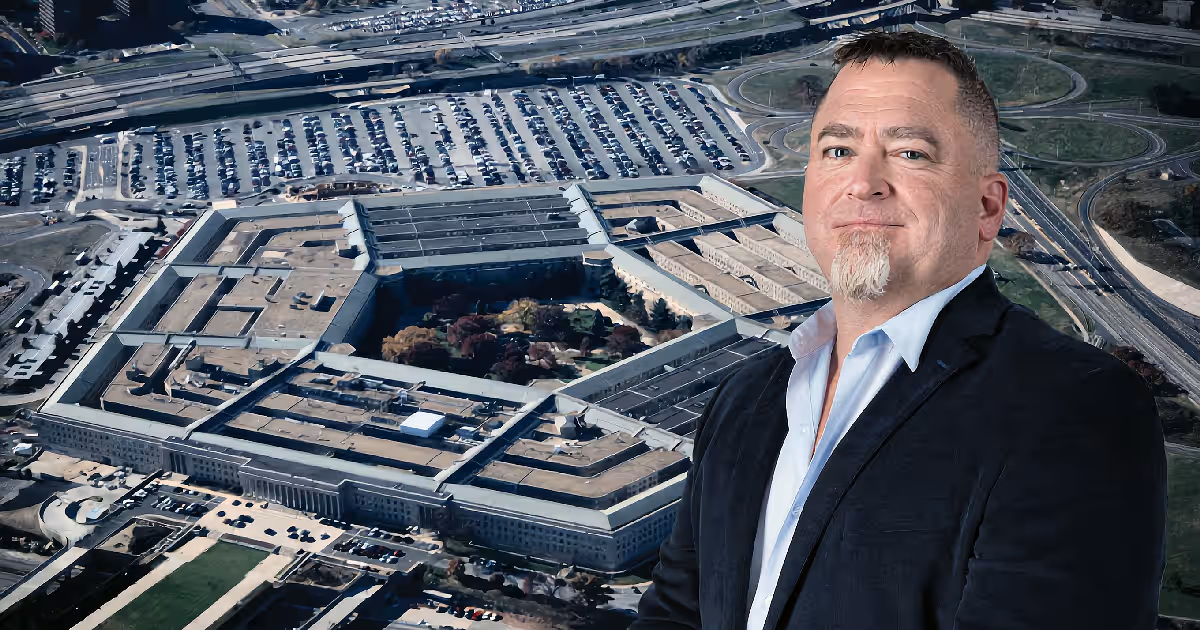
Luis Elizondo, the man who started it all, above the Pentagon.
Illustration, not a photograph.
Opening
On 16 December 2017, the New York Times revealed that the Pentagon had been secretly studying UFOs, and published Navy videos of objects nobody could identify. The man at the centre of the story was Luis Elizondo, a career counterintelligence officer who said he had run the programme, the Advanced Aerospace Threat Identification Program, or AATIP, and had resigned in protest at the secrecy around it. More than anyone else, Elizondo started the modern disclosure era. He has since written a number one bestseller, testified to Congress, and fought a long public battle with the Pentagon over what his job actually was.
Timeline
Early life. Elizondo is born in Texas and grows up in Florida, the son of a Cuban exile who volunteered for Brigade 2506, the force that landed at the Bay of Pigs. He studies microbiology and immunology at the University of Miami.
1995. He enlists in the US Army, and serves in South Korea, Kuwait and the United States.
2000s. As a counterintelligence and military intelligence officer, he runs operations in Afghanistan, South America and at the Guantanamo Bay detention camp, and works on counterterrorism cases involving al-Qaeda, Hezbollah and later ISIS.
2007 to 2012. At the request of Senate majority leader Harry Reid, the Defense Intelligence Agency funds a UFO research effort, about $22 million spent largely through Robert Bigelow's company. AATIP is the name later given to the Pentagon side of it.
2008. Elizondo joins the Office of the Under Secretary of Defense for Intelligence at the Pentagon. He says he was brought into AATIP in about 2009 and later led it.
4 October 2017. He resigns. His letter to Defense Secretary James Mattis protests that the subject is not being taken seriously and that excessive secrecy and internal opposition are blocking it.
October 2017. He joins Tom DeLonge's new company, To The Stars Academy of Arts and Science, alongside former Pentagon official Christopher Mellon and physicist Hal Puthoff.
16 December 2017. The New York Times story by Helene Cooper, Ralph Blumenthal and Leslie Kean reveals AATIP and publishes two Navy videos, followed by a third. They become known as FLIR1, Gimbal and GoFast.
2019 to 2020. He appears in the History channel series Unidentified: Inside America's UFO Investigation. In April 2020 the Pentagon officially releases the three videos.
2019 onward. The Pentagon's statements about him contradict each other. A spokeswoman confirmed in 2017 that he had led AATIP. Another said in 2019 that he had no responsibilities for it. Harry Reid wrote in 2021 that Elizondo had been involved and had a leadership role.
Late 2020. He and Mellon leave To The Stars to concentrate on pressing Congress for transparency.
May 2021. He files a complaint with the Defense Department's Inspector General, accusing named Pentagon officials of disinformation, misconduct and reprisal against him as a whistleblower.
August 2024. His memoir, Imminent: Inside the Pentagon's Hunt for UFOs, goes straight to number one on the New York Times bestseller list. In it he says the US has a decades-old programme to retrieve crashed craft, that non-human bodies were recovered, and that strange glowing orbs appeared in his own home.
13 November 2024. He testifies under oath to the House Oversight Committee's hearing, "Exposing the Truth", alongside retired Rear Admiral Tim Gallaudet, journalist Michael Shellenberger and former NASA official Mike Gold. He tells Congress that the government has operated a secret crash retrieval programme.
April to June 2026. He tours the US with a speaking show called Persona Non Grata.
August 2026. His second book, Reckoning: The Unspoken Truth about UFOs and the Urgency of Now, was due from HarperCollins on 27 August, but it misses that date. No new date has been announced, and some retailer listings now show 2027.
Key figures
Harry Reid, the Senate leader who started the funding, backed Elizondo's account until his death in 2021. Christopher Mellon, a former deputy assistant secretary of defense for intelligence, has been his closest ally. Tom DeLonge brought him into To The Stars. Robert Bigelow's company ran the research side of the original contract. Leslie Kean and Ralph Blumenthal, who co-wrote the 2017 story, later broke David Grusch's story too. On the other side are the Pentagon officials, including Garry Reid, who wrote that Elizondo had "aggrandized his role", and former AARO director Sean Kirkpatrick.
Physical and documentary trail
The documents are a tangle. There is his resignation letter. There are the Pentagon's contradictory statements, collected through freedom of information requests by The Black Vault's John Greenewald. There is the Inspector General complaint, and a Pentagon memo by Garry Reid saying Elizondo had no job responsibilities related to AATIP. There is the 2017 Times story, the three videos the Pentagon later confirmed were real, his book, and his sworn testimony.
The program itself is not in doubt. The Pentagon has confirmed AATIP existed and that the Navy videos are authentic. What is disputed is Elizondo's exact role in it, and his claims about crash retrievals, which he says he cannot fully detail because they are classified.
Things you might not know
- His father landed at the Bay of Pigs. Elizondo's father was a Cuban exile who volunteered for Brigade 2506, the CIA-trained force in the failed 1961 invasion.
- He was a biologist first. Before the Army, he studied microbiology and immunology at the University of Miami.
- The Pentagon has said both things about him. In 2017 a Pentagon spokeswoman confirmed he led AATIP. In 2019 another spokesperson said he had no responsibilities for it.
- The videos he released are now official. The Pentagon formally released FLIR1, Gimbal and GoFast in April 2020, and confirmed the objects in them remain unidentified.
- Harry Reid vouched for him in writing. In 2021, the year he died, the former Senate leader confirmed Elizondo's involvement and leadership role in the programme.
- He says the phenomenon followed him home. In Imminent he describes glowing orbs appearing inside his house, something he says other people connected to the programme also experienced.
- The same reporters broke Grusch. Leslie Kean and Ralph Blumenthal, two of the three bylines on the 2017 Times story, also published David Grusch's first interview in 2023.
Competing explanations
A truth-teller the Pentagon tried to discredit. His supporters point to the facts that are not in dispute: AATIP existed, the videos are real, the Pentagon's statements about him have changed, Harry Reid confirmed his role, and he has repeated his claims under oath. In this view, the attacks on his credibility are the kind of treatment whistleblowers often get.
An insider who overstated his role. Critics argue that he exaggerated how central he was to AATIP, and that his claims about bodies and crash retrievals rest on information he cannot show. Some sceptics have also challenged images and stories he has shared in public.
Both partly right. It is possible to accept that AATIP was real and that Elizondo worked on it, while waiting for the documents that would settle exactly what he did and what he saw.
Later life of the case
Everything in the modern disclosure story runs through 2017: the hearings, David Grusch, AARO, the UAP Disclosure Act and PURSUE. Elizondo's resignation and the Times story were the start of it. He remains one of the most recognisable faces of the subject, with a large and loyal following, and a group of critics who have watched his every claim.
Finding
Luis Elizondo changed the history of this subject. The programme he spoke for was real, the videos he helped bring out were real, and the Pentagon's own confused statements about him have done more to damage its credibility than his. His larger claims, about crash retrievals and recovered bodies, are made under oath, and are the same claims David Grusch and others have made.
What still will not resolve: what Elizondo saw that he says he cannot talk about. The classified records he describes would answer it, and they have not been released.