WHITLEY STRIEBER
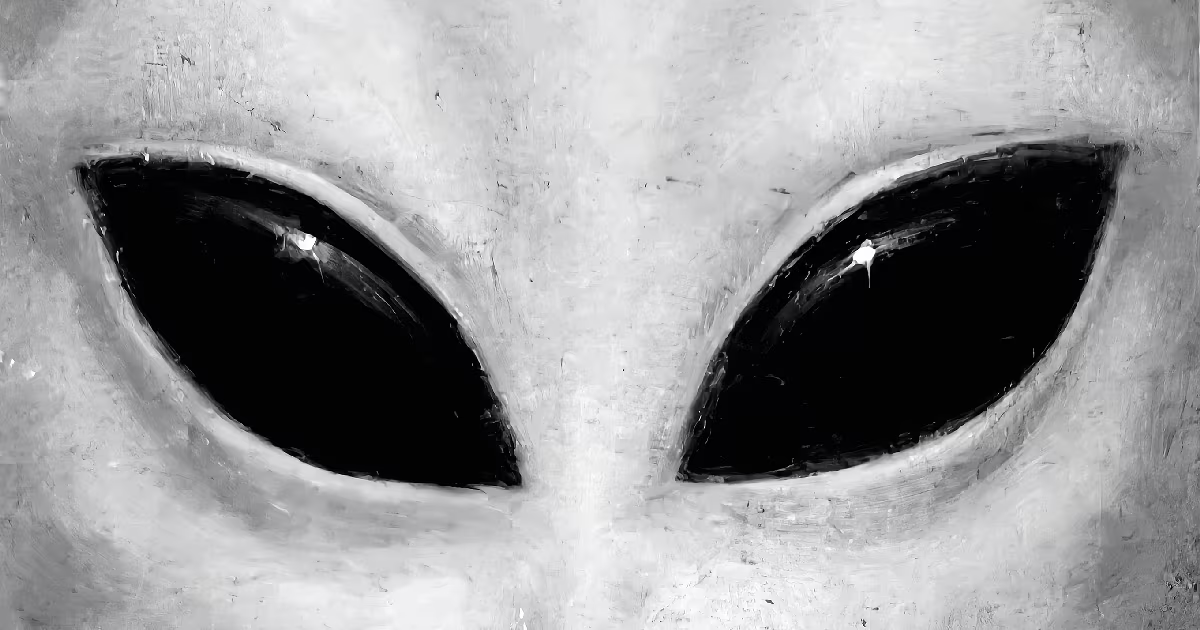
The visitor's face: grey skin and huge black almond eyes.
Illustration, not a photograph.
Opening
In February 1987 a successful horror novelist published a book that was not a novel. Communion: A True Story described how Whitley Strieber, author of The Wolfen and The Hunger, had been taken from his cabin in upstate New York on the night of 26 December 1985 by beings he called "the visitors". Its cover, a painting of a pale grey face with huge black almond eyes, became the most famous image of an alien ever made. The book went to number one on the New York Times non-fiction list, sold millions of copies, and did more than any other single work to put alien abduction into ordinary living rooms.
Timeline
13 June 1945. Louis Whitley Strieber is born in San Antonio, Texas.
1968. He graduates from the University of Texas at Austin and studies at the London School of Film Technique, then works in advertising in New York, rising to vice president before leaving in 1977 to write.
1978 and 1981. His horror novels The Wolfen and The Hunger are published. Both are made into films, The Hunger starring David Bowie and Catherine Deneuve.
1984. Warday, written with James Kunetka, imagines America after a limited nuclear war, and becomes a bestseller.
26 December 1985. At the family's cabin in the woods of upstate New York, Strieber wakes in the night to find small figures in his bedroom. He later recalls being taken out of the house and into a small round room, where he was examined by beings including a slender figure with large black eyes.
Early 1986. Troubled by fragmented memories, he contacts abduction researcher Budd Hopkins, and undergoes hypnosis with psychiatrist Donald Klein. The sessions bring back more detail.
February 1987. Communion is published by Beech Tree Books, an imprint of William Morrow. It reaches number one on the New York Times non-fiction bestseller list.
1988. The sequel, Transformation, continues the story. The Los Angeles Times reportedly lists it as fiction.
1989. The film of Communion is released, with Christopher Walken playing Strieber.
1999. The Coming Global Superstorm, written with radio host Art Bell, becomes the loose basis for the 2004 disaster film The Day After Tomorrow.
2001. The Key describes a night in a Toronto hotel room on 6 June 1998, when Strieber says a mysterious visitor came to his door and talked with him for hours.
2015. His wife and lifelong partner, Anne Strieber, dies. Together they had read and sorted the many thousands of letters readers sent after Communion. In 2017 he publishes The Afterlife Revolution, written with her and about her.
2016. He writes The Super Natural with Rice University religion scholar Jeffrey Kripal.
2023. The letters from Communion readers, more than 3,400 of them, are accessioned into Rice University's Archives of the Impossible.
2025. The Fourth Mind continues his writing about the visitors, telepathy and human potential. He still hosts the Dreamland podcast through his Unknown Country website.
Key figures
Whitley Strieber is the witness, the author and the case. Anne Strieber stood beside him through all of it and ran the business side of their work. Budd Hopkins, the New York artist who pioneered abduction research, was one of the first people Strieber contacted, though the two later fell out. Psychiatrist Donald Klein conducted the hypnosis sessions. Artist Ted Seth Jacobs painted the cover face. Jeffrey Kripal and the Rice archive have made Strieber's work, and his readers' letters, a subject of serious academic study.
Physical and documentary trail
The main record is Strieber's own books, written over almost forty years, and the hypnosis sessions he described in them. Beyond that are the reader letters: thousands of people wrote to say they had experienced something like what he described, and those letters are now preserved at Rice University. Strieber has also described physical effects over the years, including marks on his body and an object he believes was an implant.
What there is not is outside evidence from the night itself. Nobody else in the cabin saw the beings, and no photograph or object from 26 December 1985 has been produced.
Things you might not know
- The face on the cover was painted to his description. Artist Ted Seth Jacobs worked from Strieber's memory to create the grey face with black eyes. It became the image most people now picture when they hear the word "alien".
- He never called them aliens. Strieber used "the visitors" on purpose, because he did not know where they came from and did not want to assume.
- He wrote vampires and werewolves first. The Hunger, his 1981 vampire novel, became a cult film with David Bowie, Catherine Deneuve and Susan Sarandon.
- Christopher Walken played him. The 1989 film of Communion starred Walken as Strieber, in one of his strangest performances.
- He co-wrote the book behind The Day After Tomorrow. His 1999 book with Art Bell, The Coming Global Superstorm, inspired the 2004 climate disaster film.
- His readers wrote back by the thousand. More than 3,400 of their letters, many describing their own encounters, are now in Rice University's Archives of the Impossible.
- A newspaper filed the sequel under fiction. When Transformation came out in 1988, the Los Angeles Times reportedly placed it on its fiction list, much to his frustration.
Competing explanations
A real encounter. Strieber has told the same core story for almost forty years, at great cost to his reputation as a novelist. Thousands of readers recognised their own experiences in his. Supporters see him as a witness who was brave enough to describe what many others had kept quiet.
Sleep paralysis and memory. Sceptics point out that his first experience began at night, in bed, with figures in the room: the classic setting of sleep paralysis. They argue that hypnosis can create detailed false memories, and that a gifted horror novelist would be especially good at turning a frightening night into a vivid story.
Something stranger than either. Strieber himself rejects the simple "alien" label as much as the sceptics do. His view, close to Jacques Vallée's, is that the visitors are real but not easily explained, and may be bound up with consciousness, death and what it means to be human.
Later life of the case
Communion defined the look and feel of alien abduction for a generation. The grey face is on T-shirts, posters and album covers around the world. Strieber's work is now studied by academics at Rice, and his idea that the encounter is as much about consciousness as about spacecraft has moved closer to the centre of the field.
Finding
Whitley Strieber described something that changed his life, and he has never wavered from it. Whatever happened at the cabin on 26 December 1985, his book gave thousands of people a way to talk about experiences they had kept to themselves, and gave the world its picture of the visitors.
What still will not resolve: what was in the room that night. Strieber has spent forty years asking, and the one person who could answer has always been him.