TRAVIS WALTON
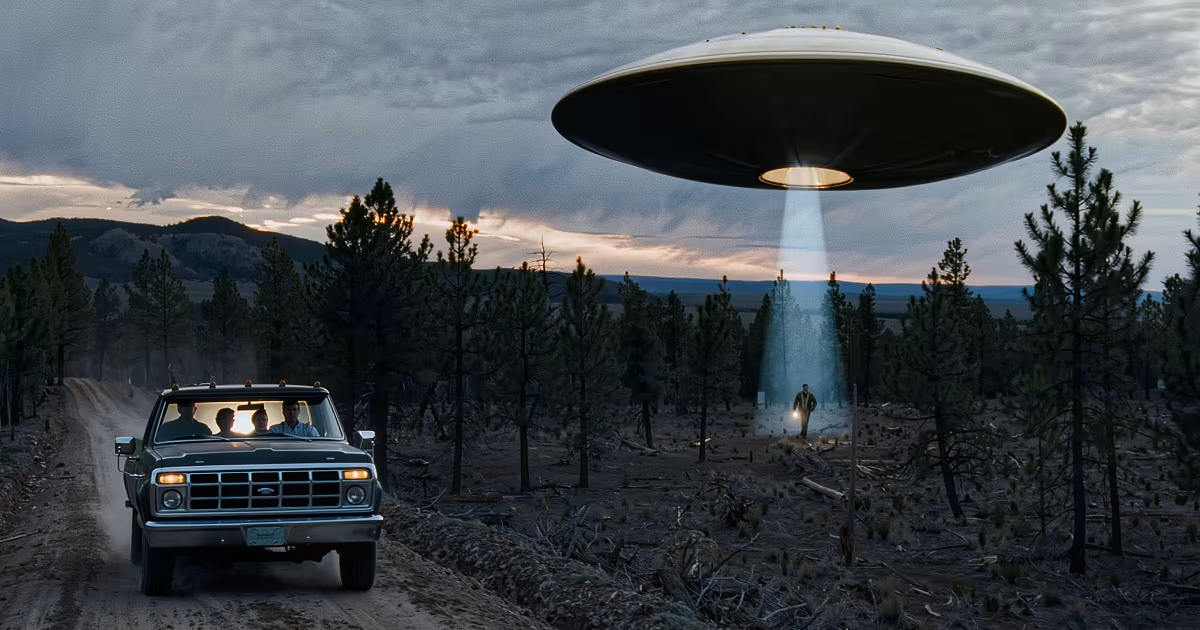
Forest road at dusk. Disc in the trees.
Illustration, not a period photograph.
Opening
On the evening of 5 November 1975, seven forestry workers, including twenty-two-year-old Travis Walton, were driving back from a logging job in Arizona's Apache-Sitgreaves National Forest when they saw a bright light through the trees, resolving into a saucer-shaped object hovering above a clearing. Walton got out for a closer look; witnesses said a beam of light or energy struck him and threw him backward, at which point the rest of the crew fled in panic. When they returned minutes later, Walton was gone. He reappeared five days later, found dazed and dehydrated at a roadside phone booth, with an account of having been taken aboard the craft and examined by humanoid beings.
This case sits in an unusual position: it is one of the very few multi-witness alien abduction accounts, six other men corroborate at least the sighting and Walton's disappearance, and it also carries one of the most tangled, contested polygraph histories of any UFO case on record, with genuinely different test results pointing in different directions depending on which examiner and which round is being cited.
Timeline
Roughly two weeks before the incident. NBC airs The UFO Incident, a prime-time dramatization of the Betty and Barney Hill abduction case, a detail Klass and other skeptics later cite as a plausible narrative template available to the crew shortly before their own account emerged.
5 November 1975, after 6 p.m. Driving from the Turkey Springs work site toward Snowflake, Walton and crew member Allen Dalis are the first to spot a saucer-shaped object hovering over a slash pile in a clearing. Walton exits the truck to approach it; witnesses report a flash or beam striking him and throwing him several feet, after which the crew, believing him dead or badly injured, flees the scene in fear.
Same night, shortly after. Crew leader Mike Rogers, having driven some distance, decides the group cannot leave Walton behind and returns to the site; Walton is nowhere to be found.
Following days. An extensive search, including law enforcement, is mounted for Walton. Investigators, unable to rule out foul play, treat it partly as a possible murder investigation; Klass later notes that during the five days Walton was missing, family members and coworkers reportedly showed little overt concern in media interviews and police interrogations, and that Walton's brother Duane was overheard saying, "He's not even missing. He knows where he's at, and I know where he's at," a remark cited by skeptics as suggestive and disputed by supporters as taken out of context.
Within days of the disappearance. Rogers and five of the six other crew members undergo polygraph examinations administered by the Arizona Department of Public Safety. The examiner's stated conclusion is that the men's tests indicated they had genuinely witnessed some unusual, unexplained event, though this examination did not and could not speak to Walton's own separate account, since he was still missing.
5 days after the disappearance. Walton is found at a phone booth outside Heber, Arizona, dehydrated, disoriented, and roughly ten pounds lighter, but medically noted by an examining physician as not showing the expected fat-burning physiological signs of five days without food, a detail some later analysts read as inconsistent with his stated timeline.
Shortly after Walton's return. The Waltons agree to a National Enquirer-sponsored polygraph examination administered by examiner Jack McCarthy, one of Arizona's most experienced examiners at the time. McCarthy's unpublished conclusion, later uncovered by investigator Philip Klass, was blunt: "the plainest case of lying he had seen in 20 years," and he separately noted Walton appeared to be using polygraph countermeasures, including breath-holding. Per the Enquirer's advance agreement with the family, this failed test was not published at the time.
Following the suppressed test. Local UFO investigators, unconvinced by McCarthy's finding, arrange a further polygraph with a different examiner, Pfeifer, whose actual reported result was inconclusive; the sponsoring UFO organization nonetheless announced to the press that the results were positive and confirmed Walton's account, and this is the specific examination Walton describes in his own book as having passed. Both McCarthy and the original Department of Public Safety examiner, Gilson, later reviewed Pfeifer's results themselves and agreed they were genuinely inconclusive rather than confirmatory.
1978. Walton publishes The Walton Experience, a book widely believed, though never confirmed, to have been ghostwritten with assistance from Jerome Clark, then editor of the International UFO Reporter.
Later. The National Enquirer awards Walton and the crew $5,000 for "Best UFO Case of the Year," a fraction of the $100,000 top prize they had reportedly hoped for; Walton received $2,500, with the remaining $2,500 split among the other six men.
Klass's investigation, published in his 1983 and 1988 books. Klass uncovers the suppressed McCarthy test and other case details, and proposes that the entire event was fabricated by the crew as a way to avoid contractual penalties for falling behind schedule on their Forest Service logging contract, a motive theory that critics note is complicated by the crew's continued work relationship with the same logging company afterward and by their not seeking early contract release even before Walton's disappearance.
1993. Fire in the Sky, a heavily dramatized Paramount film based on Walton's book, brings the case to a much wider audience, though it substantially fictionalizes the depicted onboard experience.
1993, following the film's release. Rogers, Walton, and Dalis undergo a further round of polygraph examinations; Klass, in a proposed arrangement, offers to pay for the tests if the men pass and to have a UFO organization pay if they fail. Skeptic and magazine editor Michael Shermer later separately reports on the arrangement's specific terms and outcomes in detailed published accounts.
2007 (roughly 33 years after the event). Walton appears on the Fox television program Moment of Truth, a polygraph-based game show; asked directly whether he was abducted by a UFO on 5 November 1975, he answers yes without hesitation, and the show's own polygraph administration returns a result of "false," an outcome both Walton and Shermer, who was present, treat with real caution given the polygraph's broadly disputed scientific reliability as a lie-detection method in any context.
2015. The documentary Travis: The True Story of Travis Walton revisits the case with additional retrospective interviews.
Key figures
Walton is the case's central witness and, notably, the only person actually claiming direct abduction experience; the other six men corroborate only the sighting and his disappearance, not what happened to him afterward, a distinction often collapsed in popular retellings that treat this as a fully multi-witness abduction account rather than a multi-witness sighting plus a single-witness abduction claim.
Rogers is the case's key corroborating witness and crew leader, whose decision to turn back for Walton despite the crew's fear is cited by supporters as inconsistent with a premeditated hoax, and who has remained a consistent public defender of the account's truthfulness across decades of skeptical challenge.
McCarthy and Pfeifer represent the case's central, unresolved polygraph contradiction: one experienced examiner found "gross deception," another found a genuinely inconclusive result that was then publicly mischaracterized as a pass by the sponsoring UFO organization, a discrepancy that, once uncovered, significantly complicates any simple "he passed a lie detector test" summary of the case.
Klass is the case's most persistent skeptical investigator, whose specific documentary findings, the suppressed McCarthy test, the questioned family reactions during the search, the pending contract deadline, form the backbone of the hoax theory, though his proposed motive (avoiding contractual penalty) has not been independently corroborated by any confirmed record of contract trouble beyond the coincidental timing.
Shermer is the case's most recent notable investigator, whose direct, personal, decades-long engagement with Walton, including witnessing the 2007 television polygraph result firsthand, adds a rare instance of a skeptic maintaining ongoing, apparently respectful personal contact with a case's central witness even while remaining professionally unconvinced.
Physical and documentary trail
On the paper, this file has an unusually large and specific documentary record for an abduction case: multiple named polygraph examiners with directly conflicting assessments, a Department of Public Safety examination of the six corroborating witnesses, medical notes on Walton's physical condition upon return, Klass's detailed published investigative findings, and Walton's own book-length account.
What it lacks is any physical trace evidence at all connecting Walton's account of the craft's interior to anything checkable, no photograph, no recovered material, no independently verifiable detail from inside the alleged craft. The case's entire evidentiary weight rests on witness testimony and contested polygraph results rather than on physical evidence of the kind Socorro or Falcon Lake, however inconclusive those cases remain, at least partially offer.
The plainest case of lying he had seen in 20 years.
Competing explanations
A deliberate hoax to avoid a contractual penalty. This is Klass's proposed explanation, supported by the suppressed McCarthy polygraph finding and by his reading of the family's demeanor during the search. Its weakest point is motive specificity: no independently confirmed contract-penalty document has surfaced, and the crew's continued working relationship with the same logging company afterward sits somewhat awkwardly with a theory requiring them to have staged an elaborate, risky fabrication specifically to escape that same employer's terms.
A genuine sighting followed by a fabricated or exaggerated personal abduction account. This reading takes the six corroborating witnesses' sighting testimony, independently supported by their own passed Department of Public Safety polygraphs, at face value while treating Walton's own subsequent, single-witness abduction narrative as a separate and more questionable claim, a distinction the case's own contested polygraph history (strong results for the group sighting, genuinely disputed results for Walton's personal account specifically) arguably supports better than treating the whole story as one unified claim.
A genuine abduction experience, exactly as Walton describes. This remains Walton's own consistent, lifelong account, and it is bolstered by the crew's sighting corroboration and by the genuine ambiguity in his own polygraph history, since even the "failed" McCarthy test has been criticized by supporters as administered under confrontational conditions, and no polygraph result, in any direction, carries the kind of scientific reliability that would definitively settle a claim this large either way.
Later life of the case
Fire in the Sky brought the case to a vastly larger audience than the original 1975 reports ever reached, cementing Walton's account as one of the most culturally recognizable alien abduction stories in American media despite the film's own acknowledged fictionalization of the onboard sequence. The case's decades-long polygraph saga, five separate examinations across more than thirty years, returning results ranging from "gross deception" to "inconclusive" to a 2007 television "false," makes it a genuinely unusual data point on just how far lie-detection technology's own limitations can stretch a single case's evidentiary record in multiple directions without ever producing a clean resolution.
Finding
Seven men's independent, contemporaneous testimony establishes that something unusual was seen and that Walton genuinely disappeared for five days under circumstances an extensive law-enforcement search could not resolve as ordinary. What remains genuinely contested is Walton's own personal account of what happened to him during that time, supported by one polygraph result publicly (though inaccurately) characterized as a pass, and directly contradicted by an earlier, more experienced examiner's unpublished finding of "gross deception," with a decades-later television polygraph adding a third, also scientifically disputed, data point.
What still will not resolve: any physical evidence connecting Walton's specific abduction account to a verifiable external event, and any polygraph result in this case's history that both sides accept as reliable. Until one of those changes, Travis Walton's own personal claim stays exactly as contested as it has been for fifty years, resting on testimony and a genuinely mixed lie-detection record rather than on anything checkable beyond it.