KECKSBURG
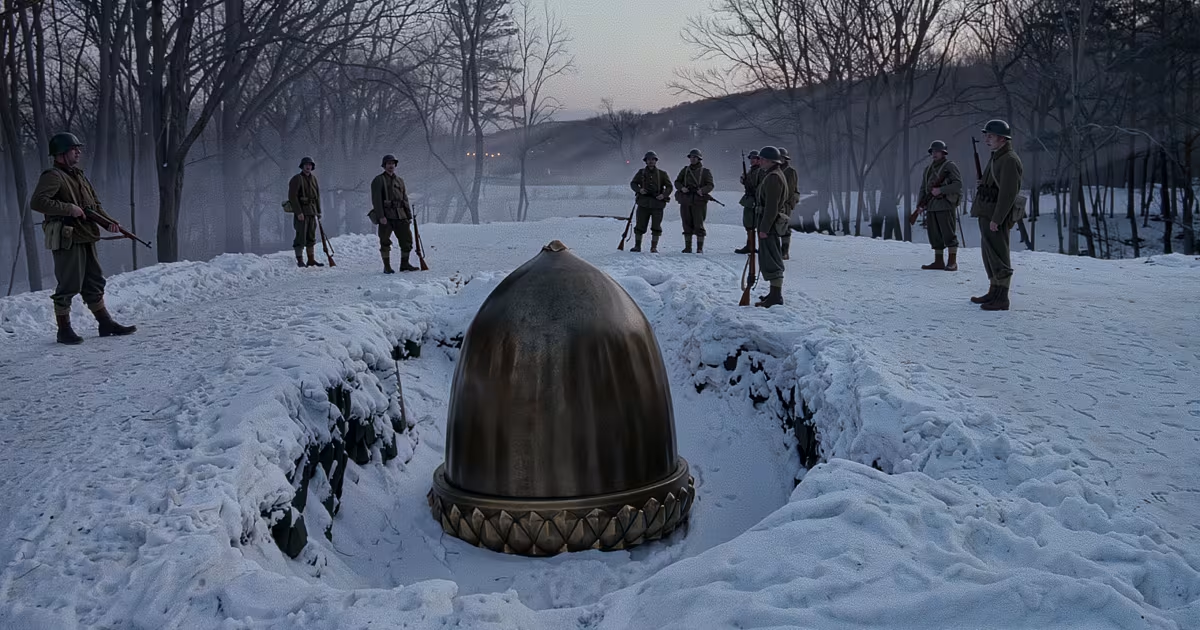
Kecksburg woods and acorn mock-up.
Illustration, not a period photograph.
Opening
On the evening of 9 December 1965, a large, brilliant fireball crossed the sky over at least six U.S. states and Canada, visible from Detroit to Windsor, Ontario, before reportedly descending steeply and coming down in the woods near Kecksburg, a small village in western Pennsylvania. What followed, according to local residents, was a controlled-seeming landing of a metallic, acorn-shaped object roughly the size of a Volkswagen Beetle, bearing markings some described as hieroglyphic, followed by a military cordon and the object's removal on a flatbed truck. What followed in the historical record, over the next sixty years, was a genuinely rare thing: a federal lawsuit that forced NASA to admit it had lost the actual government records on the case.
Kecksburg is often called "Pennsylvania's Roswell," and the comparison holds in one specific way: like Roswell, its most solid documented fact is not what fell from the sky but the demonstrated unreliability, gaps, and contradictions in the government's own paper trail about it.
Timeline
9 December 1965, evening. The fireball is observed across Idaho, Indiana, Ohio, Pennsylvania, West Virginia, and New York, as well as the Detroit-Windsor area, an unusually wide and well-documented multi-state sighting for a single meteor-adjacent event.
Same evening, near Kecksburg. Local residents report the object descending into the woods with an apparent trajectory and speed inconsistent with a typical meteor, and some report a metallic, acorn-shaped object on the ground shortly afterward. Kecksburg's volunteer fire department, including fire chief Ed Myers, responds to search the area.
Same evening, disputed detail. Some later witness accounts describe military personnel arriving, cordoning the site, and removing an object on a flatbed truck; Myers himself has stated flatly and repeatedly over the following decades that "nothing crashed in those woods" and that he personally searched the area until 10 p.m. without finding anything.
March 1966. UFO researcher Ivan Sanderson compiles a detailed account from multiple eyewitnesses and calculates the object's visible flight lasted about six minutes on a northwest-to-southeast trajectory, at an estimated speed of roughly 1,000 mph, considerably slower than a typical meteor and, in his reading, inconsistent with a simple natural fireball.
Following days. Air Force and astronomical assessments at the time lean toward a meteor bolide explanation, describing a steep-angle descent from southwest to northeast likely terminating near the northwestern shore of Lake Erie, near Windsor, rather than at Kecksburg specifically, a geographic mismatch some skeptics cite against the Kecksburg landing claim itself.
1990. NBC's Unsolved Mysteries airs a season-opening segment reenacting the incident with a mock acorn-shaped prop, drawing roughly 17.7 percent of television households and reigniting national interest a quarter-century after the event. More than fifty Kecksburg residents, including Myers and Jerome and Valerie Miller (whose home had been portrayed as a site of military activity), sign a petition attempting to stop the broadcast, calling the story a hoax cultivated by a couple of local men whose acorn-and-hieroglyphics account had only surfaced shortly before, decades after the original event.
2003. The Sci Fi Channel airs a two-hour documentary in which Kecksburg resident John Hays repeats, largely unchanged, an account he had first given in 1990 as a ten-year-old witness to a flatbed truck emerging from the site carrying something "the size of a VW."
December 2005. NASA releases a public statement, timed near the incident's fortieth anniversary, saying agency experts had examined metallic fragments from the area at the time and determined they came from a Soviet satellite that re-entered and broke up, but that the records documenting those findings had been lost sometime in the 1980s.
2005-2007. Investigative reporter Leslie Kean, working with SyFy network backing, sues NASA under the Freedom of Information Act for the missing records. On 26 October 2007, following a court order, NASA agrees to conduct a documented search. NASA public liaison officer Steve McConnell testifies that two specific boxes of papers from the time of the Kecksburg incident are missing, with no surviving chain of custody explaining their disposition. NASA's own account places the missing material in its "Fragology" file series, records specifically maintained for recovered space-debris objects, mostly of Soviet origin, whose summary index lists no confirmed Kecksburg entry but shows a numbering gap consistent with at least one deleted or missing record.
1991 and 1998. NASA orbital debris specialist James Oberg proposes the Soviet Venus probe Kosmos 96 as a specific identity for the debris, based on that probe's documented atmospheric re-entry on the same date. U.S. Air Force space-tracking data available by this point places Kosmos 96's orbital decay earlier in the day and in a different location than the 4:43 p.m. Kecksburg-area fireball, directly contradicting the proposed match on both timing and geography.
2021. Freedom of Information Act releases obtained via The Black Vault add further documentary detail to the Project Blue Book and NASA record trail without resolving the object's ultimate identity.
Key figures
Myers is the case's most consistent and most inconvenient-for-the-legend witness: the actual 1965 fire chief who led the search, present on the scene the entire relevant evening, who has stated for decades that no object and no military recovery occurred, and who has attributed the acorn-and-hieroglyphics version specifically to two named local men whose account did not surface until decades after the event.
Sanderson is the case's earliest serious independent investigator, whose 1966 trajectory and speed calculations, drawn from contemporaneous witness compilation rather than later retelling, form the technical basis for arguing the object's flight was too slow and too controlled-seeming for an ordinary meteor.
Kean is the figure most responsible for the case's most concrete documented fact: that NASA's own records on the incident are provably, admittedly missing, established not through speculation but through a federal court process and sworn testimony from a NASA official.
Oberg is the case's leading scientific advocate for a specific conventional identity, and his own proposed candidate, Kosmos 96, is itself directly undercut by tracking data from the same government apparatus he draws on, a rare instance of a skeptical explanation failing its own evidentiary test as cleanly as the sensational one.
Hays and the other later "new" witnesses represent the case's most contested testimonial layer: accounts that, per Myers and other original-era residents, emerged or hardened significantly only after national television attention arrived in 1990, a pattern consistent with either suppressed memories finally surfacing under safer conditions or with a story growing in the retelling once an audience existed for it.
Physical and documentary trail
On the paper, this file has a genuinely unusual documented fact for any UFO case: a federal agency's own sworn court testimony admitting specific, identifiable government records about the incident are missing, with no chain of custody, discovered only through litigation rather than voluntary disclosure. It has Sanderson's contemporaneous trajectory analysis, astronomical assessments placing the fireball's likely endpoint near Lake Erie rather than Kecksburg, and a specific, testable conventional candidate (Kosmos 96) that has been directly contradicted by independent tracking data rather than merely disputed.
It also has a genuine internal contradiction among its own local witnesses: the original fire chief's flat, decades-long denial standing directly against later, more dramatic accounts that Myers and others attribute to specific named individuals and a specific, comparatively late point of origin.
I was all over the woods and didn't see a thing... I stayed until 10 p.m. and didn't see anything.
Competing explanations
A meteor bolide. This is the earliest official reading, supported by widespread multi-state visibility consistent with a genuine bright meteor and by astronomical trajectory analysis placing its likely descent and endpoint near Lake Erie rather than at Kecksburg specifically. Sanderson's slower-than-meteor speed calculation and the object's reported course change argue against a simple, uncontrolled natural fireball, though speed estimates from excited eyewitnesses carry real uncertainty.
Re-entering Soviet space debris, specifically Kosmos 96. This is the reading NASA itself eventually endorsed and the one its own missing records reportedly supported, but the specific candidate proposed by its own debris expert is directly contradicted by independent orbital tracking data on both timing and location, meaning the "Soviet satellite" explanation may be broadly correct in category while wrong in its most specific, checkable claim.
A hoax or later-embellished local legend. Myers's direct, sustained, and specifically attributed account of the acorn-and-hieroglyphics story's origin is a serious, named, on-the-record challenge to the case's most dramatic details, not a vague skeptical dismissal, and deserves the same evidentiary weight as any other named witness's testimony.
A genuine recovered object whose identity the missing records would have settled. This reading is bolstered specifically by the documented fact of the records' loss: had the case been an unremarkable meteor, there would be little institutional reason for records specifically indexed under a "Fragology" system built for recovered space hardware to exist for it at all, let alone to go missing without explanation.
Later life of the case
Kecksburg's acorn-shaped prop from the 1990 Unsolved Mysteries broadcast remains on permanent display at the Kecksburg volunteer fire station, a small but telling sign of how thoroughly the legend has been absorbed into the town's identity regardless of the original fire chief's own denials. The case remains a recurring subject of FOIA-driven document releases and skeptical re-examination alike, with neither side having produced the single piece of evidence, a surviving fragment, a located record, that would close it.
Finding
A genuine, widely observed fireball crossed the sky over multiple states on 9 December 1965, and NASA's own later admission that its records on the incident are lost is independently verified federal court testimony, not ufological speculation. The specific proposed conventional identity for the debris, Kosmos 96, fails against the same government's own tracking data, and the town's own original fire chief has consistently and specifically denied the crash-and-recovery story's most dramatic elements.
What still will not resolve: the actual contents of NASA's missing Fragology records, and which of Kecksburg's competing local accounts, Myers's flat denial or the later, more dramatic witness testimony, more accurately reflects what happened in those woods on a December evening six decades ago. Until the paper trail turns up, this stays a case defined less by what fell from the sky than by what has since gone missing from the filing cabinet.