BATTLE OF LOS ANGELES
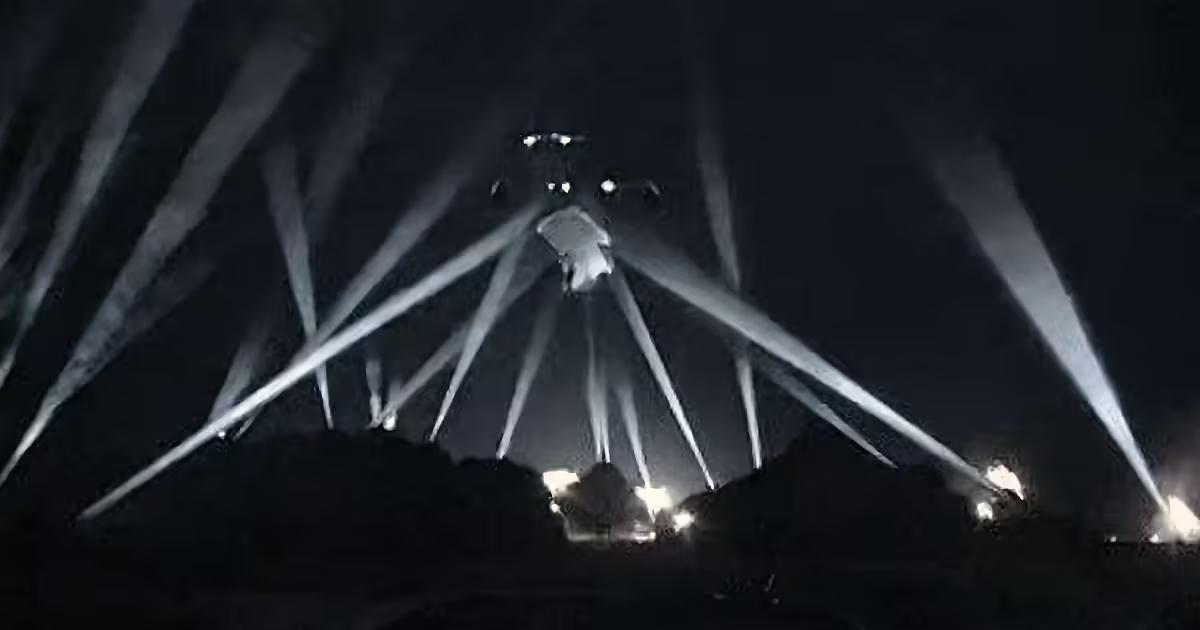
Searchlights and flak bursts around a pale shape over Los Angeles.
Illustration, not a period photograph.

Opening
In the small hours of 25 February 1942 Los Angeles woke to sirens and searchlights. Radar and coast watchers had already been nervous after a Japanese submarine shelled an oil field near Santa Barbara the day before. Sirens sounded at 02:25, and from 03:16 anti-aircraft batteries in the basin fired. Shells burst under lights that held something, or held each other. No bomb fell on the city. No wreck came down that the Army could show as an enemy aircraft. In the morning there were dud shells in streets and a press photograph of beams crossed on a bright core.
Secretary Stimson said unidentified aircraft. The Navy talked about war nerves. Japanese records after the war did not hand over a raid. The barrage is not in dispute. The target is.
Timeline
23 February 1942A Japanese submarine fires on the Ellwood oil field near Santa Barbara. The coast, already blacked out and jumpy after Pearl Harbor, takes it as the start of something larger.
Night of the 24th into the 25thRadar plots appear off the coast. Yellow alert, then red. Sirens at 02:25. At 03:16 the batteries open. Searchlights cone over the basin. Witnesses disagree on number and motion: one slow object, several, a thing that sat while shells burst under it. Fire continues in waves until 04:14. All-clear at 07:21.
Morning papersDamage is from American shells coming back down, not from bombs. A handful of deaths tied to wrecks and heart failure in the panic, not to enemy fire. The photograph of crossed beams on a bright nucleus runs nationwide.
Washington splits. Stimson speaks of unidentified aircraft. The Navy prefers nerves and weather balloons. Postwar Japanese paper does not claim a strike on Los Angeles that night. No wreck is put on a trestle.
Key figures
The battery crews are the record. They fired because plots and lights said fire.
Coastal radar and aircraft-warning people own the first boards. They put something in a grid.
Stimson and Knox own the split official story.
The city owns the morning metal in the streets and the photograph that will outlive the memos.
Physical and documentary trail
What exists:
One: the alert sequence and the barrage itself, logged in Army paper, thousands of rounds.
Two: searchlight and witness reports of an object or objects held in the cones.
Three: falling flak damage and the complete absence of an enemy wreck or unexploded enemy bomb.
Four: the morning photograph and the Stimson-Navy split.
There is no recovered airframe. There is no Japanese after-action that claims the flight. There is no captured crew.
Things you might not know
- The guns fired 1,440 rounds. An Air Force history later counted 1,440 anti-aircraft rounds fired by the 37th Coast Artillery Brigade.
- The panic killed five. Three people died in car crashes and two of heart attacks. None was killed by enemy action.
- The submarine attack was during Roosevelt's fireside chat. Japanese submarine I-17 shelled the Ellwood oil field on the evening of 23 February while the president was on the radio. The damage came to about $500.
- The famous photo was painted. The Los Angeles Times picture of searchlights meeting on a bright shape was heavily retouched before it ran on 26 February. The bright centre later read as a UFO.
- A balloon was blamed. In 1949 the Coast Artillery Association said a weather balloon sent up at 1 a.m. had started the shooting.
- Spielberg made a comedy of it. His 1979 film 1941 is loosely based on the night.
Competing explanations
A real unknown object that drew fire and left. Fits the lights and Stimson's word. Does not give a wreck.
War nerves after Ellwood, searchlights on cloud and smoke, guns following guns. Fits the empty morning. Has to live with radar plots.
A Japanese reconnaissance Tokyo never owned. Possible. Not in the captured paper as a strike on the city.
Later life of the case
The night was a wartime embarrassment before it became a UFO story. Once flying saucers arrived in 1947, the retouched searchlight photograph was read as a craft held in the beams, and it is still one of the most shared images in UFO history. Spielberg played the panic for laughs in 1941, and the 2011 alien-invasion film Battle: Los Angeles borrowed the name. For the lights that crews were chasing over Europe at the same time, see the foo fighters.
Finding
Los Angeles batteries fired through the night of 24-25 February 1942 at lights in the searchlight cones, and morning found flak in the streets and no enemy wreck.
What still will not resolve: a piece of whatever the lights were holding, or a Japanese log that claims the flight.
Evidence signature
5/9 Solid
- Witnesses
- several people
- Instruments
- photo, film or physical traces
- Paper
- official records at the time
How well documented the case is, not whether it's true. A strong record can still have an ordinary answer, and a thin one can still be real.
You decide · BATTLE OF LOS ANGELES
What do you think happened?
One vote per case, anonymous. You'll see how other readers voted once you've voted.