GREEN FIREBALLS
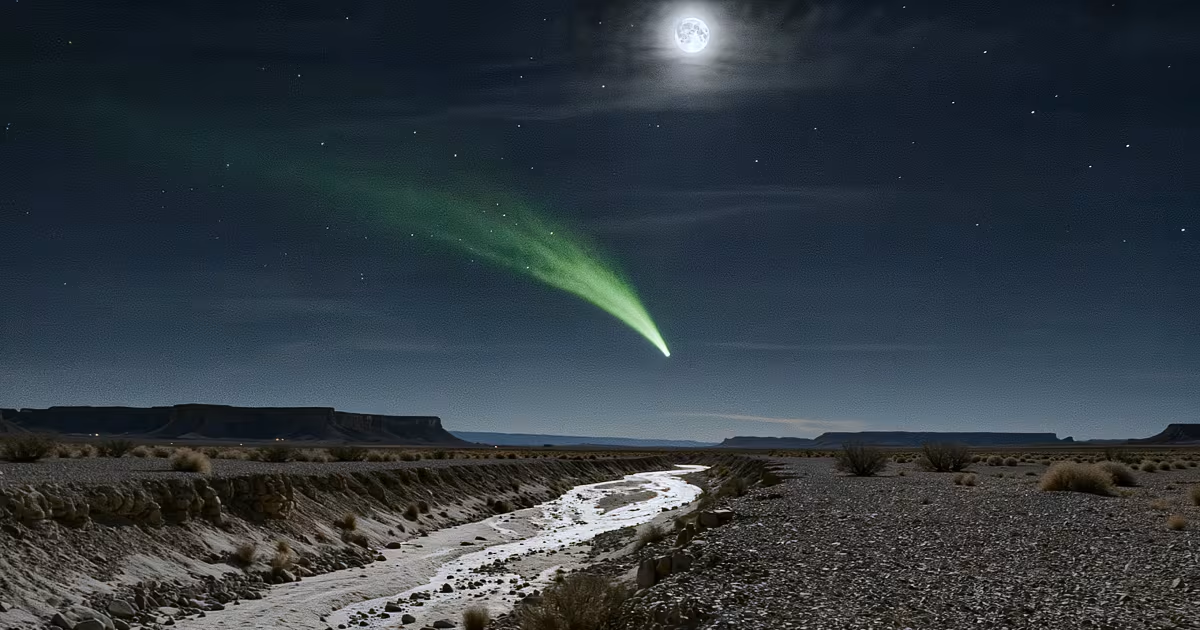
New Mexico night sky. Green streak, empty desert.
Illustration, not a period photograph.
Opening
Starting in late November 1948, residents around Albuquerque, New Mexico, began reporting a bright green light streaking low across the night sky. Air Force intelligence at Kirtland Field initially wrote the reports off as discharged soldiers' surplus flares. Then, on the night of 5 December 1948, two separate aircrews, one military, one civilian, flying roughly twenty minutes apart, independently reported a large green fireball crossing their flight paths at close range. Over the following two years, roughly 150 sightings would be logged near the two most sensitive nuclear weapons installations in the United States, Los Alamos and Sandia Base, drawing in a nuclear physicist, a meteor specialist, the FBI, and an Air Force-funded but never fully realized tracking network.
This is a case where the investigating scientists never agreed with the investigating military on what to conclude, and where that disagreement is itself documented, rather than inferred from silence.
Timeline
Late November 1948. First reports of a green streak low on the horizon near Albuquerque circulate; Kirtland Air Force Base intelligence and Project Sign personnel initially attribute them to surplus military flares.
5 December 1948, night. A military and a civilian flight crew, separated by about twenty minutes, each independently report a bright green fireball, described by one witness as appearing as big as or bigger than a full moon just before evasive action was taken. Reports pour in from across northern New Mexico overnight; by morning a full investigation is underway.
6 December 1948. Kirtland Air Force Base Office of Special Investigations agent Melvin E. Neef interviews pilots Van Lloyd and copilot James Smith, who describe the object somewhat differently on second telling, a white flash followed by a whitish-orange object, an early sign of how witness description could shift between the initial excited report and the formal follow-up interview.
Following days. University of New Mexico News Bureau head Ward Fenley drafts a public press release asking residents to report similar sightings; the release is halted before publication due to pressure from other agencies also investigating the phenomenon, an early and directly documented instance of official secrecy being imposed on what had, up to that point, been an openly discussed local mystery.
13 January 1949. The Director of Army Intelligence at Fourth Army Headquarters in Texas writes that the fireballs may represent radiological warfare experiments by a foreign power and recommends a scientific board study the situation given their concentration near sensitive installations.
17 February 1949. A conference convenes at Los Alamos, drawing Project Sign personnel, military officers, and scientists including physicist Edward Teller and atmospheric scientist Joseph Kaplan, specifically to address the fireballs. No origin is identified.
1949, later. The Air Force contracts Land-Air, Inc. to conduct scientific observation and establishes Project Twinkle, a planned network of camera and tracking stations meant to photograph and measure the objects in flight, in an effort to move past eyewitness description to instrumented data.
14 October 1949. A second Los Alamos conference is held, with representatives from Fourth Army, the Armed Forces Special Weapons Project, the University of New Mexico, the FBI, the Atomic Energy Commission, the University of California, the Air Force Scientific Advisory Board, the Air Materiel Command's Geophysical Research Division, and Air Force OSI all attending. The group reaches no explanation but formally concludes the phenomena are real and warrant continued scientific study, specifically because their recurrence near sensitive installations remains a cause for concern.
1950-1951. Project Twinkle is only partially implemented and produces limited usable data before being discontinued, with the Air Force's eventual official conclusion holding the phenomena were "probably natural" in origin, a finding LaPaz and other investigating scientists explicitly disputed.
Key figures
LaPaz is the case's central scientific figure: Director of the Institute of Meteoritics and head of the Mathematics and Astronomy department at the University of New Mexico, with wartime experience tracking Japanese Fu-Go balloon bombs and working on proximity fuze ballistics, giving him genuine, applied expertise in distinguishing natural meteoric phenomena from artificial ones. He had been Project Sign's first choice as scientific consultant in early 1948 but declined due to teaching duties, recommending his wartime colleague J. Allen Hynek instead, a detail that places LaPaz and Hynek on opposite sides of the same UFO-investigation infrastructure from its earliest days. LaPaz personally observed fireballs, analyzed dozens of reports, and concluded that at least half the observed phenomena were not of meteoric origin, going further than most contemporary investigators by suggesting an artificial, possibly foreign, source.
Teller and Kaplan represent the case's highest level of scientific attention: a nuclear weapons physicist and an atmospheric scientist, both drawn into a dedicated conference specifically to address an unexplained aerial phenomenon recurring near America's primary nuclear weapons laboratory, a level of institutional seriousness rarely matched in UFO history.
Fenley is a minor but telling figure: a university press officer whose attempt at ordinary public science communication, asking residents to report sightings, was specifically halted by other agencies' intervention, showing that official secrecy around this case was applied early and deliberately rather than emerging gradually.
Lloyd and Smith are the case's key December 5th witnesses, whose shifting description between initial report and formal interview is a genuine, documented feature of the case file rather than a later embellishment, and a useful reminder that even well-credentialed witness testimony can vary in detail across retellings taken only a day apart.
Physical and documentary trail
On the paper, this file has real institutional weight: an Army Intelligence memo raising the radiological-warfare-experiment hypothesis, minutes and attendee lists from two dedicated Los Alamos conferences, a formally chartered (if underfunded and short-lived) observation network in Project Twinkle, and LaPaz's own personal papers and case-by-case analysis, preserved and later drawn on by researchers reconstructing the case's full chronology.
What it lacks is any successful instrumented capture of the phenomenon. Project Twinkle, the one program specifically designed to generate exactly that kind of hard data, camera triangulation, trajectory measurement, was never fully implemented and produced no conclusive results before its cancellation, leaving the case's entire evidentiary weight resting on eyewitness description even after two years and considerable institutional investment aimed at doing better than that.
The continued occurrence of unexplained phenomena of this nature in the vicinity of sensitive installations is cause for concern.
Competing explanations
Ordinary meteors. This is the Air Force's eventual official position, and it has the advantage of meteors being a genuinely common, well-understood natural phenomenon. Its weakness is specific and well-documented: witnesses and investigators alike noted the fireballs' reported trajectories were frequently level and horizontal rather than following the steep, descending arcs typical of meteoric entry, and the objects were not reported leaving the debris, sound, or persistent trails ordinarily associated with meteor fireballs. LaPaz's own professional judgment, from someone whose career was built on correctly identifying meteoric phenomena, explicitly rejected this explanation for at least half the cases he examined.
Misidentified conventional flares or ordnance. Plausible for the earliest, dismissed November 1948 reports, given the genuine postwar prevalence of surplus signal flares, but this explanation was itself abandoned by investigators once sightings persisted, grew more detailed, and continued without any corresponding rise in publicity that could explain psychologically inflated reporting.
Foreign, likely Soviet, reconnaissance or weapons-testing activity. This was seriously proposed at the highest levels, by Fourth Army's own Director of Intelligence, precisely because of the phenomena's concentration near Los Alamos and Sandia. It was never confirmed by any subsequent evidence of an actual Soviet program capable of producing the observed effects, and remains speculative rather than established.
A genuine, unexplained atmospheric or aerial phenomenon. This is effectively where the case's own most senior investigating body left it: the October 1949 conference's formal conclusion affirmed the phenomena were real and warranted continued study without endorsing any specific cause, a rare instance of an official UFO-adjacent inquiry declining to force a premature conventional explanation onto the record.
Later life of the case
The green fireballs remain a frequently cited example, within serious UFO historiography, of a case where genuine scientific concern (drawing in figures like Teller and a dedicated Institute of Meteoritics director) coexisted with an ultimately underfunded and incomplete investigative effort. LIFE magazine reproduced a firsthand eyewitness painting of a fireball sighting by LaPaz's own wife in 1952, a small but telling sign of how far the case had traveled from a discharged-soldier's-flare dismissal to a subject serious enough for national coverage within four years.
Finding
A real, sustained cluster of green aerial fireball sightings occurred near America's most sensitive nuclear installations between late 1948 and 1950, taken seriously enough to draw a nuclear physicist, a professional meteor specialist, the FBI, and two dedicated scientific conferences into the investigation. The case's own leading meteor expert explicitly rejected the ordinary-meteor explanation for at least half the reports he examined, and the dedicated instrumented observation program built specifically to settle the question was never properly completed.
What still will not resolve: any confirmed cause, natural or artificial, for the phenomena LaPaz judged non-meteoric, since Project Twinkle's failure to fully deploy means the case closed on an administrative decision to stop looking rather than on a scientific finding that explained what had been seen.