DEXTER-HILLSDALE
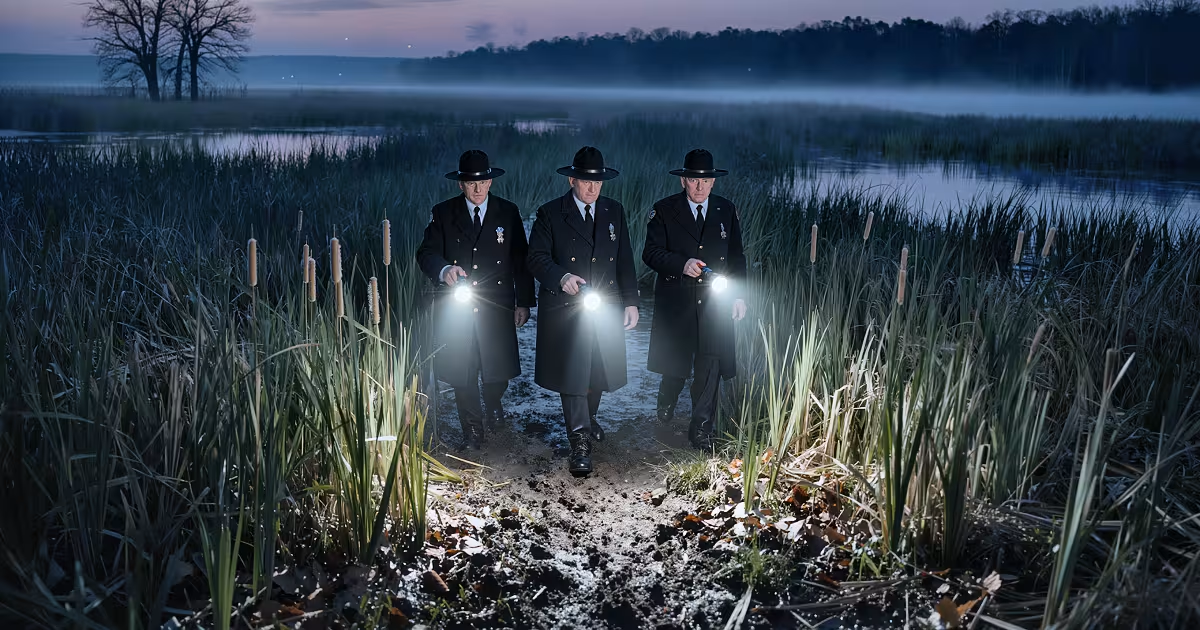
Three sheriff's deputies with torches searching a marsh at night.
Illustration, not a period photograph.

Opening
On the evening of 20 March 1966, Frank Mannor, his wife and his son Ronald saw a glowing object settle over a marshy patch near their farm outside Dexter, Michigan. Police officers who arrived reported lights in the swamp. The next night, 87 women at Hillsdale College, about 60 miles away, watched flashing lights over the college arboretum for more than three hours.
On 25 March the Air Force sent its consultant, the astronomer J. Allen Hynek, to explain the sightings to a packed press conference in Detroit. He offered marsh gas as a possible cause. The papers turned it into "swamp gas", and the phrase became a national joke, a congressional issue and, in the end, the reason the Air Force paid for a two-year scientific study.
Timeline
14 March 1966Police in Washtenaw County report fast-moving lights in the early morning, the start of a week of reports across southern Michigan.
20 March, about 8:30pmThe Mannors' dogs start barking. Frank and Ronald walk towards the swamp and say they got within about 500 yards of a football-shaped object with a quilted surface, pulsing red and green. Deputies Stanley McFadden and David Fitzpatrick search the marsh on foot. Patrolman Robert Hunawil reports an object passing over his car. About a dozen officers and some 60 people in total say they saw something.
21 March, about 9pmResidents of MacIntyre Residence Hall at Hillsdale College watch lights over the arboretum and take notes. Hillsdale County civil defence director William Van Horn sees the lights through binoculars.
25 MarchHynek speaks to about 60 reporters at the Detroit Press Club and proposes marsh gas from decaying vegetation for both locations.
28 MarchCongressman Gerald Ford, House Minority Leader and a Michigan representative, calls for a congressional investigation of the sightings.
April 1966The House Armed Services Committee holds a hearing. Hynek tells it that some UFO reports merit serious scientific study.
October 1966The Air Force contracts the University of Colorado, under the physicist Edward Condon, to study UFOs.
Key figures
Frank Mannor gave the closest-range account and the most detailed description of a structured object.
The Hillsdale College women were the largest group of witnesses, and they watched for hours rather than seconds.
William Van Horn was the civil defence official who backed the Hillsdale witnesses, and who publicly rejected Hynek's suggestion that pranksters with flares might be involved.
J. Allen Hynek was the Air Force's scientific consultant for Project Blue Book. The press conference followed him for the rest of his career.
Gerald Ford turned a local embarrassment into a national inquiry. Eight years later he was president.
Physical and documentary trail
The trail: Blue Book's case material, Hynek's statement to the press, newspaper coverage including a police sketch drawn by Corporal David Severance from witness accounts, Ford's press release, the April 1966 hearing, and the Condon Report's later treatment. A photograph taken by Deputy Fitzpatrick was dismissed by Hynek as a time exposure of the Moon and Venus. There is no physical trace, and no instrument reading taken in the swamp that night.
Things you might not know
- Hynek said marsh gas. He offered it as a plausible explanation. The press shortened it to "swamp gas", and that is the version that stuck.
- The sheriff was not convinced. Washtenaw County Sheriff Douglas Harvey called it a weak excuse, and four decades later still remembered the statement as very strange.
- The witnesses kept notes. The Hillsdale women wrote down what they saw as they watched, which is rare for a mass sighting.
- A future president asked the questions. Gerald Ford's call for hearings came three days after the press conference.
- It changed Hynek's mind in public. In 1972 he wrote that swamp gas had become a household word and a standard humorous synonym for UFOs. The same year he introduced the "close encounter" categories.
- He made it into Spielberg's film. Hynek consulted on Close Encounters of the Third Kind (1977) and has a cameo in it.
Competing explanations
Marsh gas. Hynek's case was that spring thaw releases methane from rotting vegetation, which can ignite and glow briefly near the ground. Both sightings were over wet ground, and some of the lights were described as low and flickering.
Something structured and unknown. Mannor's quilted surface, the object passing over a patrol car, and three hours of observation at Hillsdale do not sit easily with marsh gas, which flickers for seconds rather than hovering for hours.
Ordinary lights and hoaxers. The Condon Report later judged the Mannors too far away to see detail, and put the Hillsdale lights down to pranksters with flares, though it named no prankster.
Later life of the case
The sightings did more to change official UFO policy than almost any other case. Ford's pressure led to the Condon study, and the Condon Report was used to close Blue Book in 1969. Hynek himself moved from consultant to advocate, founding the Center for UFO Studies in 1973.
Finding
Dozens of people, including police officers and a civil defence director, saw lights in two places on consecutive nights in March 1966, and the official explanation was offered within days, before anyone could test it. Marsh gas may cover some brief low lights. It does not account well for what Mannor described or for three hours of observation at Hillsdale, and the flare explanation came with no names attached.
What still will not resolve: Blue Book's own case notes against the witnesses' statements, and any evidence of the flares that Condon's team said explained Hillsdale.
Evidence signature
6/9 Solid
- Witnesses
- trained, independent witnesses
- Instruments
- nothing on record
- Paper
- formal investigation, court or declassified file
How well documented the case is, not whether it's true. A strong record can still have an ordinary answer, and a thin one can still be real.
You decide · DEXTER-HILLSDALE
What do you think happened?
One vote per case, anonymous. You'll see how other readers voted once you've voted.