LUBBOCK LIGHTS
1951 Texas night street. Empty, no lights in sky.
Illustration, not a period photograph.
Opening
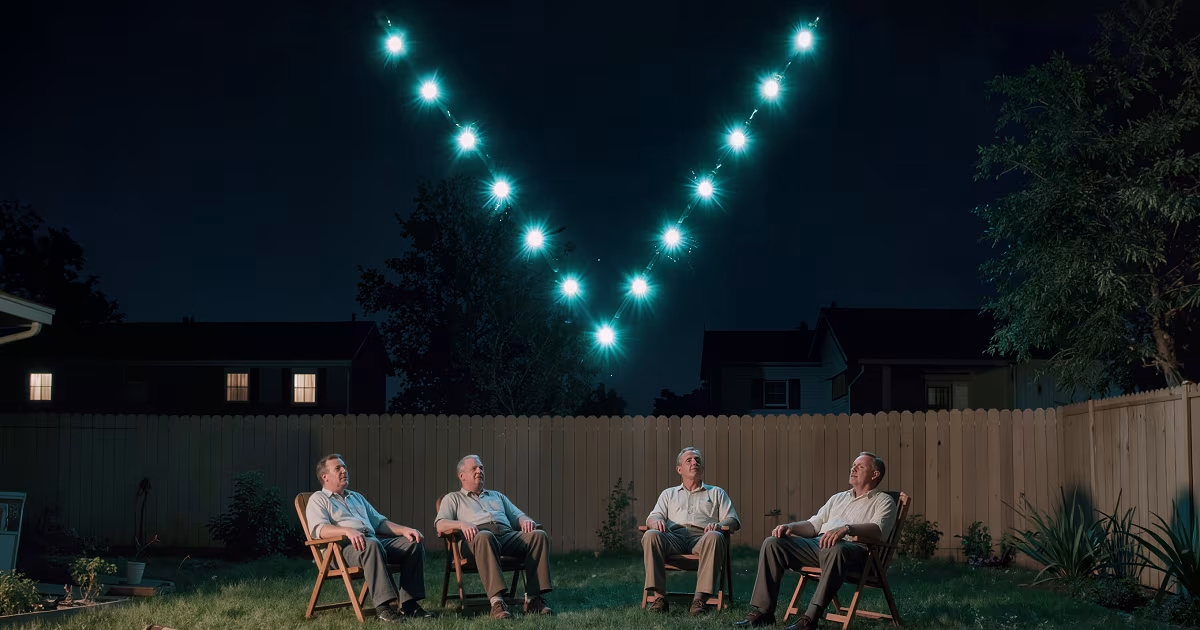
Around 9:20 p.m. on 25 August 1951, four Texas Technological College professors, sitting in geologist W. I. Robinson's backyard discussing micrometeorites, watched a loose, semicircular formation of twenty to thirty soft, bluish-green lights sweep overhead from north to south at high speed and in complete silence. As Edward Ruppelt, who later ran Project Blue Book, put it: "if a group had been hand-picked to observe a UFO, we couldn't have picked a more technically qualified group of people." Over the following three weeks, similar formations were reported repeatedly by hundreds of Lubbock residents, and on 30 August, a Texas Tech freshman photographed a formation directly, producing the first widely published photographs claimed to show a genuine UFO in American history.
This case has an unusual structure worth noting up front: the professors' verbal sightings and Carl Hart's photographs are, on the professors' own later assessment, not necessarily the same phenomenon, a distinction the popular retelling routinely collapses.
Timeline
25 August 1951, approximately 9:20 p.m. Robinson, chemical engineer A. G. Oberg, petroleum engineering department head W. L. Ducker, and a fourth colleague observe the first formation; they explicitly rule out meteors given the lights' shape, group behavior, and silence. A second, similarly configured group passes overhead about an hour later while the men are still discussing the first.
Same night, independently. German professor Carl Hemminger and three women in Lubbock separately report peculiar flashing lights the same evening, unaware of the professors' sighting.
Following days. Reports multiply rapidly across Lubbock: housewives, airmen, farmers, and students all describe the same basic pattern, a silent, fast-moving arc or V of lights crossing the sky, sometimes ten to twenty at once. Mathematics professor R. S. Underwood attempts a triangulated altitude and speed estimate, calculating roughly 2,000 feet and 750 mph, an estimate later investigators treat cautiously given the inherent difficulty of triangulating a fast-moving nighttime light from an untimed, uninstrumented ground position.
31 August 1951. An Air Force officer's wife and daughter report seeing a UFO while driving toward Lubbock from Matador the same night a nearby Air Defense Command radar station separately reports detecting an unidentified object at roughly 13,000 feet traveling at approximately 900 mph, giving the case one of its few instrumented, non-visual data points.
30 August 1951, around 9 p.m. (some sources date Hart's photographs to this night, others to the 31st). Carl Hart Jr., an eighteen-year-old Texas Tech freshman, lying in bed near an open window watching for the lights, sees a formation appear, grabs his 35mm Kodak, and runs to the yard, capturing five photographs of a passing group before they vanish. Some of the resulting images show what looks like a larger, more diffuse light trailing the tighter formation, a detail some later observers read as a possible "mother ship" and others as lens flare or reflection.
Following days. The Lubbock Avalanche-Journal publishes Hart's photographs; they are quickly picked up nationally and run in Life magazine, making Lubbock briefly a center of national UFO attention.
September 1951. The Robinson group of professors examines Hart's photographs directly and, notably, states that the lights shown do not match what they themselves saw on 25 August and afterward, a detail that significantly complicates any single unified explanation for "the Lubbock Lights" as one phenomenon.
Late September 1951. The case formally reaches the Air Force. Ruppelt travels to Lubbock, interviews the professors, Hart, and numerous other witnesses, and has the photographs examined in detail; the Air Force's photographic analysis finds no evidence of deliberate fakery but stops short of a positive identification, officially stating it could neither prove nor disprove the photographs' authenticity as depicting a genuine unconventional phenomenon.
Ruppelt's investigation. He interviews a rancher near Brownfield who reports hearing "the unmistakable call of the plover" at the same time lights were seen, and later favors migratory plovers, birds with pale undersides capable of reflecting Lubbock's newly installed municipal street lighting, as his leading explanation for the professors' original verbal sighting specifically. Other witnesses offer competing bird identifications, including a flat claim from one interviewee that "it definitely was ducks," and plovers' typically smaller flock sizes are noted by some as a weak point in the theory.
Later assessment. Ruppelt's own book records that officially, all of the Lubbock sightings except the one radar detection are classified as unknowns, the radar case apparently having been separately identified or discounted on its own terms rather than folded into the general plover explanation.
Key figures
Robinson, Oberg, Ducker, and their unnamed fourth colleague are the case's foundational witnesses, whose professional scientific training gave their account, and their explicit rejection of both the meteor explanation and, later, the equivalence of Hart's photographs to their own sighting, unusual credibility and unusual internal nuance for a UFO case of this era.
Hart is the case's photographic witness, an eighteen-year-old whose five images became the most widely circulated UFO photographs of their decade, subjected to detailed Air Force analysis that found no evidence of fakery without confirming what they actually depicted.
Ruppelt is the case's central investigating officer, and his own plover hypothesis is more measured in its actual scope than popular retellings often suggest: it addresses the professors' verbal sighting specifically, given the Brownfield rancher's independent bird-call testimony, without necessarily explaining Hart's separately assessed photographs, which the professors themselves distinguished from what they had witnessed.
The unnamed Air Force officer's wife and daughter, and the separate radar operators who logged an object the same general period, represent the case's least-examined thread: an instrumented detection running roughly parallel to the visual reports, treated by Ruppelt's own accounting as distinct from, and not resolved by, the general bird explanation.
Physical and documentary trail
On the paper, this file has genuinely unusual documentary weight for an early Blue Book case: multiple independent scientifically trained witnesses, a physical photograph set subjected to formal Air Force analysis and found not to show evidence of deliberate fakery, at least one independent radar detection in the same general window, and Ruppelt's own detailed, published, and notably candid investigative account distinguishing between the case's different evidentiary strands rather than flattening them into one finding.
What it lacks is a single explanation covering all of it. The plover theory, however well it may fit the original professors' description alongside the Brownfield witness's bird-call testimony, was never claimed by Ruppelt or anyone else to explain Hart's photographs, which the professors themselves said did not match their own sighting, leaving the photographs formally unresolved even under the explanation most commonly cited as having "solved" the case.
If a group had been hand-picked to observe a UFO, we couldn't have picked a more technically qualified group of people.
Competing explanations
Migratory plovers reflecting new municipal street lighting. This is Ruppelt's own leading explanation for the original professors' sighting, supported by an independent witness's bird-call testimony and Lubbock's documented 1951 street-lighting upgrade, a real, dateable civic change that provides a plausible new light source birds could have begun reflecting that specific season. Its weakness is scope, plovers typically fly in smaller groups than the twenty-to-thirty-light formations described, and the professors' own comparison of Hart's photographs to their sighting suggests even they did not consider one explanation sufficient for everything attributed to "the Lubbock Lights."
An unidentified aerial phenomenon, potentially structured and craft-like. This reading is bolstered by the professors' explicit, trained rejection of mundane explanations for their own sighting, by the independent radar detection Ruppelt's own book classifies separately from the bird explanation, and by the Air Force's own photographic analysis finding no evidence Hart's images were faked.
A hoax or misidentification specific to Hart's photographs. Given the professors' own stated view that the photographed lights did not match what they saw, and given the photographs' commercial and media windfall for a young amateur photographer, some skeptics have proposed the images represent a separate, possibly staged event rather than a genuine capture of the same phenomenon reported by hundreds of other witnesses; the Air Force's own contemporary analysis, however, did not find technical evidence supporting fakery.
Mass excitement following genuine but mundane initial sightings. Given the scale of subsequent reporting once the story went national, some of the hundreds of later Lubbock-area sightings plausibly reflect ordinary aircraft, stars, or other conventional stimuli reinterpreted through the lens of a story already in every local paper, a pattern common to UFO flaps generally and not unique to this case.
Later life of the case
The Lubbock Lights remain one of the most frequently cited early UFO photograph cases specifically because the photographs survived formal government technical analysis without being declared fake, a comparatively rare outcome. Ruppelt's own published distinction between the professors' sighting, the photographs, and the radar detection, treating them as related but evidentially separate strands rather than one unified mystery with one unified solution, remains an unusually careful piece of period UFO investigation literature, and a useful corrective against later popular tellings that treat "plovers" as having closed the entire case.
Finding
Four professionally trained, skeptically minded witnesses reported a specific, repeatable aerial light pattern they explicitly distinguished from known natural phenomena, a pattern potentially explained by migratory birds reflecting new city lighting. Separately, a widely published photograph set survived formal Air Force technical scrutiny without being confirmed as fake, and an independent radar detection in the same general period was never folded into any single explanation. The professors' own comparison of the photographs to their sighting suggests the "Lubbock Lights" may never have been one single phenomenon at all.
What still will not resolve: a confirmed identification for Hart's specific photographs, which the case's own most credible original witnesses did not think matched what they themselves saw, and the radar detection Ruppelt's own book leaves outside the general bird explanation. Until those two threads are separately addressed rather than folded into the plover story, this case stays only partially, not fully, explained.