TRINDADE
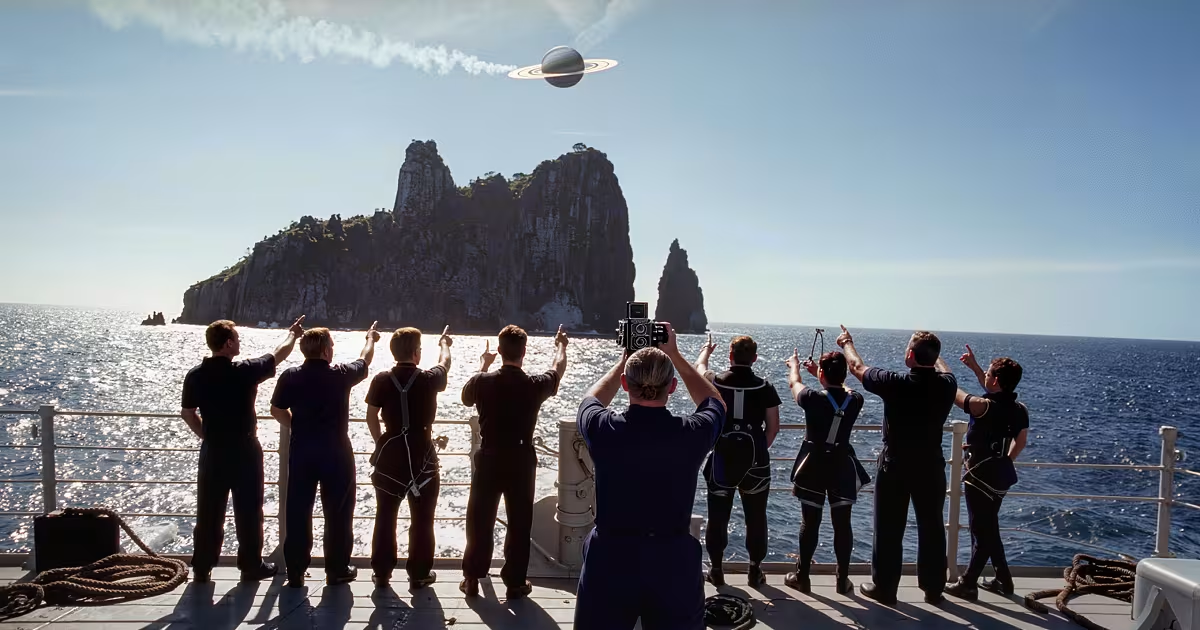
1958 ship deck. South Atlantic island astern, empty sky.
Illustration, not a period photograph.
Opening
At around 12:15 p.m. on 16 January 1958, as the Brazilian Navy hydrographic vessel Almirante Saldanha prepared to depart Trindade Island in the South Atlantic after supporting International Geophysical Year research, a dark, glittering, ring-shaped object surrounded by a greenish haze approached the island, passed behind its central peak, and departed at high speed, all within one to two minutes. Somewhere between 47 and roughly 100 people aboard, out of a crew and passenger complement of some 300, reported seeing it. A civilian photographer aboard, Almiro Barauna, captured six frames on film, developed aboard ship in a makeshift darkroom, that would become some of the most fought-over UFO photographs of the twentieth century.
This case carries an irony too good for any UFO researcher to have invented: Barauna had, before this trip, previously demonstrated in print how a convincing fake flying saucer photograph could be manufactured, a fact that has cut both ways in the decades of argument that followed, either proof he knew exactly how to fake his own photos, or proof that a man who had already shown off his faking technique in public had no obvious reason to reuse it under his own name months later.
Timeline
Early December 1957 through mid-January 1958. Navy personnel and civilian workers stationed at the Trindade Island weather post, established as part of Brazil's contribution to the International Geophysical Year, report several earlier unusual aerial sightings in the weeks before the main event, establishing that the island had a documented pattern of anomalous reports prior to Barauna's photographs specifically.
16 January 1958, approximately 12:15-12:20 p.m. As the Almirante Saldanha, under the command of Captain José Saldanha da Gama, prepares to depart with roughly 300 aboard, an object is sighted simultaneously by a large number of observers on deck, variously reported as 47 to around 100 depending on the source. Barauna, a professional photographer specializing in underwater work and a civilian invited aboard along with a small group including lawyer Amilcar Vieira Filho and retired Air Force captain José Teobaldo Viegas, captures six photographs as the object approaches, passes behind the island's central peak, and departs.
Same day. The film is developed aboard ship in an improvised darkroom, with witnesses present during the development process, a detail later cited by supporters as reducing the opportunity for the specific double-exposure fakery scenario skeptics would later propose.
Following the ship's return to port. The photographs and film are handed over to the Brazilian Navy Ministry for analysis. Navy technical analysts examine the negatives and conclude, in a report initially kept confidential, that the images are authentic and show an object roughly 50 feet in diameter moving at an estimated 600 mph.
21 February 1958. Brazilian newspapers Correio da Manhã and O Jornal publish the photographs, released to the press with the authorization of Brazilian President Juscelino Kubitschek after the Navy's initial secrecy. The Navy Minister, Admiral Alves Câmara, and other high-ranking officials are quoted publicly vouching for the photographs' authenticity.
Following months. The case draws international attention, with the photographer interviewed at length by journalist João Martins and by International UFO Reporter, and the Navy's technical findings circulated through UFO research channels including NICAP.
Harvard astronomer Donald Menzel's evolving position. Menzel initially proposes the object was an aircraft seen through fog, then, in his first book devoted to debunking UFO claims, revises his position to argue the photographs were deliberately faked, specifically that Barauna had earlier photographed a small model UFO at home and later double-exposed the same roll of film with shots of the open sky over Trindade.
1971. A previously secret Brazilian Navy technical report authenticating the photographs, originally never published domestically, surfaces in an Argentine magazine article by researcher Jorge C. Pineda, adding a documented institutional authentication to the public record well after the fact.
Later analysis. Photo analyst Martin J. Powell conducts a detailed technical study of the first two photographs specifically, examining shadow angles, object positioning, and other geometric details against the ship's and sun's documented positions at the time, without reaching a fully conclusive verdict either way.
Recent decades. The Trindade photographs are cited as one of a small number of cases selected for inclusion in a report compiled for senior government officials specifically highlighting the strongest available photographic evidence for genuinely anomalous aerial craft, a sign of the case's continued standing among researchers as one of the more technically substantial photographic cases on record.
Key figures
Barauna is the case's central and most contested figure: a credentialed professional photographer with specific underwater and technical photography expertise, whose prior public demonstration of flying-saucer photo fakery is the single detail skeptics return to most often, and whose supporters counter that a demonstrated fakery expert publicly showing his own methods beforehand is an unusual choice of cover story for someone planning a hoax under his own name.
Saldanha da Gama and the Almirante Saldanha's roughly 300-person crew and passenger complement represent the case's central strength: a very large potential witness pool aboard a naval vessel, with a substantial fraction independently reporting the same sighting within the same brief window, a scale of corroboration few UFO photograph cases can match.
Kubitschek and Câmara are notable for the degree of official Brazilian government engagement the case drew, a sitting president personally authorizing photograph release and a Navy minister publicly vouching for authenticity, a level of high-level institutional involvement unusual even among the more prominent UFO cases of the era.
Menzel is the case's most prominent and specific skeptical voice, whose own position notably shifted over time, from a fog-and-aircraft misidentification theory to a specific double-exposure fakery claim, a change some critics note weakens rather than strengthens his overall case, since it suggests his first explanation did not survive scrutiny.
Powell represents the case's more recent technical middle ground, applying detailed photogrammetric analysis without reaching the kind of confident conclusion either committed believers or committed skeptics have offered.
Physical and documentary trail
On the paper, this file has an unusually strong combination: a very large witness pool aboard a naval vessel, film developed aboard ship with witnesses present during processing, an official (if initially secret) Brazilian Navy technical authentication report, president- and minister-level public endorsement, and a paper trail extending from 1958 through a 1971 secret-report disclosure and into detailed modern technical re-analysis.
Against that sits the specific, technically plausible fakery method Menzel proposed, one that a photographer with Barauna's documented prior interest in and demonstrated skill at producing fake saucer images would have been well positioned to execute, though the aboard-ship development process, if accurately reported, would have significantly complicated the specific double-exposure method Menzel described.
The pictures were authentic.
Competing explanations
A deliberate hoax by Barauna, using a model and double exposure. Menzel's specific, later-adopted theory has the advantage of drawing on Barauna's own documented prior expertise and public demonstration of exactly this kind of fakery. Its weakness is the reported witness presence during aboard-ship film development, which would have made a private double-exposure substitution considerably harder to pull off undetected than in a simpler, unsupervised darkroom scenario.
Misidentified aircraft or natural atmospheric phenomenon seen through fog or haze. This was Menzel's own earlier, since-abandoned position, and its abandonment by its own original proponent is itself a data point against it, though it has not been definitively ruled out by any independent technical study since.
A genuine unconventional aerial object. This remains the reading best supported by the sheer scale of independent witness corroboration aboard a single vessel, the Navy's own technical authentication (however delayed in public release), and the high-level Brazilian government officials willing to publicly vouch for the photographs' legitimacy, a degree of institutional confidence that would represent an unusual risk to stake on a photograph later provably faked.
Later life of the case
Trindade remains one of the most frequently cited "hard" UFO photograph cases specifically because of its combination of a large ship-based witness pool and an official government technical authentication, a combination matched by few other photographic cases on record. Its continued inclusion in modern compilations of the strongest available UFO photographic evidence, decades after the original sighting, reflects that comparatively strong evidentiary standing relative to most single-photographer, single-witness cases.
Finding
A large number of independent witnesses aboard a Brazilian naval vessel reported the same brief sighting, a professional photographer captured it on film developed aboard ship with witnesses present, and Brazil's own Navy technical analysts, in a report initially kept secret before surfacing in 1971, concluded the photographs were authentic. Set against that is a specific, technically detailed fakery theory resting on the photographer's own documented prior demonstrated skill at producing exactly this kind of fake image, a genuine and serious point against him that the aboard-ship development circumstances only partially address.
What still will not resolve: definitive confirmation or refutation of Menzel's double-exposure theory against the specific, reported conditions of the film's aboard-ship development, and no fully conclusive modern technical re-analysis has settled the question either way. Until one does, Trindade remains one of the strongest witness-corroborated UFO photograph cases on record, and also one of the few where the leading suspect for a hoax is the photographer's own prior public résumé.