KAIKOURA
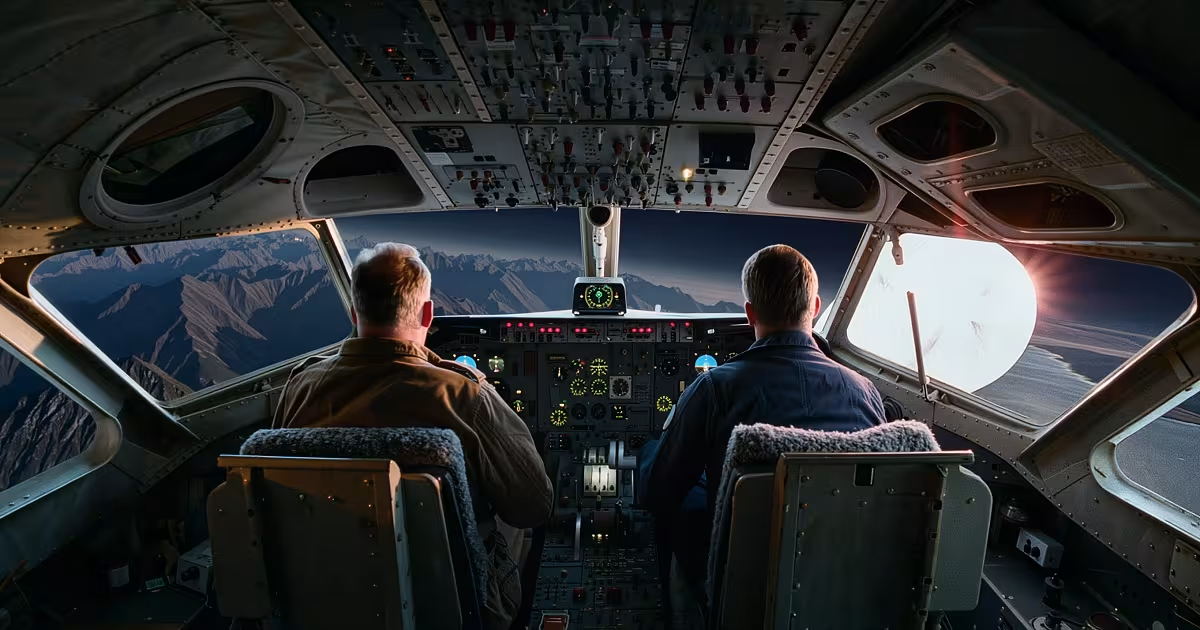
Two pilots in a cargo plane cockpit at night, a bright light outside.
Illustration, not a period photograph.

Opening
Late on 30 December 1978, a Safe Air Argosy freighter on a newspaper run along New Zealand's east coast took off with a television crew aboard. They were there to film a story about unexplained lights an Argosy crew had reported near Kaikoura ten nights earlier. On this flight the pilots saw lights too, and Wellington air traffic control reported radar targets near the aircraft.
Cameraman David Crockett filmed bright lights through the cockpit windows, on the way south and again after a 2:16 a.m. departure from Christchurch. The footage went round the world within days. It remains one of the few cases where film, ground radar, and trained aircrew overlap, though never quite at the same moment.
Timeline
20 to 21 December 1978Wellington air traffic control picks up small unidentified targets off Blenheim, towards Cape Campbell. In the early hours of 21 December, Captain Vern Powell and First Officer Ian Pirie of Safe Air report lights matching targets on Wellington radar. Two Argosy flights are asked to check the Clarence River area; one crew has the impression of lights moving in rectangular patterns, the other sees nothing.
25 DecemberWellington radar shows unusual returns over the Clarence River area, at the same time as a crew in an aircraft reports a red light.
30 December, 23:46The Argosy, flown by Captain Bill Startup and First Officer Bob Guard, leaves on a run that will take it to Christchurch and back to Blenheim. Aboard are Quentin Fogarty, an Australian reporter for Melbourne's Channel 0, cameraman David Crockett, and his wife Ngaire Crockett as sound recordist. South-east of Cape Campbell the pilots see lights towards Kaikoura. Wellington reports targets near the aircraft, at one point a target alongside it for at least half a minute.
31 December, 01:01The Argosy lands at Christchurch. The Christchurch radar operator tells the crew he saw an anomalous target that did not impress him much. Ngaire Crockett stays behind; Dennis Grant, a Christchurch reporter, joins the return flight.
31 December, about 02:19Climbing out through low cloud, the crew see a bright yellow, white, and orange light to the right. Startup's own radar, in ground-mapping mode, shows a return he judges three to five times bigger than a large fishing boat. Crockett films. Startup turns about 90 degrees towards the light; it does not end up dead ahead, and it falls behind as he turns back. Christchurch and Wellington radar report nothing during this sequence. The Argosy lands at Blenheim at about 03:10.
Early January 1979The film airs internationally. The Royal New Zealand Air Force investigates, with help from the Department of Scientific and Industrial Research (DSIR).
8 to 9 January 1979DSIR staff photograph the Wellington radar screen through the night while observers watch the coast. Several times, when large returns paint on the radar, the coastal observers see nothing in the air or on the sea at the positions given.
1982Fogarty publishes Let's Hope They're Friendly! (Angus & Robertson).
22 December 2010The New Zealand Defence Force releases its UFO files from 1952 to 2009, including the RNZAF report and a copy of Bruce Maccabee's analysis.
Key figures
Captain Bill Startup and First Officer Bob Guard flew the 30-31 December flight and knew the route well. Startup made the turn towards the light.
Quentin Fogarty narrated into a recorder as it happened. David Crockett shot the film. Dennis Grant, on the return leg, was the only person who took written notes during the sightings, according to Maccabee.
Vern Powell and Ian Pirie were the crew whose 21 December sighting brought the TV team aboard.
Bruce Maccabee, an optical physicist, wrote the most detailed defence of the case, "What Really Happened in New Zealand", for the New Zealand UFO Studies Centre, working from eight witnesses and the film.
Physical and documentary trail
The record includes Crockett's film, Fogarty's taped commentary, Grant's notes, Wellington and Christchurch air traffic control accounts, the RNZAF report, the DSIR radar observations of January 1979, and Maccabee's analysis.
The aircraft radar detail matters. On the return leg it was in ground-mapping mode, which looks at the surface below and ahead. A return there points to something at or near sea level as readily as to something in the air.
I've had quite enough of UFOs for one night.
The central difficulty is timing. Ground radar targets came mostly on the southbound leg; the most famous filmed light came on the return leg, when neither ground station saw anything.
Things you might not know
- The controllers joked about Santa. When the first small targets appeared off Blenheim around 20 December, Wellington controllers joked it was Father Christmas.
- The last light of the night may have been an airfield. Maccabee's report notes that the last flashing light Fogarty described, near Blenheim, may have been the Blenheim airfield beacon.
- Venus hadn't risen yet. The RNZAF linked the 2:25 a.m. sighting to Venus, which did not rise until about 3:28. DSIR scientists said strong refraction could make it visible early.
- Maccabee put the light at least 16 km away. Even so, Fogarty recalled looking almost straight down on it, and Startup was sure he passed over it.
- Maccabee checked that the film was continuous. It runs from airport lights and cockpit shots to Fogarty at Christchurch airport to the lights, which he took as evidence it was not a hoax.
Competing explanations
Fishing boat lights. The RNZAF noted that an unusually large number of vessels had sailed from Wellington, often at night, to fish off Banks Peninsula. Squid boats use very bright lamps, and their glow on cloud or sea can look like a light in the sky. The ground-mapping radar return on the return leg fits a surface source.
Venus seen through strong refraction. The RNZAF's explanation for the light during the turn, on bearing and appearance. It does not explain a radar return.
Spurious radar. The RNZAF concluded the Wellington returns off the east coast were unreliable, and controllers told investigators returns in the Clarence area had been anomalous for months. The DSIR's January observations support that. A DSIR ionosphere specialist, Robert Unwin, said publicly that ionospheric conditions could not explain the radar sightings, though the RNZAF's case rested on lower-atmosphere refraction, a different mechanism.
Unknown objects. Maccabee argued that the brightness, size (20 metres or more), and duration (over twelve minutes) of the return-leg light set hard conditions for any conventional source, and that radar and visual sightings coincided at points on the southbound leg.
Later life of the case
Kaikoura is New Zealand's best-known UFO case. The 2010 file release put the RNZAF's reasoning and Maccabee's report side by side in public for the first time, and the case gets new coverage on its anniversaries.
Finding
Settled: on 21 and 30-31 December 1978, experienced aircrew saw bright lights off the Kaikoura coast, Wellington radar recorded targets near the aircraft on several occasions, and a professional crew filmed lights on continuous footage. Fishing boat lights, a refracted Venus, and a Wellington radar shown to be throwing false returns explain much of that record. They don't neatly explain all of it, because the radar targets and the filmed lights rarely line up.
What still will not resolve: a one-to-one match between a specific radar return and a specific filmed light. Without it, the case can't be closed in either direction.
Evidence signature
8/9 Strong
- Witnesses
- trained, independent witnesses
- Instruments
- more than one sensor agrees
- Paper
- official records at the time
How well documented the case is, not whether it's true. A strong record can still have an ordinary answer, and a thin one can still be real.
You decide · KAIKOURA
What do you think happened?
One vote per case, anonymous. You'll see how other readers voted once you've voted.