WARMINSTER
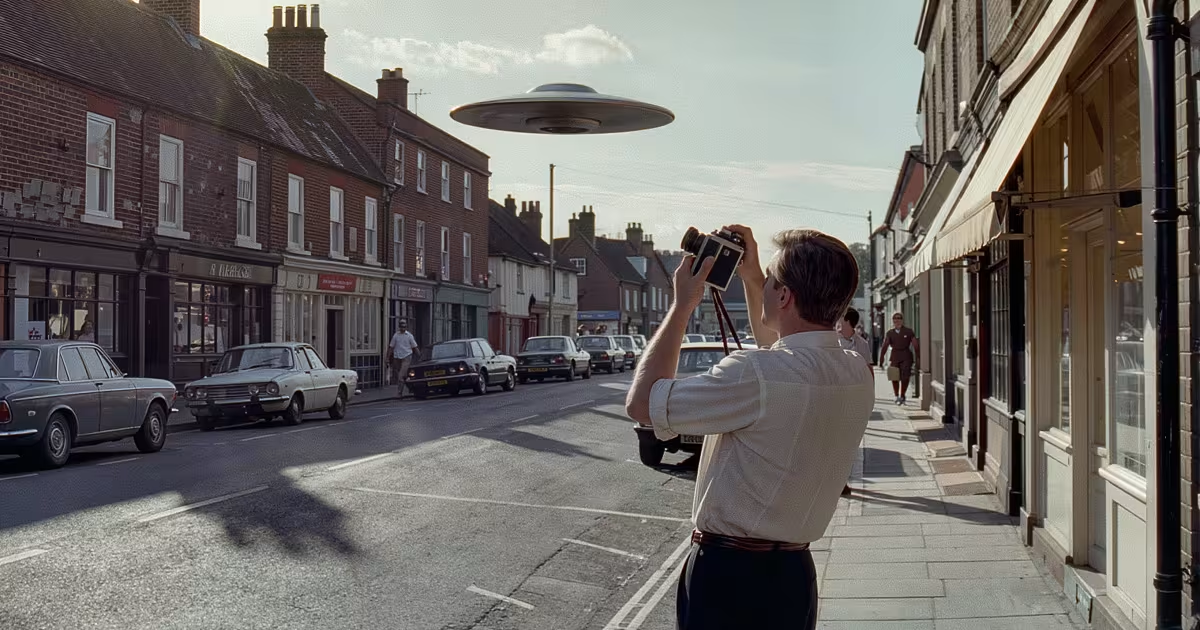
Wiltshire market town skyline 1965. Empty sky.
Illustration, not a period photograph.
Opening
Warminster, Wiltshire, spent 1965 as a town that looked at the sky. Arthur Shuttlewood wrote the nights. Gordon Faulkner's still of a dark object, printed in the Warminster Journal, became the picture the wave pinned to a lamp-post. The town already sat near ranges and a white horse. That is weather. The 1965 cluster is why the name left the county.
Later Warminster became a pilgrimage and then a joke about a journalist who could not stop. Keep the first still and the first winter separate from the later inn talk.
The spine of the file is a Wiltshire still and a year of reports. Warminster is Faulkner's frame. It is not a landing on the Plain that a unit logged.
Timeline
1964-65 first noises and lights. 1965 Faulkner's still. Shuttlewood's columns.
Weekend skywatchers arrive. The town becomes a destination.
Later books and a thinning of the first winter's grain. Those books are later life.
The Journal still is first for the picture. The first winter is first for the wave.
1965 is a winter of calls before the town became a weekend. Faulkner's still in the Journal is why a Wiltshire wave has a picture and not only Shuttlewood's columns. Ranges sit next door. They do not own the print unless a log says so.
The first nights and the first still have to live before the inn talk. A market town looking up is a civic object. A later pilgrimage is a second tray.
Key figures
Gordon Faulkner owns the still.
Arthur Shuttlewood owns the columns that named the wave.
Town witnesses own the 1965 nights before the inn filled.
The ranges own the mundane door.
Physical and documentary trail
On the paper, 1965 gives you four hard objects and no unit wreck.
One: clustered Warminster reports that year.
Two: Faulkner's photograph in the Journal.
Three: Shuttlewood's contemporary columns.
Four: the later pilgrimage. Gordon Faulkner photograph, Warminster Journal, 1965, is the originating picture tray.
There is no second still from the same minute. There is no range log that claims the object as a known round. There is no landing pit the council kept.
A Journal still and a year of reports are the stay-behinds. A second camera on Faulkner's minute would finish the picture. A range log that owns the object would finish the other door.
There is no council pit. There is no unit wreck. The print is still the print.
I photographed what was over the town.
Competing explanations
A wave of unknown lights over a Wiltshire town. This is 1965. It has a still. It has columns.
Ranges, aircraft, a journalist's weather. The mundane door. Has to carry the first winter before the inn.
A hoaxed still that then grew a town. Possible for the picture. Not for every early report.
Hybrid caution. A town looked up. A paper printed a frame. Morning had no wreck on the Plain.
Later life of the case
Pilgrimage years and later jokes. I keep those on the later-life shelf. The Journal still stays first.
Finding
Warminster spent 1965 reporting lights, and Gordon Faulkner's still in the Journal is the picture that wave kept. Believe the first winter. A market town does not invent a year of looking only for a later inn.
What still will not resolve: a second camera on Faulkner's minute, or a range log that owns the object. Either one would pin the still. The proving object is still that shape over the town, held as craft or as trick by more than one county print.