LEVELLAND
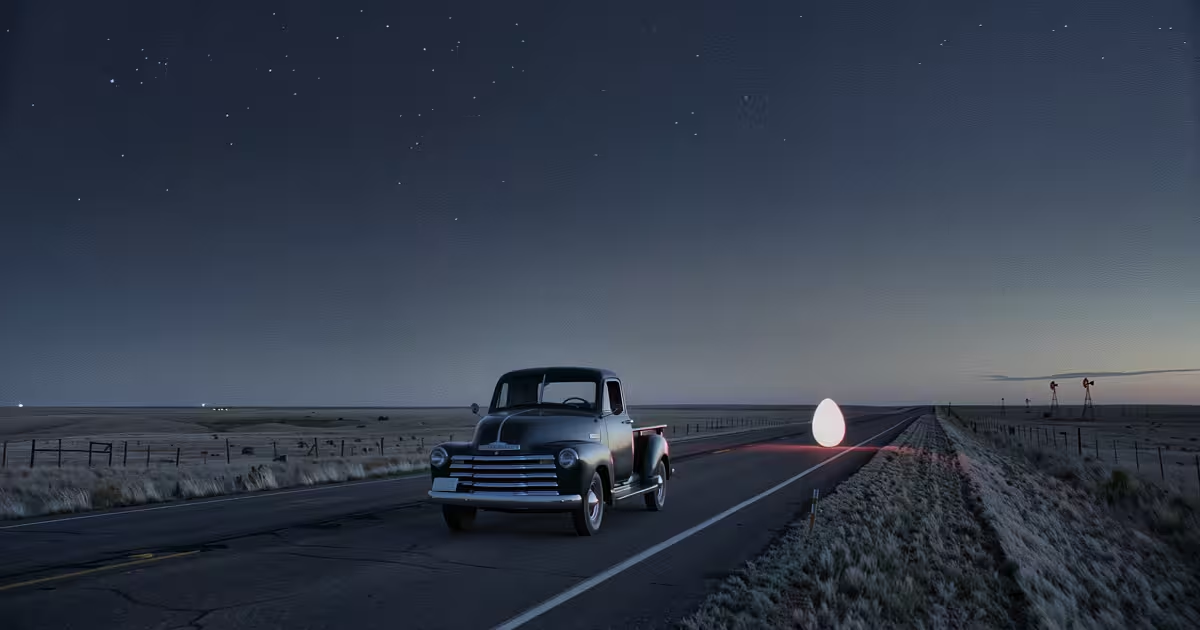
Texas highway at night. Egg-shaped glow on the road.
Illustration, not a period photograph.
Opening
Between 10:30 p.m. on 2 November 1957 and roughly 1:30 a.m. the following morning, at least eight to fifteen separate witnesses on the highways around Levelland, Texas, reported the same repeating sequence: a glowing, elongated or oval object appeared at close range on or near the road, their vehicle's engine died and headlights failed, the object moved off, and their vehicle worked normally again the moment it was gone. The witnesses included farmhands, a fire marshal, a sheriff and his deputy, and two city patrolmen, none of whom knew each other's reports at the time they called them in.
What makes Levelland worth a serious file is not any one sighting but the volume and consistency across independent witnesses in a single narrow window, and what makes it worth a skeptical file as well is a genuinely inadequate official investigation that later researchers, using the Air Force's own internal correspondence, have shown got its central facts wrong.
Timeline
2 November 1957, 10:30 p.m. Truck driver Pedro Saucedo and his passenger Joe Salaz, driving four miles west of Levelland, see a blue flash in a field; a torpedo-shaped object rises and rushes toward them with a sound like thunder, their engine and headlights dying as it passes low overhead. Saucedo does not report it to Levelland police until he reaches his destination roughly ten miles further on, and by his own account the desk officer does not take it seriously at first.
Same night, 11:00 p.m. onward. Similar reports begin arriving from other drivers on different roads around Levelland: Jim Wheeler, Ronald Martin, Frank Williams, Newell Wright, and Jose Alvarez each separately describe an approaching glowing object coinciding with total engine and light failure, followed by restored function once the object departed.
Same night, into the early hours. Officer A. J. Fowler, working the Levelland police desk, receives a mounting series of calls, fifteen in total by night's end, and later states plainly that "everybody who called was very excited."
3 November 1957, 1:30 a.m. Hockley County Sheriff Weir Clem and deputy Pat McCulloch, on Oklahoma Flat Road north of town, independently see a bright oval red light roughly 400 yards off, illuminating the pavement for about two seconds before vanishing.
Same time, roughly two miles behind the sheriff. Levelland police patrolmen Lee Hargrove and Floyd Gavin separately see a streak of light moving east to west close to the ground. Minutes later, the police constable of nearby Anton, Texas, reports the same kind of flash.
Same night. Fire Marshal Ray Jones, also out searching, has his headlights dim (though not fail completely) and his engine sputter (though it does not fully die) as the object passes nearby, a partial version of the effect other witnesses described in full.
5 November 1957. Project Blue Book dispatches a single investigator, an Air Force staff sergeant from the 1006th Air Intelligence Service Squadron, who arrives at the sheriff's office around 11:45 a.m., makes two driving excursions around the area during the day, interviews six of the roughly fifteen known witnesses (missing nine, including several of the law enforcement witnesses), and tells Sheriff Clem he is finished before leaving.
Following the investigation. The Air Force's official conclusion attributes the case to a severe electrical storm producing ball lightning or St. Elmo's fire, stating the storm "stimulated the populace into a high level of excitement" that led witnesses to inflate ordinary occurrences. The investigator's report specifically claims thunderstorms and rain were present in the area at the time.
Later analysis. Reviewing the actual weather data available (Reese Air Force Base in nearby Lubbock recorded complete overcast with reduced visibility, not the active thunderstorm and lightning the official report described), researchers including Temple University historian David Jacobs conclude the investigator's key factual premise, that a storm was actively occurring, does not hold up. Jacobs's research into internal Air Force correspondence finds that Blue Book officers privately believed the Levelland sightings were most likely a case of mass suggestion, a materially different, more psychologically minimizing explanation than the officially stated electrical-storm finding.
1967, roughly a decade later. Atmospheric physicist James McDonald conducts an independent study and determines there had been no significant electrical storm activity in the Levelland area at the relevant time, directly contradicting the Air Force's central premise.
Later. J. Allen Hynek, Blue Book's own longtime scientific consultant, writes plainly in his book The UFO Experience that the entire on-site investigation consisted of one man in civilian clothes spending a single day, making two brief excursions, before declaring the case closed.
Key figures
Saucedo and Salaz are the case's originating witnesses, farmhands whose initial report was met with skepticism at the police desk before the volume of subsequent, independent calls changed the department's posture.
Sheriff Clem, deputy McCulloch, and patrolmen Hargrove and Gavin are the case's most consequential witnesses precisely because of their professional role: law enforcement officers on duty, independently positioned on different roads, reporting the same category of light within the same narrow window while actively searching for the source themselves rather than passively encountering it.
The unnamed Blue Book staff sergeant is the case's central institutional failure, an investigator whose one-day, six-witness inquiry, missing nine of the roughly fifteen known reports, produced a stated weather premise that later independent analysis, using the Air Force's own regional weather data, does not support.
Jacobs and McDonald are the case's most consequential later investigators, each independently establishing, through documentary and meteorological analysis respectively, that the Air Force's official storm-based explanation rests on a factual claim the available weather data does not confirm.
Hynek is the case's most damning insider critic, a Blue Book consultant whose own published account of the investigation's actual scope, one man, one day, two drives, directly undercuts the thoroughness the official "ball lightning" conclusion would seem to require.
Physical and documentary trail
On the paper, this file has an unusually large cluster of independent, closely timed witness reports, including several from on-duty law enforcement officers with no evident motive to fabricate or exaggerate, a formal if thin Air Force investigation file, and, critically, later documented internal Air Force correspondence (per Jacobs) showing officials privately favored a different, more skeptical explanation, mass suggestion, than the one they released publicly.
The weather record is the case's most concretely contested piece of evidence: the Air Force's own investigator cited an active electrical storm as his premise, while the actual regional weather data for the relevant hours, and McDonald's later independent atmospheric study, do not support significant storm activity at the time. There is no photograph, no radar data, and no vehicle mechanically examined and confirmed to have failed by an independent technician at the time, consistent with a nighttime highway phenomenon but also a real limit on how far any explanation, mundane or otherwise, can be pushed on physical evidence alone.
I was told that the Blue Book investigation consisted of the appearance of one man in civilian clothes at the sheriff's office at about 11:45 a.m. on November 5; he made two auto excursions during the day and then told Sheriff Clem that he was finished.
Competing explanations
Ball lightning or St. Elmo's fire during a severe electrical storm. This became the Air Force's official public explanation, and both phenomena are genuine, if imperfectly understood, atmospheric electrical effects capable of causing brief, localized vehicle electrical disruption. Its central weakness is factual rather than theoretical: the storm the explanation depends on does not appear to have been occurring, per both the regional weather record and McDonald's independent later study, and ball lightning's typically small size (a few feet at most) sits awkwardly against witness descriptions of a 200-foot object.
Mass suggestion or psychologically amplified ordinary events. This was, per Jacobs's documented finding, the Air Force's own private preferred explanation, one it did not release publicly, and it faces a real problem the officially stated storm explanation does not: it requires independently positioned, professionally trained law enforcement officers, actively searching for the source of other people's reports, to have separately misjudged perfectly ordinary sights as anomalous within the same narrow window, without having spoken to each other beforehand.
An inadequate, rushed investigation reaching a predetermined conventional conclusion regardless of fit. This reading is well supported by Hynek's own account of the investigation's actual scope, one day, six of fifteen witnesses, and by the specific factual error (the claimed storm) baked into its stated reasoning.
A genuine unconventional aerial phenomenon. This remains the reading best supported by the sheer number and professional composition of independent witnesses reporting the same specific, repeatable effect, engine and light failure at close approach, within the same two-and-a-half-hour window, a level of witness consistency the case's own investigating officer did not seriously attempt to explain away with any specific mechanism beyond a storm that does not appear to have existed.
Later life of the case
Levelland remains frequently cited in serious UFO literature specifically as a textbook case of Blue Book's investigative shortcomings during its later, more perfunctory years, made through named historians' direct documentary work rather than speculation: Jacobs's access to internal correspondence and Hynek's own firsthand insider account both independently corroborate a badly under-resourced inquiry. It is also frequently cited as one of the strongest volume-of-witnesses cases in the broader "vehicle interference" category of UFO reports that would recur in later decades.
Finding
A genuinely unusual cluster of independent witnesses, including on-duty law enforcement personnel actively searching for the phenomenon's source, reported the same specific and repeatable effect within a narrow two-and-a-half-hour window. The Air Force's official public explanation rests on a weather premise, an active electrical storm, that the region's own weather data and a later independent atmospheric physicist's study do not support, and the Air Force's own internal correspondence shows officials privately favored a different explanation than the one they released.
What still will not resolve: any mechanism, mundane or otherwise, that accounts for the specific, repeatable engine-and-light failure pattern across so many independently positioned witnesses without requiring either an implausible storm that the record does not show occurred, or an equally implausible degree of coincidental misjudgment from multiple on-duty law enforcement officers in the same short window. Until one does, Levelland stands as much as a case study in investigative inadequacy as it does an open question about what was on those roads that night.