WANAQUE
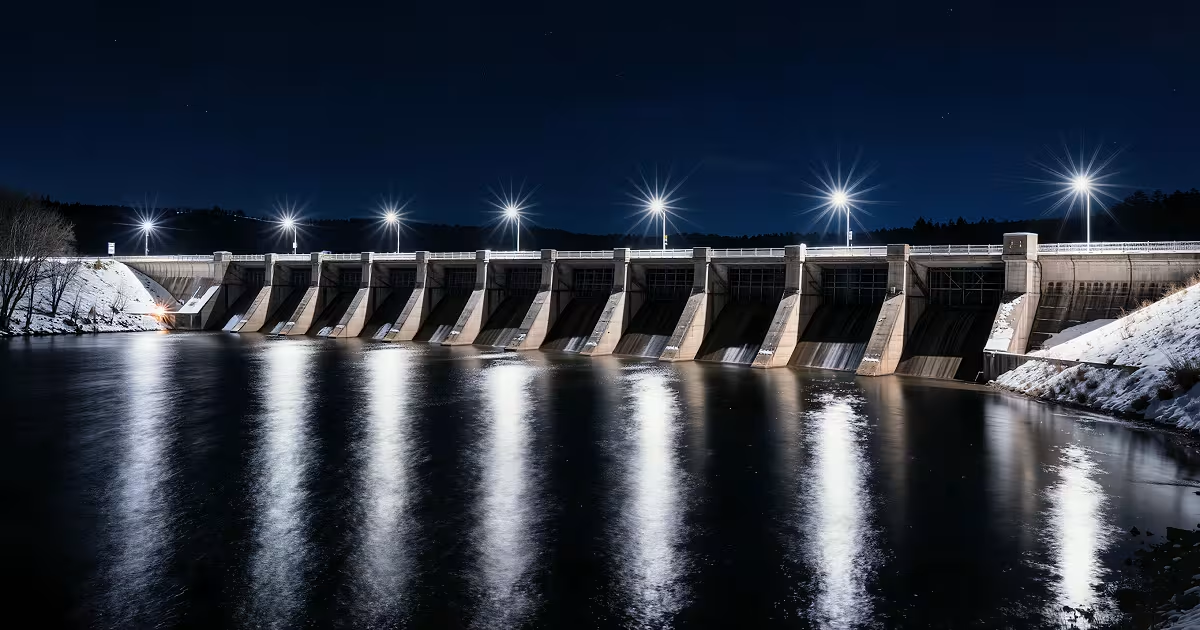
The Wanaque Reservoir dam lit by floodlights on a winter night.
Illustration, not a period photograph.

Opening
On Tuesday 11 January 1966, at about 6:30 p.m., the Pompton Lakes police radio took a call about a bright light over the Wanaque Reservoir in Passaic County, New Jersey, and sent Wanaque Patrolman Joseph Cisco to look. Mayor Harry T. Wolfe, councilmen, reservoir police and a crowd along Ringwood Avenue then watched a silent white light over the Raymond Dam. It was back the next night. The New York Journal-American of 12 January and the New York Times of 13 January both carried it.
Timeline
11 January 1966, about 6:30 p.mThe Newark Evening News (12 January, Cecilia King) and the Passaic Herald-News (12 January, Peter A. Dvarackas) put the first report on the Passaic County police radio hookup in Pompton Lakes. The monitor told Cisco that people in Oakland, Ringwood, Paterson, Totowa, Wayne and Butler were claiming a flying saucer over the Wanaque. Cisco called reservoir Patrolman George Dykman. NICAP's 1966 chronology times the same opening at 6:20 p.m.
Wolfe drove to the reservoir with his 14-year-old son, Billy, and councilmen Arthur Barton and Warren Hagstrom. The Sunday Record of Passaic (16 January) also names councilman John Shutte. Billy told the Newark Evening News the light did not flicker: a continuous light that changed from white to red to green and back to white. Wolfe called the shape oval and put it between two and nine feet across, with the distance anywhere from 10,000 feet to a million miles. He told the Sunday Record he did not know what it was.
Dykman, Civil Defense Director Bentley Spencer, CD member Richard Vrooman, and reservoir employee Frederick Steines went up on the dam. Steines told the Newark Evening News he saw a bolt of light shoot down, as if attracted to the water, like a beam from a porthole. Dykman told the Journal-American the light looked about two feet across and disc-shaped, and that a round light about nine feet across was reflected in the water. Reservoir Police Lt. George Destito turned sightseers away at the gate. Two teenagers, Michael Sloat, 16, and Peter Melegrae, 15, ran up to Dykman's car pointing at it.
Patrolman Charles Theodora of the reservoir force told the Journal-American the disc left at 8:30 p.m. and was back about 2:20 a.m. He said it raced up and down the dam, flashed a ray, and that he and a companion found a hole in the ice while the rest of the dam stayed covered. The Herald-News says he photographed it with an instant camera and got a light blur on a dark sky. The same paper says reservoir guards were not sold on a helicopter, because they heard nothing.
After midnight, 12 JanuaryThe Newark Evening News says word came from Stewart Air Force Base in Newburgh, New York, that an Air Force helicopter with a powerful beacon had been over Wanaque about the time of the light. At 6:15 a.m. Major Donald Sherman, a Stewart spokesman, denied that a helicopter or any aircraft from the base had been on a mission there. The Herald-News prints the same denial and the time as 6:30 a.m.
12 January, nightThe Times, datelined Wanaque 12 January and printed 13 January, called it the second night in a row: hovering, soaring and diving, "very white, very bright and much bigger than a star," to some people a big white disk. Two policemen and a reservoir guard agreed on that description. Wolfe had seen it. The Sunday Record says that on Wednesday night Patrolman Jack Wardlaw, at his home in Stonetown, west of the reservoir, watched a bright white disc that stopped, shot left and right, moved straight up and down, and left toward Ringwood. Sergeant David Sisco, on patrol at 6:30 p.m., said it glided, then streaked faster than any jet, and rose straight up.
13 JanuaryAn Associated Press story out of Washington, printed with the Times account, said the Air Force believed two New Jersey sightings had been Venus and Jupiter. The Paterson News that day quoted Philip J. Del Vecchio, director of the Paterson Museum: Venus low in the southwest for the earlier evening, Jupiter high in the east and then sinking west for the sighting between 2 a.m. and 4 a.m. He called that a guess until someone logged position and movement. The News phoned McGuire Air Force Base and Stewart. Both answered "Negative" on aircraft. A Journal-American sidebar says a spokesman at the Air Force's Air Phenomena Branch at Wright-Patterson said the Wanaque report had not reached his office, and that Stewart and McGuire had denied sending planes.
16 JanuaryThe Sunday Record quotes Lt. Donald Gilleland, head of information at Stewart. Sceptics had been saying the light was a Stewart helicopter. Gilleland said Stewart had no helicopters, and that he had not been able to verify a helicopter in the area at all.
10 October 1966, about 9:15 to 9:30 p.mThe light, or another one, came back. NICAP dates this night to 10 October, 9:15 p.m. Sergeant Benjamin Thompson of the reservoir police, interviewed on tape on 12 October by Dr. John Pagano, with Joe Murphy of the Jersey Journal present, said Pompton Lakes had asked him to check a light going north. He told the New York Times (12 October, an AP story datelined 11 October) that it came at him, went over his head, stopped, backed up, and zigzagged. The Sunday Star-Ledger of 16 October, in Roger Harris's account, puts him on Westbrook Road at 9:20 p.m. and has him place the light about 75 feet over Windbeam Mountain. He described a basketball with a football thrust through it, silent, lighting the ground, and said a reservoir-station switchboard took something like 150 calls. Sergeant Robert Gordon of Pompton Lakes and his wife Betty had watched a bright light from their house on Midland Avenue and had the desk radio Thompson.
The World Journal Tribune of 24 October dates Thompson's night to 11 October, and so does a Science & Mechanics piece in May 1967. Thompson's own tape, the Times, and the Star-Ledger put it on Monday the 10th.
13 OctoberThe Record (Thomas Sullivan and Jerry Pulwer) has Thompson and Gordon on Channel 13's "The World at Ten," with Mitchell Kraus. Thompson said they had not bothered to call the Air Force this time, because they had not been believed the last time, and that six helicopters and several planes were over the area within minutes. Colonel Maston M. Jacks at the Pentagon said the Air Force had no report, did not solicit reports, and did not investigate anything not officially sent on from the nearest base. Lt. William Marley at Wright-Patterson, attached to Project Blue Book, said nothing had come in from Stewart or from McGuire.
14 OctoberThe Paterson Morning Call (Jerry Pulwer and Jerome Morgan) says calls to McGuire and to Stewart "proved fruitless": Air Force officials again denied they had any planes in the area. Call reporters at the reservoir after 9:30 p.m. wrote that the only red and green lights they could find were two single-engine jets and a helicopter.
Key figures
Joseph Cisco took the first radio assignment on 11 January.
George Dykman, on the reservoir force, is the officer who described the disc and the reflection on the water. Charles Theodora, reservoir patrolman and guard, is the one who reported the hole in the ice and the blurry instant photo. David Sisco, a Wanaque sergeant, is in the Sunday Record for Wednesday night and in the Paterson News for early Wednesday morning.
Harry T. Wolfe was the mayor. Barton, Hagstrom and Shutte are the councilmen named in the 12 and 16 January papers. Billy Wolfe, 14, is the one who described the colour change.
Jack Wardlaw is the Stonetown patrolman who watched the light dart and climb on the Wednesday night.
Donald Sherman is the Stewart major who withdrew the helicopter story on the morning of 12 January. Donald Gilleland is a different Stewart officer, a lieutenant in the information office, who told the Sunday Record four days later that the base had no helicopters. Ben Thompson and Robert Gordon carry the October night. John Casazza, reservoir police chief, told the World Journal Tribune he had seen the lights too, and that he did not know what they were.
Physical and documentary trail
The sources: the Journal-American of 12 January 1966, the Newark Evening News and the Herald-News the same day, the Times and the Paterson News of 13 January, the Sunday Record of 16 January, then the Times of 12 October, the Record of 13 October, the Morning Call of 14 October, the Star-Ledger of 16 October, and the World Journal Tribune of 24 October. NICAP's chronology cites the Journal-American and U.F.O. Investigator, January-February 1966, page 3.
The ice is not a blank. Theodora told the Journal-American there was a hole, with the rest of the dam still frozen. Dykman, in that same paper, gave nine feet as the size of a reflection on the water, not as a measured hole. The World Journal Tribune on 24 October wrote that a January object had drilled a hole nine feet wide while policemen watched. I found no survey, no depth, and no photograph of the hole. Theodora's instant photo, as the Herald-News describes it, was a smear of light.
Things you might not know
- Billy had the colours. The mayor's 14-year-old son, not a later book, is the source of white to red to green and back to white, in the Newark Evening News the next day.
- The helicopter lasted until breakfast. Stewart's beacon-helicopter story was in circulation after midnight. Sherman pulled it back at 6:15 a.m.
- Stewart said it owned no helicopters. Gilleland, on 16 January: "We have no copters here." He added that he could not even verify one had been in the area.
- Nine feet is a reflection first. Dykman's nine feet, in the Journal-American, is light on the water. The nine-foot hole shows up in the Tribune nine months later.
- The picture was a blur. Theodora's instant camera, Herald-News, 12 January: a light smear on a dark sky, not a structured craft.
- They changed the bulbs. Casazza told the Tribune that after the February visits the reservoir swapped its old floodlights for mercury vapour lamps, and that the lights over the water then stopped. They came back in October anyway.
- Windbeam, and a football in a basketball. Thompson, in the Star-Ledger of 16 October, put the October light about 75 feet over Windbeam Mountain and described that shape. He told Pagano he heard no sound.
- It is Newark's water. The Times of 12 October describes the reservoir as part of the Newark supply, about 25 miles northwest of the city. The Tribune calls it 6.6 miles long.
Competing explanations
A helicopter with a beacon. This is the explanation Stewart itself put out on the first night, and it fits a bright light that hovers and moves. Sherman withdrew it the next morning. Gilleland said the base had no helicopters to send. Theodora, Dykman and the reservoir guards said they heard no motor. In October, Thompson said helicopters and planes arrived after he had already put the light on the radio, and Morning Call reporters did see a helicopter and two jets while the crowds were out. Those aircraft can cover some of the later lights. They do not, on the record, cover the silent light of 11 January.
Venus and Jupiter. That is the Air Force line in the Washington AP story of 13 January, and Del Vecchio's split of the clock is the most careful version of it: one planet for the early evening, another for the hours after 2 a.m. A planet does not shoot sideways, stop, and climb straight up, which is what Wardlaw and Sisco described on the Wednesday night, and it does not light a dam and leave a reflection Dykman put at nine feet. Del Vecchio said as much: without positions, the planet reading was a guess.
A misread aircraft or satellite, high and quiet. Del Vecchio offered that too, from satellite-tracking experience. It has the same problem as the planets once the witnesses are on the dam talking about a low disc and a beam on the ice.
Seismic light. On 3 December 1978 the North Jersey paper, in a column by Bryan LaPlaca reprinted by The UFO Chronicles in 2013, reported that Vestigia Inc. of Stanhope, founded by Robert Jones of Byram Township, was gearing up to test an idea: pressure on quartz along the Ramapo Fault making soft glowing lights close to the ground. That is a plan and a hypothesis, not a published result. Jones's own description, soft lights near the ground, does not match a light Thompson compared to a car and a 250-watt bulb.
Later life of the case
February and March 1966 brought more calls. The Tribune says Wolfe and about 400 people watched an "oversize star" on the Monday before 24 October, and that Casazza had the floodlights changed after February. James W. Moseley asked Edward Condon, then starting the University of Colorado study, to look at Wanaque. The Morning Call printed that request. Blue Book, through Marley and Jacks, said no October report had arrived from either nearby base.
Later retellings add a McGuire weather-balloon explanation that was given and then withdrawn. It is not in the January or October papers. Weird NJ gathered the newspaper accounts again in January 2024.
Finding
The names and the dates hold. On 11 and 12 January 1966, Cisco, Dykman, Theodora, Wolfe, Barton, Hagstrom and Sisco, with Wardlaw on the Wednesday night, reported a bright silent light over the Wanaque dam, and they said so to papers that printed it the next day. Stewart's ordinary explanation was a beacon helicopter, and Stewart then denied it had flown one. The Air Force's next public answer was Venus and Jupiter. A helicopter still fits a moving light better than a planet, and aircraft were over the reservoir in October, but no flight was ever tied to the light the police watched on the 11th.
What still will not resolve: what made the light, and whether Theodora's hole in the ice was measured. The cause is open.
Evidence signature
6/9 Solid
- Witnesses
- trained, independent witnesses
- Instruments
- photo, film or physical traces
- Paper
- official records at the time
How well documented the case is, not whether it's true. A strong record can still have an ordinary answer, and a thin one can still be real.
You decide · WANAQUE
What do you think happened?
One vote per case, anonymous. You'll see how other readers voted once you've voted.