MARIANA FILM
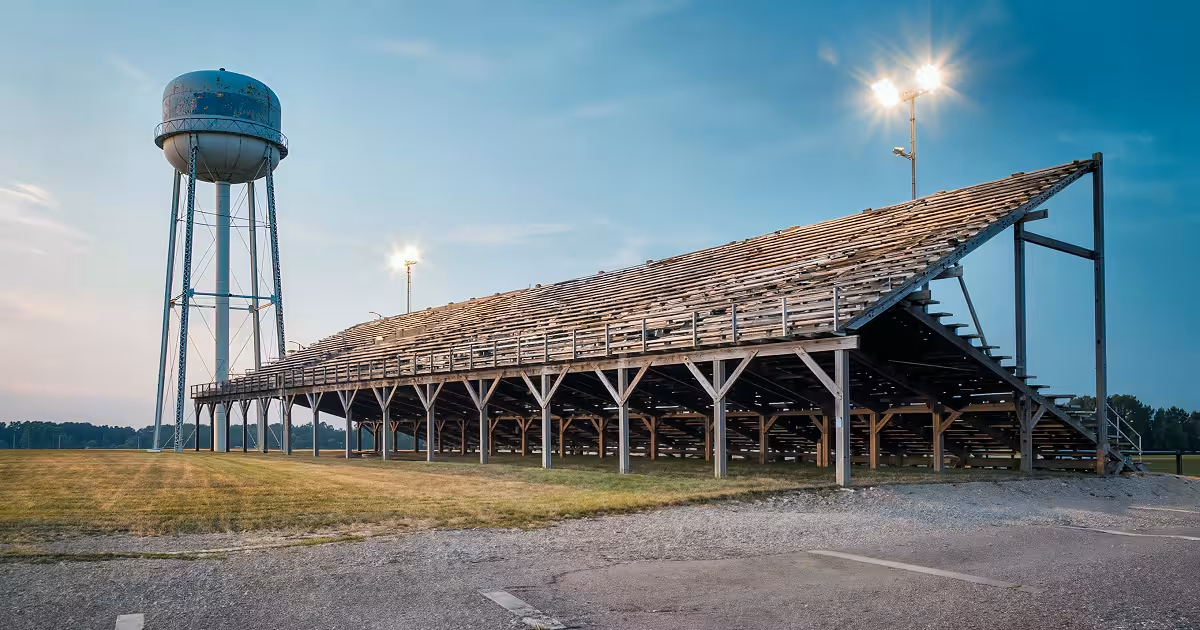
The grandstand and water tower at a Montana ballpark on a sunny day.
Illustration, not a period photograph.

Opening
In August 1950, Nicholas Mariana, general manager of the Great Falls Electrics baseball team in Montana, was at Legion Stadium with his secretary, Virginia Raunig, when he saw two bright objects crossing the sky. He grabbed his 16mm colour movie camera and filmed them for about sixteen seconds as they passed behind a water tower. The film is one of the earliest motion pictures of a UFO. Project Grudge, Project Blue Book, a CIA-convened panel and the University of Colorado all studied it, and they did not agree on what it shows.
Timeline
August 1950, late morningMariana and Raunig see two bright objects over Great Falls. He films them from the ballpark, catching the water tower in some frames. The date is usually given as 15 August, but the first newspaper story, on 6 August, says it happened the day before.
Autumn 1950Captain John P. Brynildsen at Great Falls Air Force Base (later renamed Malmstrom) interviews Mariana and, with his permission, sends the film to Wright-Patterson. Project Grudge writes the objects off as sunlight reflecting from two F-94 jet fighters that were in the area. The Air Force tells Mariana its photo analysts were unable to find anything unusual.
After the film comes backMariana says the first frames, where the objects were clearest and showed a spinning disc shape, are missing. The Air Force says it removed only one damaged frame.
January 1951Bob Considine's Cosmopolitan article "The Disgraceful Flying Saucer Hoax" takes aim at saucer witnesses. Mariana sues for slander. The suit is dropped in September 1955.
July 1952Edward Ruppelt, head of Project Blue Book, persuades Mariana to let the Air Force look again. The analysts rule out birds, balloons and meteors, and find the F-94 explanation does not hold up. Ruppelt later writes that "it was an unknown."
January 1953The Robertson Panel, convened by the CIA, views the film with the Tremonton footage and concludes it probably shows aircraft reflecting sunlight.
1955 to 1956Robert Baker, an engineer at Douglas Aircraft, analyses a copy for Greene-Rouse Productions, which is making the documentary UFO. He calls the aircraft explanation "quite strained."
1967Roy Craig of the University of Colorado's UFO study reinvestigates, interviewing Mariana and Raunig.
1969The Condon Report publishes the case. Its analyst William Hartmann finds it hard to believe the objects were aircraft, but says that possibility cannot be ruled out.
Key figures
Nicholas Mariana took the film. A former Air Force corporal, he was a local sports figure who ran the Electrics, and he maintained that the Air Force kept the best of his footage. He described two silvery, rotating discs, about 50 feet across, making a whooshing sound.
Virginia Raunig, his 19-year-old secretary, was the second witness. In 1967 she told Roy Craig she saw only one light, after running outside behind Mariana.
Edward Ruppelt reopened the case in 1952 and was the senior Air Force officer most willing to call it unexplained.
Robert Baker gave the strongest technical case against the aircraft explanation, and repeated it to Congress in 1968 and to a scientific symposium in 1969.
William Hartmann and Roy Craig gave the Condon Report's view: Hartmann cautious, Craig sceptical of Mariana's account of the missing frames.
Physical and documentary trail
The sources: the film itself, Air Force correspondence, Blue Book's case file, the Robertson Panel's report, Baker's analysis, and the Condon Report's chapter on the case.
The film runs at 16 frames a second. Accounts of how much survives vary: one count gives 315 frames showing the objects, while the Air Force returned around 290. Mariana said about 30 frames at the start, showing the discs clearly, were never returned. Only his word supports what they showed, and Craig noted that Mariana could not produce the letter he said admitted the removal.
The date is also unsettled. Most accounts give 15 August, but the first newspaper report points to 5 August, and Craig found that the Electrics were playing in Twin Falls, Idaho, on the evening of the 15th.
Also missing: precise positions for the two F-94s at the moment of filming, which is what the aircraft explanation needs.
Things you might not know
- Mariana ran a baseball team. He was general manager of the Great Falls Electrics, a minor league club, which is why he was at the ballpark.
- The film lasts sixteen seconds. He shot it on a 16mm colour camera with no sound.
- Even its length was disputed. The officer who sent it to Wright-Patterson told a reporter there were about eight feet of film, but his own message said about fifteen.
- It went to the cinema. In 1954 a production company bought the rights, and the footage appeared in the 1956 documentary UFO.
- The team is named after it. Before the 2008 season the Great Falls club renamed itself the Voyagers in honour of the film, with an alien mascot called Orbit. The team marked the 75th anniversary in August 2025.
- A famous sceptic tried to match it. Philip Klass compared the film with a photograph of a plane reflecting the sun. Mariana's supporters rejected the comparison.
Competing explanations
Two jets. F-94s were landing at the nearby base around that time. Bright sunlight on their fuselages at a distance could look like featureless glowing objects. This is Project Grudge's and the Robertson Panel's view, and Philip Klass's.
Unknown objects. Ruppelt's 1952 review and Baker's analysis argued the objects' brightness and motion did not match the jets' known positions. The Condon Report did not rule this out.
Something else again. Birds, balloons and meteors were considered in 1952 and rejected.
Later life of the case
The Mariana film is a fixture of UFO documentaries, because it's early, in colour, and was taken seriously at the time. The missing-frames dispute feeds claims that the Air Force covered up the best part of the evidence. It is also part of the long record of strange sightings around Great Falls; for the missile-field reports seventeen years later at the same base, see Malmstrom, and for the other film the Robertson Panel watched, Tremonton.
Finding
A real film of two bright objects, studied more carefully than almost any other early footage. The Air Force's own 1952 review called it unknown, the CIA's panel called it aircraft, and the Condon Report could not settle it. The jet explanation is reasonable and has never been proven. Nobody has shown the film can't be aircraft.
What still will not resolve: the missing frames, and whether they showed the disc Mariana said they did.
Evidence signature
5/9 Solid
- Witnesses
- one person, or a tradition
- Instruments
- photo, film or physical traces
- Paper
- formal investigation, court or declassified file
How well documented the case is, not whether it's true. A strong record can still have an ordinary answer, and a thin one can still be real.
You decide · MARIANA FILM
What do you think happened?
One vote per case, anonymous. You'll see how other readers voted once you've voted.