CANARY ISLANDS 1976
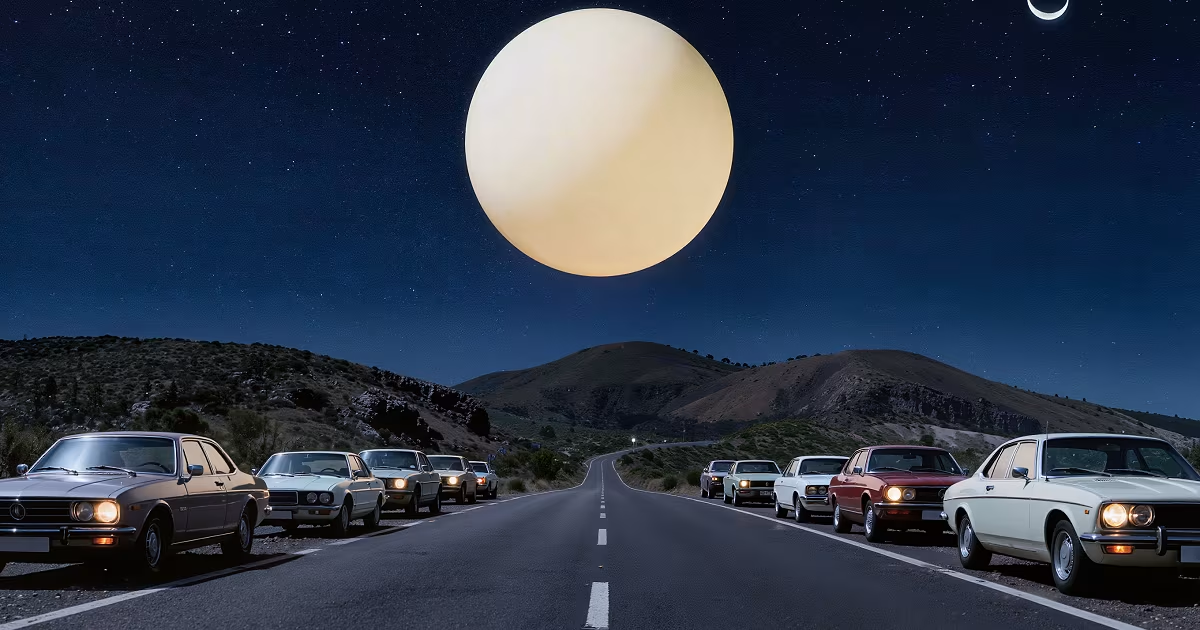
Tenerife night road. Cars stopped and large sphere in sky.
Illustration, not a period photograph.
Opening
In June and July 1976 the Canary Islands produced a cluster of night lights and landings in the telling, and the Spanish Air Force wrote some of it as unidentified rather than as a clean astronomical close. Declassified Spanish paper is why this card is not only tourist talk. Tenerife and the other islands sat under the same weeks. No wreck sat on a volcanic slope the file can close.
Canary Islands 1976 is an official unidentified written on European paper. Keep later catalogue ivy on the shelf.
The spine of the file is Spanish Air Force language and a summer of lights. The Canaries are June-July 1976. They are not a stored craft in a hangar this card can open.
Timeline
June-July 1976 clustered reports across the islands.
Spanish Air Force attention and later released paper that leaves some cases unidentified.
No wreck. No single astronomical close for the whole cluster.
Later lists keep the Canaries. That list is later life. The official language is first.
1976 Canary Islands nights put lights and civilian calls on a compiled season. Official weather offered known traffic. No wreck sat on a public island tray this card will stamp.
An island season of calls is a corridor. One aircraft close will not do every night unless the desks say so in paper you can hold.
June and July 1976 put clustered lights on Tenerife and other Canary desks. Spanish Air Force attention followed. Later released paper left some of those nights unidentified. No wreck sat on a public island tray. No single planet close ate the whole cluster.
An official season that will not name every light is already a complete island file. Later catalogues do not replace that paper.
Key figures
Island witnesses own the nights.
Spanish Air Force desks own the unidentified stamp on some files.
Later compilers own the cluster as a season.
The volcanoes own the lack of a wreck.
Physical and documentary trail
On the paper, summer 1976 gives you four hard objects and no wreck.
One: clustered island reports.
Two: Spanish Air Force files later released.
Three: unidentified language on some of those files.
Four: the absence of a recovered object. Spanish Air Force paper on the 1976 Canary Islands cases, is the official tray.
There is no public craft. There is no single planet close for every night. There is no page that makes the official stamp a tourist brochure.
1976 compiled island nights are the stay-behinds. A frame a lab will sign would finish a night. An official close the season would accept would finish the other door.
1976 official island weather and unidentified leftovers are the stay-behinds. A frame a lab will sign would finish a night. A single astronomical close the desks would accept for the whole cluster would finish the other door.
Some of the nights were written unidentified.
Competing explanations
Unknown objects over the islands. This is the hard reading. It has official paper. It has no wreck.
Planets, boats, a tourist season. The mundane door. Has to carry Air Force unidentified language.
A later myth hung on a summer. Weak against released files.
Hybrid caution. A force wrote unidentified. Morning had no wreck on the slope.
Later life of the case
Later cluster lists. I keep those on the later-life shelf. The 1976 paper stays first.
Finding
The Canary Islands spent June and July 1976 under a cluster of lights, and Spanish Air Force paper left some of those nights unidentified. Believe the stamp. A service does not invent an unidentified line for a later list.
What still will not resolve: a wreck with an island chain, or a close the Air Force would sign for every night. Either one would pin the summer. The proving object is still those nights as written, held as planet or as other by more than a tourist caption.