COLARES
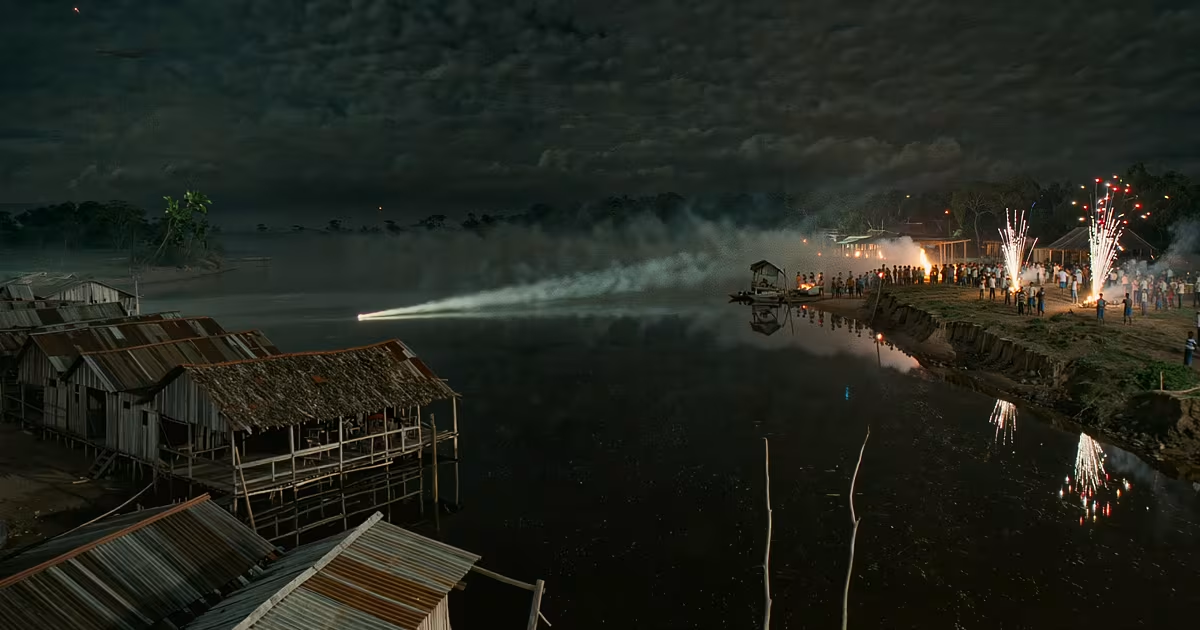
Colares waterfront night watch. 1977.
Illustration, not a period photograph.
Opening
In 1977 the island of Colares and neighbouring villages in Pará reported low luminous objects that put beams on people. Residents named the lights chupa-chupa. A local doctor treated burns, punctures, and weakness. The mayor asked the Air Force for help. Belém stood up Operacao Prato and sent officers to sit on the waterfront with cameras.
The first field phase ran from 20 October to 11 November 1977. A second sat at the end of November into early December. The team interviewed, watched at night, photographed, and filmed. The dossier later reached the national archive. The official close said no unusual phenomena. The pictures and the medical notes remain in the same stack as that sentence.
The spine of the file is an Air Force that thought the island worth months of nights, then filed a negative conclusion over a positive pile of film. Colares is a beam-and-body wave with a military camera. It is not a recovered lamp.
Timeline
Early to mid 1977. Talk of lights and beams spreads through Colares and the delta towns. People keep night watches, light fires, set off fireworks. Marks on skin go to the clinic. The name chupa-chupa sticks.
September 1977. Mayor Jose Ildone Favacho Soeiro asks the Air Force. First Command in Belem forms a team under Captain Uyrange Hollanda.
20 October to 11 November. First Prato phase. Officers on the island and in nearby settlements take statements, sit watches, shoot stills and film. 25 November to 5 December. Second phase. The paper grows. Lights are logged. Some frames show structure in a glow depending on who is reading the negative.
1978. The operation winds down. The dossier is held. Decades later it is readable at the archive. In 1997 Hollanda talks on camera to ufologists and describes more than the 1977 close allowed. Three months after that interview he is found dead at home. That death is later life. It is not a 1977 exhibit.
Key figures
The villagers and the clinic patients are the first layer. Burns and weakness are why the mayor wrote. A doctor treating marks is not an Air Force analyst. The marks are the human cost the file has to carry even when the close says nothing unusual.
Captain Uyrange Hollanda runs the nights. His 1977 paper is duty. His 1997 interview is memoir. Keep those years apart. The 1997 voice adds figures in suits and a method for reading negatives. The 1977 voice is the one that produced the archive box.
The mayor is the civilian hinge. Without the request, Prato is a different operation. Sergeants and photographers on the watches are the hands on the cameras. Their frames are the physical take.
Ademar Gevaerd and the later interviewers own the 1997 tape. They do not own 1977.
Physical and documentary trail
On the paper, 1977 gives you four hard objects and a negative stamp.
One: civilian medical complaints on Colares and nearby, treated as burns and puncture-type marks during the wave. Names and clinic notes are in the Prato harvest even if they are not a published case series in a journal.
Two: the mayor's request and the standing up of Operacao Prato out of Belem, with dated field phases in October-December 1977.
Three: photographs and film shot by the Air Force team on the watches. Counts grow in later speech. The existence of a military image take from those nights is not in dispute. What each frame shows is.
Four: the Prato dossier as later deposited for public reading, and the official line that the operation found no unusual phenomena. Both the pictures and the close live in the same Brazilian paper.
There is no recovered projector. There is no captured lamp. There is no 1977 signed identification of the beams as a known aircraft searchlight on a named flight.
Operation found no unusual phenomena.
Competing explanations
Unknown beams on people. This reading takes the clinic marks, the watches, and the film as a single class of object the Air Force could point a camera at and not name. It has images and no lamp in a crate.
Hysteria plus ordinary lights. Boats, planets, helicopters, and a river population primed by talk. A doctor can treat fear and a burn from another cause. This reading has to live with an Air Force that spent months on the bank instead of one night.
Secret military test. A domestic or foreign projector on a river that then had to be denied. Possible. Not shown. Prato would be an odd way to hide a test you yourself were filming.
Hybrid caution. People were marked. Officers filmed lights. The close said nothing unusual. Those three sentences do not cancel each other. They make the file heavy.
Later life of the case
The 1997 Hollanda interview and his death weeks later become the folklore engine. I keep that tape and the suicide arguments on the later-life shelf. The archive box from the 1977 nights stays first.
Colares still tells the beam story. The Air Force still has the pictures in a place a citizen can ask for. The lamp is not on a table.
Finding
Colares was under lights that put beams on people. Clinic marks went to a doctor. The mayor asked the Air Force for help, and Operacao Prato sat on the waterfront with cameras for months. Believe the island. Officers would not have spent those nights on a riverbank if the town had only been telling stories to itself.
What still will not resolve: a released frame from those watches that shows structure everyone will accept, or a medical series that ties a named beam to a named burn. The dossier exists. The close said nothing unusual. A picture that survives both sentences is what the file still owes the marked skin.