CAMPECHE 2004
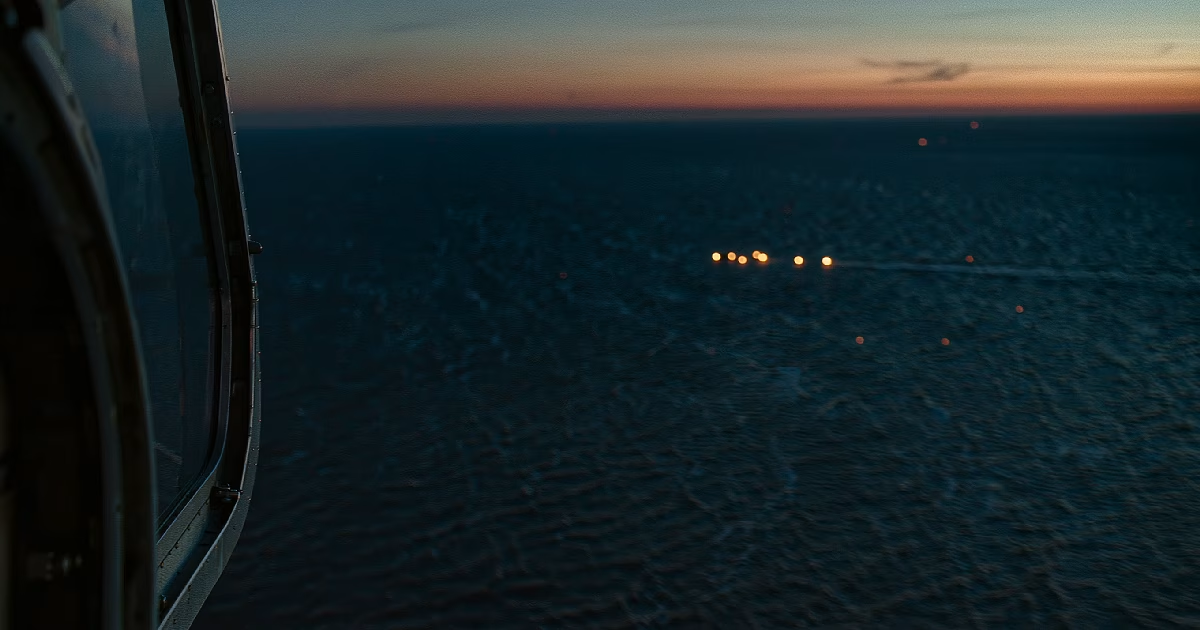
A row of bright orange lights over a dark sea at dusk.
Illustration, not a photograph.

Opening
On 5 March 2004, a Mexican Air Force surveillance aircraft was flying a drug-interdiction patrol over the Gulf of Mexico off the state of Campeche when its crew picked up bright objects on an infrared camera. They counted eleven. Only three of them showed on the aircraft's radar. The crew said they tried to follow the lights until fuel forced them back to base.
The video was released in May 2004 at a press conference in Mexico City led by the UFO researcher Jaime Maussan, and the Mexican Defence Department confirmed that it had been shot by Air Force personnel. That made it unusual: military footage, acknowledged by the military, of unidentified objects. It was shown around the world within days. An ordinary explanation was put forward almost as quickly, and the argument has not gone away.
Timeline
5 March 2004The Air Force aircraft, on an anti-drug patrol, records the objects on its infrared camera at about 11,500 feet.
May 2004Maussan presents the roughly fifteen-minute video publicly. A Defence Department spokesman confirms it was filmed by Air Force personnel.
Mid 2004The Infraspection Institute, a thermal imaging firm, examines the footage for National Geographic and concludes the objects are flare stacks. A magazine analysis by James C. Smith in Skeptic reaches the same view, using an idea credited to Captain Alejandro Franz.
LaterOnline analysts recreate the apparent motion and discuss satellite fire data showing flaring in the Cantarell area on the date.
Key figures
Major Magdaleno Castañón was the aircraft commander. Lieutenant Mario Adrián Vázquez Téllez was the operator of the forward-looking infrared camera, and he described the objects as round and featureless, flying in formations of two or three. He insisted the images could not have been altered.
Jaime Maussan, a Mexican UFO researcher, presented the video and called the objects intelligent and possessed of mass and energy. Those are his words, not the military's.
Alejandro Franz, a pilot, proposed the flare explanation. The Infraspection Institute and James C. Smith examined it.
Physical and documentary trail
The record: the infrared video, which is real and Air Force made; press statements by the Defence Department and the crew; and the Infraspection and Skeptic analyses. That is the whole body of evidence.
What I have not found is the radar recording, a flight log, or a statement from the Air Force about what its analysts concluded. The crew's accounts also differ in details between outlets, including the aircraft type, which some ufology sites give as a C-26 and most news reports do not name.
Things you might not know
- The military stood behind the film. Governments often disown such footage. Mexico's Defence Department confirmed this one was its own.
- It was a drug patrol. The crew was searching for smuggling aircraft, which is why they carried an infrared camera.
- The motion may be camera parallax. When a camera moves past a distant light, the light appears to move against the background. Critics say that is what makes the objects seem to dart.
- The oil field is real. The Cantarell complex in the Bay of Campeche is one of the largest offshore oil fields in the world, and platforms there burn off gas in tall flares.
- Heat shows from far away. A flare stack's thermal signature can be picked up from several miles away on infrared, according to the Infraspection analysis.
Competing explanations
Oil platform flares. The strongest reading is that the lights are gas flares on platforms in the Bay of Campeche, in a line with the camera's pointing direction, and that their apparent flight is parallax. This fits the video well. It leaves the three radar contacts to explain, and the crew's report that they could not close on the lights.
Unidentified objects. Maussan and others argue that the radar returns, the formations, and the crew's account show something the flares cannot. This view depends on details of the original radar and flight data that have not been published.
A mix. Some of the eleven could be flares and others something else, which would fit why people looking at the same footage see different things.
Later life of the case
Campeche became a standard case in lists of military UFO video, and flare analysis became a standard example of a thermal-imaging misread. Mexico's own Air Force has never published a conclusion that I have found.
Finding
The video is genuine. It was filmed by an Air Force crew and confirmed by the Defence Department. The best explanation for the infrared lights is gas flares on the Cantarell platforms seen from a moving aircraft, and that explanation has the strongest analysis behind it.
It does not fully cover the three radar contacts or the crew's testimony. What still will not resolve: what the radar recorded that night, and whether the Air Force ever compared it with the flare positions.
Evidence signature
5/9 Solid
- Witnesses
- several people
- Instruments
- more than one sensor agrees
- Paper
- nothing on record
How well documented the case is, not whether it's true. A strong record can still have an ordinary answer, and a thin one can still be real.
You decide · CAMPECHE 2004
What do you think happened?
One vote per case, anonymous. You'll see how other readers voted once you've voted.