LORING AFB
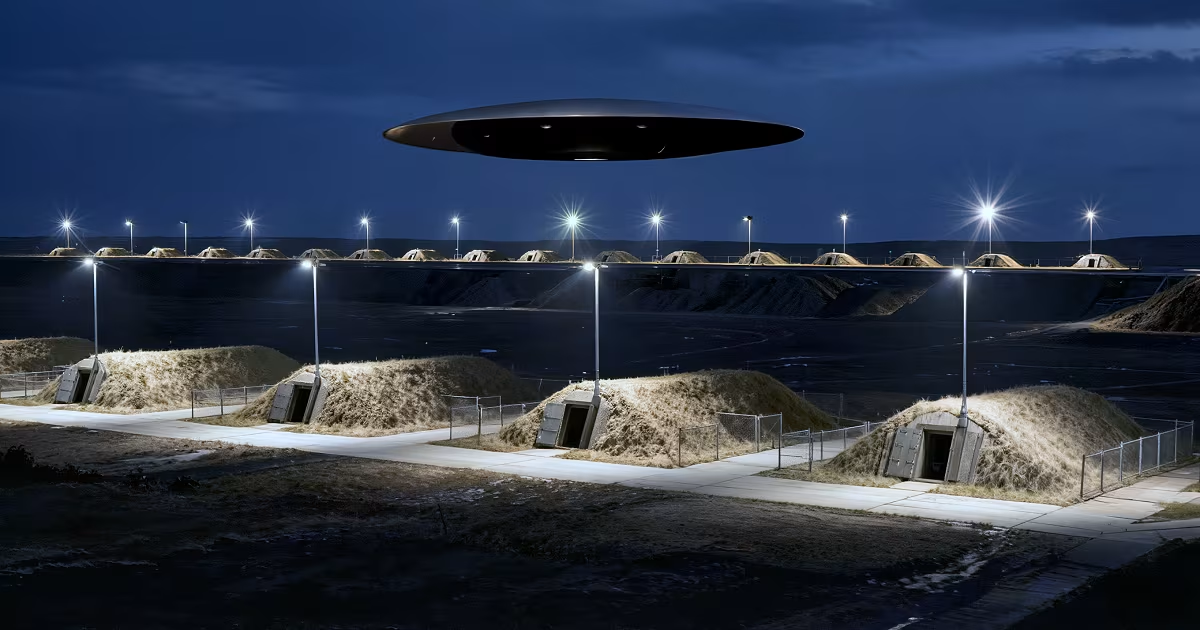
A disc hovering over lit weapons storage bunkers at night.
Illustration, not a period photograph.

Opening
On the evenings of 27 and 28 October 1975, an unidentified craft with running lights flew low over Loring Air Force Base in northern Maine, one of Strategic Air Command's nuclear bomber bases, and hovered near the weapons storage area. Security police watched it, base radar tracked it, and the base went to a heightened security alert.
A National Guard helicopter was sent after it and found nothing. The official record of this, obtained through FOIA in the late 1970s, is what makes Loring unusual: the Air Force's own messages describe an unknown aircraft showing "clear intent" in the weapons storage area.
Timeline
27 October 1975, eveningSecurity personnel see an aircraft with a red navigation light and a white strobe near the northern perimeter at around 150 feet. Radar tracks an unknown target a few miles out. The object circles near the weapons storage area, then heads off toward Canada. Colonel Robert E. Chapman, commander of the 42nd Bombardment Wing, puts the base on a Security Option 3 alert until morning.
28 October 1975, from about 19:45Security police, including Staff Sergeant William Long and Sergeant Clifton Blakeslee, report running lights coming from the north. Sergeant Danny Lewis reports a white flashing light and an amber light to the command post. B-52 crew chief Steven Eichner later describes an object about four car lengths long, reddish-orange, hovering close to the ground with heat haze around it. The object turns its lights off and on and hovers around 150 feet above the weapons area.
28 to 31 OctoberFurther reports on and off. Radar gives altitudes between a few hundred and 5,000 feet. A National Guard helicopter is sent up and can't find the object.
Late October to November 1975Similar reports come from other northern-tier SAC bases, including Wurtsmith in Michigan and Malmstrom in Montana. SAC circulates a directive on defending against helicopter assault.
1984Lawrence Fawcett and Barry Greenwood publish the FOIA documents in Clear Intent.
Key figures
The 42nd Security Police Squadron watched the object on the ground and handled the alert.
Steven Eichner gave the closest description, of a large hovering object, in later interviews. It's more detailed than anything in the 1975 messages.
Lawrence Fawcett and Barry Greenwood obtained and published the documents.
Physical and documentary trail
The trail: base logs, SAC and National Military Command Center messages, and later CIA and NORAD material released under FOIA. They confirm the sightings, the radar tracks, the alert, and the helicopter search.
The documents record an unknown aircraft, lights, and an intrusion. The "four car lengths" craft comes from witness testimony decades later.
It is our opinion that the unknown helicopter has demonstrated a clear intent in the weapons storage area, is smart and a most capable aviator.
Things you might not know
- It was SAC's biggest base. Loring covered about 14,300 acres, had the largest weapons storage capacity in Strategic Air Command, and sat a few hundred miles closer to Europe than any other US base.
- The weapons area was a first. Its storage site, the old Caribou Air Force Station or "Q Area", was the first US site built specifically to store and assemble atomic weapons.
- It got within 300 yards. A teletype to the National Military Command Center said the aircraft "definitely penetrated" the northern perimeter and once came within 300 yards of the munitions storage area.
- It flew off toward Canada. The object was tracked heading for Grand Falls, New Brunswick, about twelve miles east.
- The book took its title from the message. Fawcett and Greenwood named Clear Intent after the base's own phrase.
Competing explanations
A helicopter. The documents themselves call it an unknown helicopter, and SAC's response was about helicopter assault. A small civilian or smuggling helicopter crossing from Canada at night would explain the lights, the height, and the direction. No helicopter was identified.
A deliberate probe. Someone may have been testing SAC's security, possibly an intelligence service. No evidence of this was ever released.
An unknown craft. The hovering, the lights switching off, and the lack of any identified aircraft across several bases are the argument for something other than a helicopter. The closest descriptions come from late testimony.
Later life of the case
Loring, along with Malmstrom and Wurtsmith, became the core of the "1975 northern-tier overflights" in UFO literature and later congressional UAP interest. Loring closed on 30 September 1994. Former personnel have kept telling their stories.
Finding
Something flew over a nuclear weapons area at Loring on at least two nights, and the Air Force couldn't identify or catch it. Its own documents say so. The simplest reading, and the one the documents lean toward, is an unidentified helicopter. What's missing is the helicopter.
What still will not resolve: who was flying over Loring, and whether the same aircraft visited the other bases that month.
Evidence signature
9/9 Strong
- Witnesses
- trained, independent witnesses
- Instruments
- more than one sensor agrees
- Paper
- formal investigation, court or declassified file
How well documented the case is, not whether it's true. A strong record can still have an ordinary answer, and a thin one can still be real.
You decide · LORING AFB
What do you think happened?
One vote per case, anonymous. You'll see how other readers voted once you've voted.