BROAD HAVEN
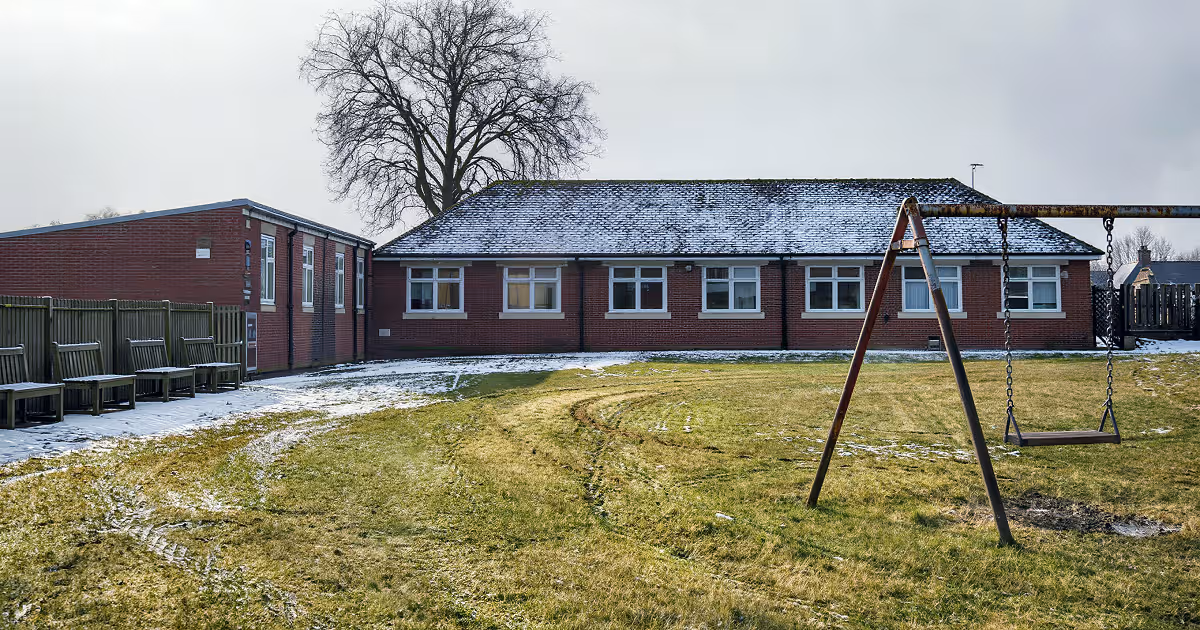
Pembrokeshire school field. Empty grass and 1970s sky.
Illustration, not a period photograph.
Opening
At lunchtime on Friday, 4 February 1977, fourteen pupils at Broad Haven Primary School in Pembrokeshire, West Wales, ran back from their playing field insisting they had seen a silver, cigar-shaped object with a domed middle section land in a field behind the school, and some said a silver humanoid figure with pointed ears near it. Headmaster Ralph Llewellyn assumed a prank. When the children returned to school the following Monday, he separated them and had them draw what they had seen under exam conditions. The drawings came back strikingly similar.
That schoolyard sighting was the opening beat of what became, over the following months, a genuine regional flap: teachers and staff at the same school, a hotelier a few miles away, and a farming family a short drive further on all reported their own encounters, escalating from lights and shapes to described humanoid figures in what witnesses likened to spacesuits. The press dubbed it the Welsh Triangle. What makes this file unusually well resolved, for a UFO flap of this size, is that a named participant eventually confessed to being behind at least part of it.
Timeline
4 February 1977, lunchtime. Fourteen Broad Haven Primary pupils, aged nine to eleven, report the cigar-shaped craft and a humanoid figure in a field behind the school. Staff dismiss it; the children submit a petition to the local police station insisting they are telling the truth.
7 February 1977 (the following Monday). Llewellyn has the children draw what they saw separately and under controlled conditions. The drawings show consistent shape and detail across multiple independent pupils.
17 February 1977. Teachers and dinner ladies at the same school report their own sighting of the craft; one adds that she also saw the humanoid figure.
Following weeks. Randall Jones Pugh, a retired veterinary surgeon and BUFORA (British UFO Research Association) investigator local to the area, who had already predicted a wave of sightings in West Wales based on 1976 activity, becomes the case's central promoter and brings it to national media attention. Press interest escalates through the spring.
Spring 1977. Reports at Ripperston Farm, home to dairy farmer Billy Coombs, his wife Pauline, and their five children, describe repeated close encounters, burned-out cars and television sets, unexplained spikes in electricity bills, and a cow herd the family said was inexplicably relocated from a locked field.
19 April 1977. Rosa Granville, owner of the Haven Fort Hotel in nearby Little Haven, is woken by a buzzing noise and sees an oval, brightly lit object and two human-like figures in boiler suits that appeared to be measuring something in a field near her hotel, a field that overlooked a bunker used by the Royal Observer Corps. She later reports finding flattened grass at the site.
23 April 1977, early hours. The Coombs family, watching television, report a seven-foot-tall figure in what looked like a spacesuit with a blank face appearing at their sitting-room window. The responding police officer later says it was the most frightened family he saw in twenty-six years of service.
Days after Granville's MP intervention. A Squadron Leader from RAF Brawdy visits the Haven Fort Hotel to interview the Granvilles, tells them there was "absolutely nothing at RAF Brawdy" that could explain the sighting, and, according to Granville, asks her not to discuss the incident further so as not to alarm the public.
14 June 1977. The head of the Ministry of Defence's UFO desk, S4(Air), quietly asks the RAF Police's Provost and Security Service to make a "discreet enquiry" into the Welsh events, explicitly noting in his own written request that he had "not even told the Minister" he was consulting them.
December 1977. In an internal MoD briefing, the same official notes that RAF Police inquiries suggested the Welsh sightings "could have been the work of a practical joker."
1996. Investigative journalist Ray Gosling, making a Radio 4 documentary on the flap, tracks down one of the men behind at least some of the later "spaceman" sightings. Glyn Edwards, a member of the Milford Haven Round Table, confesses to the Western Mail that he and another club member borrowed silver-lined asbestos suits worn by local oil refinery workers, originally for a fancy-dress event, and went walking around the area for fun shortly after the children's original sighting, at one point diving into a hedge to avoid a homeowner who appeared to aim a gun at him.
2006. The National Archives releases the Ministry of Defence's file on the events, confirming the RAF Police involvement and the internal skepticism recorded at the time.
Key figures
The fourteen schoolchildren are the case's originating witnesses and, decades later, its most consistent ones: when Gosling attempted in 1996 to get them to recant, none did. David Davies, one of the original pupils, maintained in a 2020s interview that he saw something genuinely unexplained, while carefully declining to call it extraterrestrial or even an aircraft, since the object was never seen landing or taking off.
Pugh is the case's driving promotional force, a credentialed BUFORA investigator whose local prediction of a coming wave gave him an early stake in the story's credibility, and who co-authored one of three books chronicling the flap. His personal trajectory is itself a notable data point: he withdrew from ufology in the early 1980s after concluding the phenomena he had spent years investigating were not spacecraft at all but demonic in origin.
Granville and the Coombs family are the case's most dramatic non-school witnesses, and the responding officer's own account of the Coombs family's terror is treated by later investigators as itself the most credible physical indicator that something happened to frighten them, whatever its actual cause.
Glyn Edwards is the case's confirmed, named hoaxer, though his confession covers only the later "spaceman" sightings around the hotel and farm, not the original schoolyard event that started the flap five months earlier and predates his stated involvement.
James Peduzie, head of the MoD's UFO desk, is the case's central official actor, and his own internal correspondence, made public in 2006, shows a low-priority, quietly run, and ultimately unresolved inquiry rather than either a dismissive cover-up or a serious classified investigation.
David Clarke, a British academic and journalist who has written extensively on the declassified MoD UFO files, is the case's most thorough later chronicler, and his own account keeps the schoolyard sighting and the Round Table hoax carefully separated rather than letting one explain the other.
Physical and documentary trail
On the paper, this file has the children's original drawings, produced separately under controlled conditions and preserved in the school's own 1977 scrapbook, a genuinely unusual piece of contemporaneous documentary evidence for a UFO case of any era. It has the released 2006 MoD file, showing real if minor official engagement, a discreet RAF Police enquiry, and an internal, if informal, suspicion of a hoax. It has Edwards's named, on-record confession covering the asbestos-suit sightings specifically.
What it does not have is any confirmed link between Edwards's confessed prank and the original 4 February schoolyard sighting, which occurred before his account says the joke began. It also does not have a location for the alleged "underground base" some local speculation placed beneath Stack Rocks in St Bride's Bay, an idea Clarke treats as speculation riding on the area's real concentration of military sites (the rocket testing station at Aberporth, the RAF Brawdy training and U.S. Navy submarine-tracking facility) rather than as anything with independent evidentiary support.
I did see something unexplained that day and I will stick to that story for the rest of my life.
Competing explanations
A confirmed prank explaining at least the later "spaceman" reports. Edwards's confession is solid, named, and specific, and it accounts well for the Coombs family's and Granville's humanoid sightings given the geography and the timeline of the Round Table's costumed outings. It does not, on its own terms, reach back to explain the original 4 February schoolyard sighting.
Childhood imagination or a schoolyard rumor that hardened into shared testimony. This is the default skeptical reading of the original event, and it is complicated by the drawings: children improvising or reinforcing each other's story under ordinary conditions is common, but Llewellyn's decision to separate them before drawing was specifically designed to test for exactly that, and the results came back more consistent than the imagination explanation comfortably predicts.
Misidentified military activity given the area's real concentration of nearby bases. This reading has plausibility given the genuine military density around Broad Haven, but the RAF Brawdy officer's direct denial to the Granvilles, combined with the MoD's own low-key, uncertain internal handling of the case, argues against a confirmed military source rather than for one.
A genuine unexplained phenomenon at the school specifically, separate from the later, explained hoax activity. This reading isolates the one piece of the file that survives the Edwards confession intact: fourteen children's independently drawn, mutually consistent testimony, never satisfactorily explained by prank, imagination, or military activity claims that fit the later reports better than the first one.
Later life of the case
The flap produced three books in short order, Peter Paget's The Welsh Triangle, and Pugh's own The Dyfed Enigma, co-written with cryptozoologist Ted Holliday, which linked the sightings to Welsh fairy folklore and ley-line theory, a sign of how quickly the story moved from witness testimony into broader esoteric framing. The case has had a second life in recent documentary attention, including a 2021 BBC podcast episode, a 2023 Netflix Encounters segment produced by Steven Spielberg's Amblin, and a 2020s BBC Three documentary series, each revisiting the same core witnesses and the same unresolved schoolyard question.
Finding
Part of this case is solved: Glyn Edwards's named 1996 confession accounts credibly for the costumed "spaceman" sightings at the Haven Fort Hotel and Ripperston Farm in the spring of 1977, and the declassified MoD file shows officials at the time privately suspected a hoaxer was behind at least some of the wave. What remains genuinely open is the event that started it all: fourteen schoolchildren's separately drawn, consistently detailed testimony from 4 February, five months before Edwards says his prank began, still unclaimed by any confessed hoaxer and unresolved by any official explanation.
What still will not resolve: whether the original schoolyard sighting connects to the later, explained hoax activity at all, or whether Broad Haven is really two separate stories, one solved and one not, that got folded into a single triangle by geography and a good newspaper headline.