WURTSMITH 1975
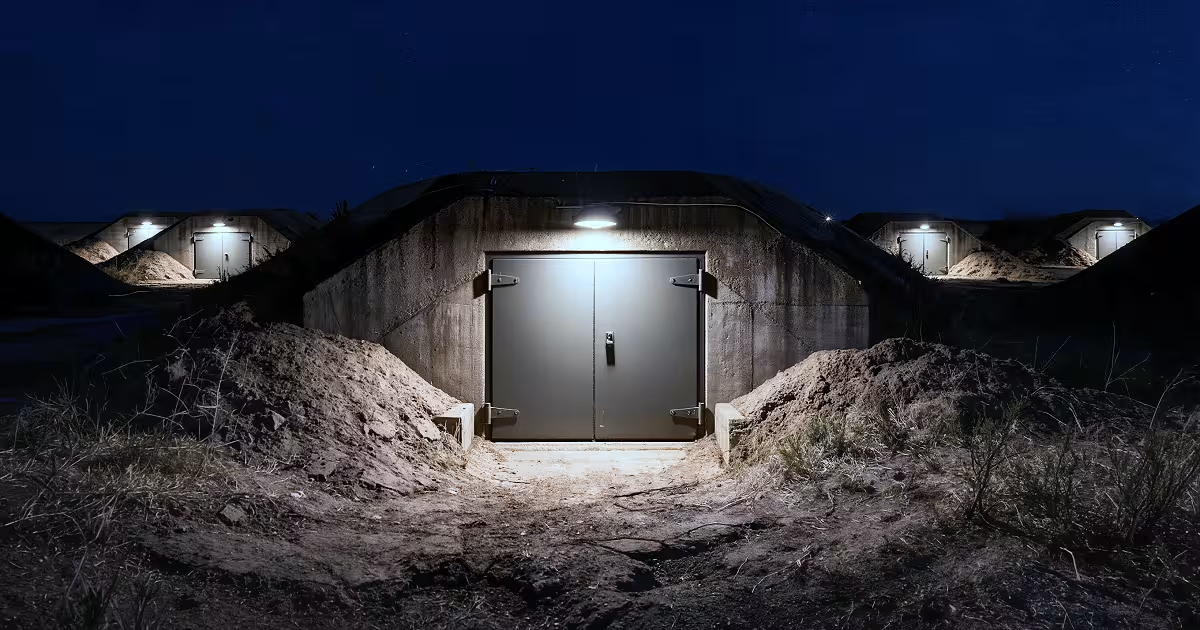
A weapons storage bunker lit by a single lamp at night.
Illustration, not a period photograph.

Opening
On the night of 30 October 1975, two days after the Loring incursions in Maine, people at Wurtsmith Air Force Base near Oscoda, Michigan, another Strategic Air Command bomber base, reported a low-flying craft near the base and over the weapons storage area. Radar tracked low targets.
The wing commander sent a KC-135 tanker that was already in the air to take a look. Its crew saw lights, closed on them, and watched them pull away each time, out over Lake Huron and down to Saginaw Bay, where they lost them. Like Loring, Wurtsmith is known from Air Force and NORAD records later released under FOIA.
Timeline
About 10:10 p.mResidents of base housing see a low-flying object with running lights moving erratically. An airman at the Capehart gate sees a craft with one white searchlight pointing down and two red lights at the rear, heading west-southwest.
10:25 p.mSecurity police report an unidentified helicopter with no lights hovering over the weapons storage area. They hear what sounds like rotors.
10:30 p.mRadar approach control tracks low-flying targets and follows one about 35 miles southeast of the base. The tower sees nothing.
The same hourWing commander Colonel Boardman orders the KC-135, already in the air near the base, to intercept. The crew see strobe-like lights and close to about a mile. Each time they approach, the object speeds up and pulls away. They follow it north over Lake Huron and then south to Saginaw Bay, where it is lost among the lights of fishing boats. Coming back, they see lights near the weapons storage area again.
31 October, 04:45 GMTNORAD's command director's log records the report: a helicopter over the weapons storage area, visual and radar contact by the tanker, and contact lost over Lake Huron.
Following weeksLocal police and the FBI's Saginaw office are told. Air traffic in the area is checked and nothing matches. The Michigan Department of Natural Resources says none of its helicopters were flying.
1984Lawrence Fawcett and Barry Greenwood publish the documents in Clear Intent.
Key figures
The KC-135 crew: Major Frederick Pappas, aircraft commander; Captain K. E. May, co-pilot; Captain Rick Meier, navigator; Captain Myron Taylor, instructor navigator; Captain Randy Higginbotham, instructor pilot; and Sergeant Steve Smith. Taylor later gave the most detailed account of the chase.
Wurtsmith's security police and Sergeant Robert J. Anderson, who watched from the motor pool as a steady red light appeared below the tanker, made the ground reports.
Fawcett and Greenwood brought the documents into the public record.
Physical and documentary trail
The record: the NORAD command director's log entry, National Military Command Center messages on the late-1975 incursions, and later interviews with the tanker crew. The documents record a helicopter-like craft, radar targets and the tanker's pursuit. They don't identify the craft.
Still missing: any radar recording, and a formal Air Force investigation report if one was written.
Things you might not know
- The tanker was the interceptor. No fighters were launched. The only aircraft sent after the object was a KC-135, a four-engined tanker built to refuel bombers.
- It left at about 1,000 knots. Myron Taylor estimated the object was cruising at around 200 knots and accelerated to roughly 1,000 when they got close.
- The lights seemed to talk. Taylor remembered strobe-like flashes passing between two objects, which looked to him like some sort of signal.
- Fishing boats ended the chase. Over Saginaw Bay the crew could no longer tell the object's lights from the boats below.
- A pilot was told to keep quiet. Captain Higginbotham said he was questioned by the Air Force Office of Special Investigations and cautioned not to discuss it.
Competing explanations
Helicopters. The first descriptions are of a helicopter, the security police heard rotors, and SAC treated the incursions as a possible helicopter threat. A civilian or smuggling helicopter over the Lake Huron shore at night is possible. None was identified, and the state's own helicopters were on the ground.
Unknown craft. The tanker's failure to close, the estimated speed on departure and the same pattern at several SAC bases within days are the argument for something else.
Later life of the case
Wurtsmith is usually paired with Loring and Malmstrom as the 1975 northern-tier overflights, one of the better-documented military UFO episodes. The base closed in 1993.
Finding
Something flew over a nuclear weapons area at Wurtsmith and outran a tanker sent after it, and nobody, from the Air Force to the FBI, identified it. A helicopter explains the ground reports well. It explains a 1,000-knot departure badly, though that figure is one crewman's estimate at night.
What still will not resolve: what the KC-135 was chasing over Lake Huron, and whether it was the same thing seen at Loring two nights earlier.
Evidence signature
9/9 Strong
- Witnesses
- trained, independent witnesses
- Instruments
- more than one sensor agrees
- Paper
- formal investigation, court or declassified file
How well documented the case is, not whether it's true. A strong record can still have an ordinary answer, and a thin one can still be real.
You decide · WURTSMITH 1975
What do you think happened?
One vote per case, anonymous. You'll see how other readers voted once you've voted.