ROSWELL SLIDES
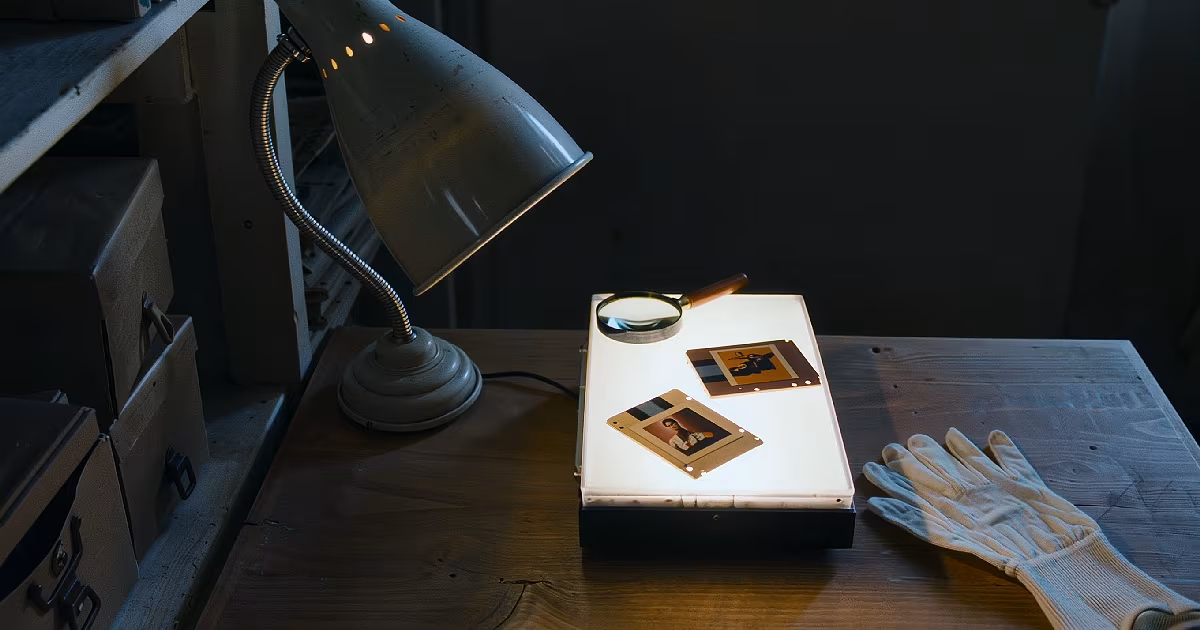
Two old colour slides on a light box beside a magnifier and gloves.
Illustration, not a photograph.

Opening
On 5 May 2015, a ticketed online event from Mexico City set out to show the world two photographic slides. The Roswell researcher Tom Carey, who had spent about three years on them with Donald Schmitt, called them evidence of the highest order. They were said to show a small, desiccated body on its back, from the 1947 Roswell crash. Jaime Maussan, the Mexican UFO promoter, was among the people fronting the reveal, and viewers paid about $20 to watch the stream.
The slides had been found by Adam Dew, a former journalist, who said Kodak experts had dated the film to the late 1940s. Within a week, online researchers had sharpened a label beside the body, read it, and concluded that it showed a child's mummy in a museum display. By then the promoters were defending the slides on one side and a growing list of researchers, some of them former allies, were walking away on the other. It is a case study in how a claim can be tested in public, and how fast.
Timeline
1947The Roswell incident, to which the slides were said to belong.
Before 2015Dew says the two slides turned up in Arizona, in a collection of snapshots said to have belonged to an oil geologist, Bernerd Ray, and his wife Hilda, both dead. Dew Media plans to sell them alongside a documentary. Carey and Schmitt investigate for about three years.
5 May 2015The reveal, described by Carey's team as a "beWitness" event, is streamed from Mexico City. Some viewers report problems with the stream. The date is twenty years after the "alien autopsy" film was unveiled in London.
Before 11 May 2015Sceptics compare the body to a child's mummy. The writer Nick Redfern notes an animal head with a label behind it and suspects both are exhibits from a curiosity museum.
11 May 2015The Roswell Slides Research Group issues a press release saying that software cleanup of the blurred label beside the case reads "MUMMIFIED BODY OF TWO YEAR OLD BOY", with further lines about burial clothing and a lender in San Francisco.
12 May 2015The British writer David Clarke and others publish rebuttals. Schmitt later apologises and says the placard reads as a mummy.
Key figures
Adam Dew found the slides and promoted them through his company, Dew Media.
Tom Carey and Donald Schmitt were Roswell researchers who investigated the slides. Carey defended them and disputed the placard reading, saying several parties had found it unreadable. He also said anthropologists had concluded the body was not a mammal, not a primate and not human. Those reports have not been published. Schmitt later said he had been drawn in and that the image is a mummy, as the placard says.
Jaime Maussan, a Mexican journalist, publicised the slides and posted images of one.
Richard Dolan said he was not convinced the body was alien, only that the slides warranted investigation.
The Roswell Slides Research Group, with researchers including Tim Printy and Lance Moody, made the label identification.
Physical and documentary trail
The record: two Kodachrome slides in cardboard mounts, the enhanced image, the 11 May press release, and the promoters' own statements. The enhanced slide shows a small figure on its back with a placard beside it.
The dating is the promoters' claim. Carey's statement says a Kodak historian dated the slides to 1947 to 1949, from manufacture to exposure. No Kodak statement has been published. Another analysis notes that Kodak stopped making that style of mount in 1949, but processors went on using their old stock, so a mount does not fix the year the photograph was taken. No provenance has been published that ties either slide to New Mexico in 1947, and the Arizona collection claim is a story, not a document.
One analyst has gone further, pointing to a 1939 National Park Service publication describing a two-year-old boy's mummy at the Mesa Verde museum, returned by a San Francisco man whose father had taken it from ruins in 1894, and arguing that this matches the placard and the shelving. That is an inference. It does not show the slides were taken at Mesa Verde.
Things you might not know
- The label was the key. The decisive evidence was not a scientific test but a placard in the picture that became readable once the image was sharpened.
- It was an anniversary. 5 May 2015 was exactly twenty years after the "alien autopsy" film was shown in London, itself later admitted to be a reconstruction.
- It cost $20. Viewers paid to log in, and the stream had errors for some, which left the reveal looking weaker still.
- The case fell apart in under a week. From the reveal to the press release naming the label took six days.
- The promoters were undone from inside. Researchers close to the project, including Schmitt, accepted the mummy reading.
- The same promoter returned. In 2017 Peruvian prosecutors said bodies Maussan had presented were recently made dolls, and in 2023 he showed other bodies to Mexico's Congress. Those are separate cases.
Competing explanations
A museum mummy. The strongest reading is that the slides show a child's mummy in a museum case, photographed there. The placard is the best evidence for it, and the people who made the original claim have largely accepted it.
A Roswell body. The claim as presented. It needs the slides to come from 1947 in New Mexico, and no one has shown that, or published the anthropologists' reports said to support it.
Later life of the case
The slides are now usually cited as a misidentification, and as a lesson in checking an image before building an event around it. Roswell itself, covered in the Roswell 1947 report, is unaffected: its evidence has always rested on other material.
Finding
The best explanation is that the slides show a mummified child in a display case. The label supports it, the researchers who investigated hardest have largely accepted it, and nothing published ties the pictures to Roswell or to 1947. That does not touch the original Roswell evidence, which was never about these slides.
What still will not resolve: which museum the case stood in, and when the photograph was taken. No provenance for the slides has been published beyond the Arizona collection story.
Evidence signature
1/9 Thin
- Witnesses
- nothing on record
- Instruments
- nothing on record
- Paper
- press and later accounts
How well documented the case is, not whether it's true. A strong record can still have an ordinary answer, and a thin one can still be real.
You decide · ROSWELL SLIDES
What do you think happened?
One vote per case, anonymous. You'll see how other readers voted once you've voted.