GHOST ROCKETS
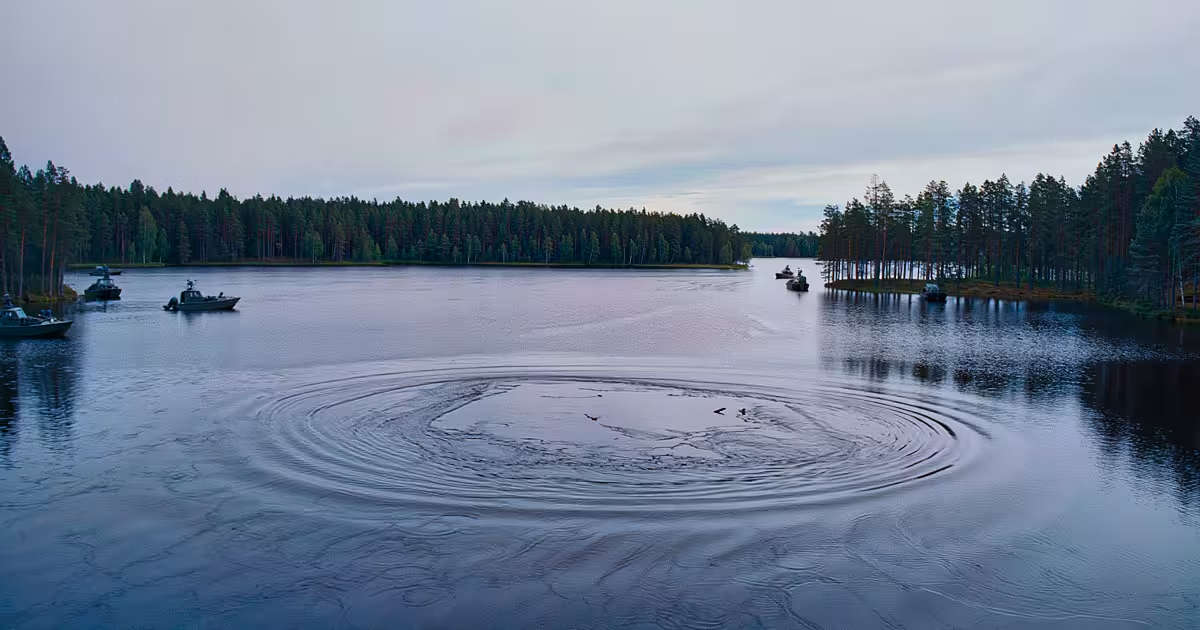
Boats circling a ring of ripples on a still Swedish forest lake.
Illustration, not a period photograph.

Opening
Through the summer of 1946 Sweden and its neighbours logged rocket-like objects in daylight and at dusk: fast, sometimes crashing toward lakes, sometimes silent, sometimes with a hiss. The wave is called ghost rockets because the things looked like weapons in a year when Europe was still counting German stocks and watching the Soviets. Military observers filed. Radar occasionally painted. Recovery teams went to lakes and brought up nothing the general staff would call a rocket.
The Swedish military treated it as a defence problem, not a club story. They asked the Americans and the British. They dragged lakes. The objects did not become a crate in a Stockholm hangar.
Timeline
May 1946First clusters. Through June and July the volume rises, with a midsummer peak. Sweden takes most of the paper. Norway and Finland take the overflow. A few reports sit farther south. Daylight cigars, fireballs, objects that seem to choose a lake and throw up a column.
Military intelligence opens a collection. Fighters are occasionally sent. They do not bring a guest home. After the better crash stories, teams go to water. Lake Kolmjarv becomes the type-scene: witnesses, a splash, a dredge, no rocket on the grab.
August into autumn the wave thins. Staff papers remain. Allied attaches in Stockholm write home. No public wreck is stood up for the press. No serial is read off a fin.
Later UFO books swallow 1946 as a prologue to 1947The staff work is first. The lakes are first.
Key figures
Swedish officers and trained spotters are the record. They had seen real German weapons a year earlier. They thought they knew a meteor from a thing that seemed steered.
Lake witnesses own the splashes. Dredge crews own the empty grabs and the official disappointment.
Allied attaches own the memos that travelled to Washington and London.
Whoever flew them, if anyone did, left no calling card on a Swedish bench.
Physical and documentary trail
The record:
One: the volume of military and civilian reports across Scandinavia, logged as a defence problem.
Two: a smaller set of radar or officer-confirmed tracks.
Three: lake-impact accounts and official searches that did not recover a rocket.
Four: Swedish staff paper and allied liaison notes.
There is no airframe on a bench. There is no Soviet admission that fits the whole wave. There is no meteor catalogue that eats every daylight steered report.
Things you might not know
- Finland saw them first. The earliest reports came from Finnish observers on 26 February 1946, months before the Swedish wave.
- The peak days matched a meteor shower. Sightings peaked on 9 and 11 August, during the Perseids, although most reports did not fall during meteor activity.
- Newspapers were told what not to print. A Swedish Army directive barred papers from giving the place, direction or speed of sightings, in case it helped whoever was testing them.
- Two famous Americans flew in. General James Doolittle and RCA's David Sarnoff arrived in Stockholm in August 1946, officially on business. Sarnoff later said he was convinced the "ghost bombs" were real missiles.
- Greece had them too. The Greek Prime Minister reported projectiles over Macedonia in September 1946. The physicist Paul Santorini, who investigated, said in 1967 they were quickly found not to be missiles.
- No rocket fragment was ever found. That is why Swedish, British and American investigators rejected the popular theory of Soviet tests with captured German V-weapons.
Competing explanations
Foreign tests, Soviet or leftover German, overflying Sweden. This is what the staff feared. It has the shape. It has no wreck.
Meteors and misreads in a nervous summer. Fits some fireballs. Struggles with slow daylight cigars and chosen lakes.
A true unknown wave. Possible. Still empty-handed on the bench.
Later life of the case
By late November 1946 the Swedish Defence Staff had close to a thousand reports. In October it had said publicly that most were vague, but that some clear observations could not be put down to natural phenomena, Swedish aircraft or imagination. A year later the American flying saucer wave began, and the ghost rockets became the opening chapter of modern UFO history. For the lights over Los Alamos a few years on, see the green fireballs.
Finding
Sweden spent the summer of 1946 logging rocket-like objects and dragging lakes that did not give a rocket back.
What still will not resolve: a fragment from those lakes with a 1946 chain, or a foreign test log that owns the tracks.
Evidence signature
7/9 Strong
- Witnesses
- trained, independent witnesses
- Instruments
- radar or measured data
- Paper
- official records at the time
How well documented the case is, not whether it's true. A strong record can still have an ordinary answer, and a thin one can still be real.
You decide · GHOST ROCKETS
What do you think happened?
One vote per case, anonymous. You'll see how other readers voted once you've voted.