GOOSE BAY
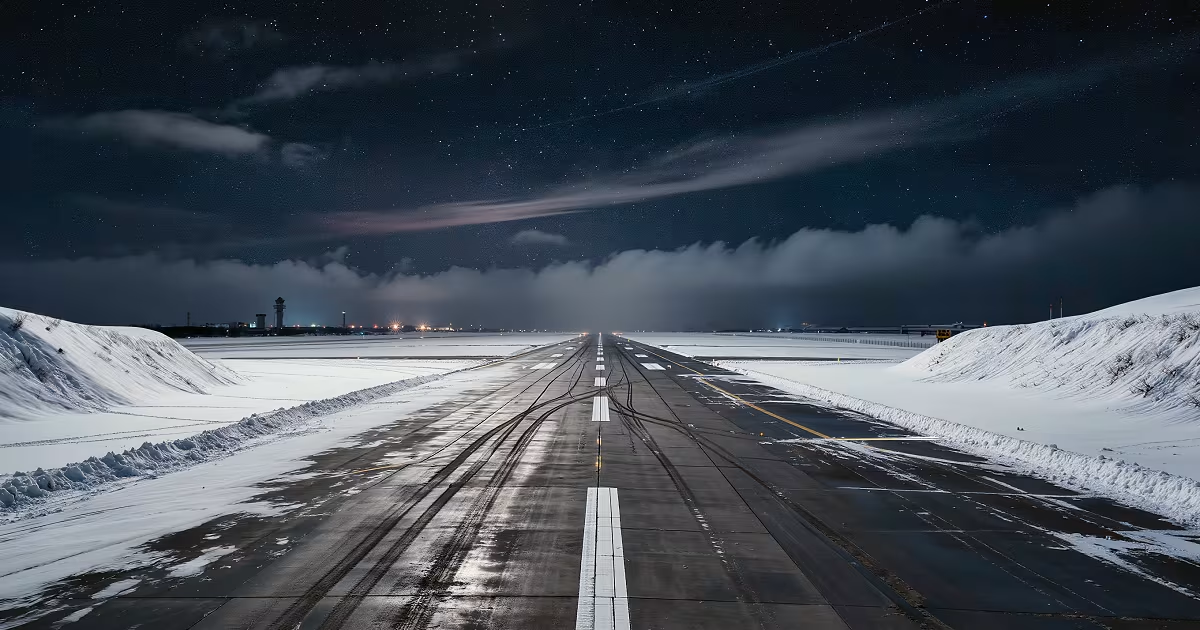
A snow-edged runway at Goose Bay, Labrador, at night.
Illustration, not a period photograph.

Opening
Goose Bay Air Force Base, built by the Royal Canadian Air Force in the remote wilderness of Labrador between 1941 and 1943 and later shared with American and British forces during the Cold War, generated one of the most sustained clusters of radar-visual UFO incidents at any single military installation in North America.
Between 1951 and 1956, U.S. Air Force intercept crews and ground radar operators at the base logged at least six formally documented cases, each involving simultaneous or near-simultaneous radar and visual contact with objects performing maneuvers period aircraft could not replicate, all catalogued in Project Blue Book's own official Unknowns list. A seventh, less formally documented account involves an entire night of ground radar contacts that airborne interceptor radar could never confirm, and, at the case's fringes, a considerably less substantiated secondhand claim about something else entirely patrolling the base's perimeter.
Timeline
13 September 1951, 9:30 p.mTechnical Sergeant Warner B. Maupin and Corporal John W. Green track two objects on ground radar at Goose Bay AFB on what appears to be a collision course; one operator attempts to warn what he believes may be an actual aircraft, and is surprised to watch it maneuver to avoid the apparent danger on its own. A third unidentified target joins the first two, and the full incident lasts more than fifteen minutes.
19 June 1952, 2:37 a.mSecond Lieutenant A'Gostino and other airmen outside see a red-lit object approach the field; simultaneously, radar operators pick up a corresponding track. The radar blip suddenly enlarges, as though the object had banked to present a larger surface to the beam, while the airmen watch the light wobble before turning white and vanishing upward at speed, consistent with a steep climb. Blue Book's own records note the radar and visual observations, while closely timed, are technically recorded as separate rather than confirmed simultaneous, a distinction later UFO writer Donald Keyhoe's popular account glossed over.
26 November 1952, 5:56 p.mAn F-94B from the U.S. Air Force's 59th Fighter-Interceptor Squadron, based at Goose Bay, pursues a maneuverable object changing color from white to red over a full fifteen minutes, achieving a brief radar lock-on before the object outmaneuvers the intercept.
Late December 1952 or early January 1953, per radar maintenance technician Bob Jones's own later written account. During a severe winter storm with winds gusting to 70 mph and visibility under twenty-five yards, ground radar tracks unidentified targets for an extended period while the base's own F-94 interceptors sit grounded and moored against the storm. No airborne aircraft is in the area to account for the contacts. When the storm eases and jets are scrambled, their own airborne radar cannot detect anything corresponding to what ground radar had tracked all night, targets that eventually fade from the ground scope more than a hundred miles southeast of the base. Jones specifically recalls the pilots' skepticism toward the ground crew directing them into what the ground radar insisted was occupied airspace, given the total mismatch between the two radar systems' respective pictures of the sky that night.
1 May 1953, 11:35 p.mCaptain R. L. Emberry and radar operator Lieutenant J. R. Morin, flying an F-94 interceptor at 24,000 feet roughly ten miles south of the base, along with an independent control tower observer, see a white light with a visible afterburner-like glow at 10,000 feet. The F-94 pursues, both aircraft climbing to 40,000 feet, before the object climbs out of sight entirely after a thirty-minute chase.
4 May 1953, 1:50 a.mA separate witness sees a football-shaped metallic object caught briefly in the glare of a rotating airfield beacon near the base, traveling south at high speed and low altitude before disappearing into low stratus clouds, reporting a distinctive sound "like tins striking together" as it passed.
12 February 1956, 10:55 p.mTwo F-89D fighters at 20,000 feet, crewed by pilot Bowen and radar observer Crawford in one aircraft, see a green and red object roughly 40 miles southeast of the base; it rapidly circles their jet while the second fighter obtains a radar track without visual contact. Approximately fifteen minutes later, Goose Bay's own ground radar independently paints a stationary target 40 miles southwest of the base. The two pilots vector toward it and achieve radar contact, but the object vanishes the moment they close to within eight miles.
1958-1959, per a secondhand account relayed decades later to a paranormal researcher. A U.S. Air Force Office of Special Investigations sergeant stationed at Goose Bay is said, according to his son's later, unverifiable written recollection, to have personally investigated both unidentified aerial phenomena and separate reports of large bipedal creatures near base security patrols, with all such reports allegedly suppressed by the base commander in a manner the son compares to the unrelated and separately disputed Rendlesham Forest case in England. This specific claim rests entirely on one secondhand family recollection relayed after the original source's 1978 death and has never been independently corroborated by any surfaced military record.
Ongoing, per official Project Blue Book classificationEach of the formally documented radar-visual incidents above (1951, 1952 twice, 1953 twice, 1956) remains catalogued among Blue Book's own official "Unknowns," cases the project's own investigators were unable to resolve to a conventional explanation despite direct military radar and pilot involvement.
2022Canadian researcher Chris Rutkowski compiles and cross-references this full cluster of incidents in Canada's UFOs: Declassified, situating Goose Bay's documented radar-visual history within his broader review of the country's Cold War-era military UFO record.
Key figures
Maupin and Green are the case's earliest formally documented witnesses, ground radar operators whose detailed, timed account of a near-collision and a third joining object established the base's pattern of unresolved radar contacts years before the more famous individual incidents that followed.
Jones is the case's most vivid firsthand narrative source, a radar maintenance technician whose own later written recollection of the storm-night incident captures both the technical mismatch between ground and airborne radar systems and the very human friction between skeptical pilots and insistent ground crew that the mismatch produced.
Bowen and Crawford, along with the second F-89 crew, represent the case's most dramatic single encounter, a period in which an intercepting jet crew and independent ground radar corroborated each other's contact with an object that specifically evaded confirmation the moment pursuing aircraft closed to visual range.
The unnamed OSI sergeant and his son represent the case's least substantiated thread, a secondhand, decades-later family account of suppressed investigations that, whatever its sincerity, has never been corroborated by any surfaced document and should be weighed as considerably less evidentially solid than the formally logged Blue Book cases above it.
Rutkowski is the case's most significant modern compiler, whose cross-referenced review situates Goose Bay's cluster of incidents within Canada's broader, independently documented Cold War military UFO record rather than treating each incident in isolation.
Physical and documentary trail
The record has an unusually dense concentration of formally logged Project Blue Book "Unknown" cases from a single installation, official Air Technical Intelligence Center reports, named pilot and radar operator testimony recorded close to the events themselves, and a later independent researcher's cross-referenced compilation drawing on multiple original archival sources.
What it lacks, for the formally documented cases, is any confirmed identification despite direct military radar and intercept-aircraft involvement in most incidents; for the separate, less substantiated Bigfoot-adjacent claim, it lacks any corroborating document, named contemporaneous witness, or surfaced military record beyond one family's secondhand oral history relayed long after the original source's death.
The jet pilots had placed their lives at risk with no results... not only were they flying in below minimum conditions due to the storm but were directed to fly into areas that were thought to be occupied by other aircraft.
Things you might not know
- A jet chased one for 25 minutes. On 15 December 1952 an F-94, guided by ground radar, pursued a reddish light that turned white as it manoeuvred, and could not catch it.
- Another climbed out of sight. On 1 May 1953 an F-94 crew and the control tower watched a white light with what looked like an afterburner; after about half an hour it climbed away.
- The interceptors came from one squadron. Several of the chases were flown by the 59th Fighter-Interceptor Squadron, based at Goose Bay.
- The reports kept coming. In February 1956 an F-89 crew reported a red and green object circling their aircraft while it showed on radar.
Competing explanations
Radar anomalies and equipment limitations specific to the era's technology, particularly the storm-night incident's own WWII-vintage CPS-5 radar system, which period ground crews themselves acknowledged could produce false or exaggerated returns under certain atmospheric conditions, a reading period pilots' own skepticism toward the ground crew's contacts directly supports for at least that specific case.
Misidentified conventional or experimental military aircraft, given the base's genuine, well-documented role hosting American, British, and Canadian forces during an active Cold War buildup, with classified aircraft testing or unfamiliar allied aircraft types potentially accounting for individual sightings without requiring any single unifying cause across the full cluster.
A genuine pattern of unconventional aerial activity specifically drawn to or operating near this particular remote northern radar installation, the reading Blue Book's own repeated "Unknown" classifications leave open, given that trained intercept pilots and independent ground radar operators across five separate years were unable to produce a conventional identification despite direct pursuit and radar lock-on in multiple incidents.
An entirely separate, evidentially much weaker claim regarding ground-based creature encounters, which this report treats as categorically distinct from the well-documented aerial radar cluster above it, resting on secondhand testimony alone with no corroborating primary source of any kind.
Later life of the case
Goose Bay's documented radar-visual UFO cluster remains a significant reference point in Canadian and American Cold War-era UFO literature specifically because of its sheer density, six or more formally logged Unknowns from a single installation across five years, and its combination of ground radar, airborne radar, and direct pilot visual testimony working in genuine, if often only partial, mutual corroboration. Rutkowski's more recent compilation work has helped situate the base's history within a broader, still-actively-researched Canadian military UFO record.
Finding
Goose Bay Air Force Base generated one of the densest documented clusters of formally unresolved radar-visual UFO incidents at any single Cold War-era military installation, spanning at least five separate years and involving named pilots, radar operators, and ground crew whose testimony was close to contemporaneous and, in several cases, independently corroborated across separate radar systems. Each of these core incidents remains an official Project Blue Book Unknown. Separately, a considerably less substantiated secondhand claim regarding suppressed creature encounters at the same base rests entirely on one family's oral history and should not be weighed alongside the formally documented aerial cluster.
What still will not resolve: any confirmed identification for the base's repeated radar-visual contacts despite direct pilot pursuit and radar lock-on across multiple separate incidents, and, entirely separately, any independent corroboration whatsoever for the unrelated ground-encounter claim. This report keeps those two threads distinct rather than letting the weaker one borrow credibility from the genuinely well-documented one.
Evidence signature
9/9 Strong
- Witnesses
- trained, independent witnesses
- Instruments
- more than one sensor agrees
- Paper
- formal investigation, court or declassified file
How well documented the case is, not whether it's true. A strong record can still have an ordinary answer, and a thin one can still be real.
You decide · GOOSE BAY
What do you think happened?
One vote per case, anonymous. You'll see how other readers voted once you've voted.