PROJECT BLUE BOOK
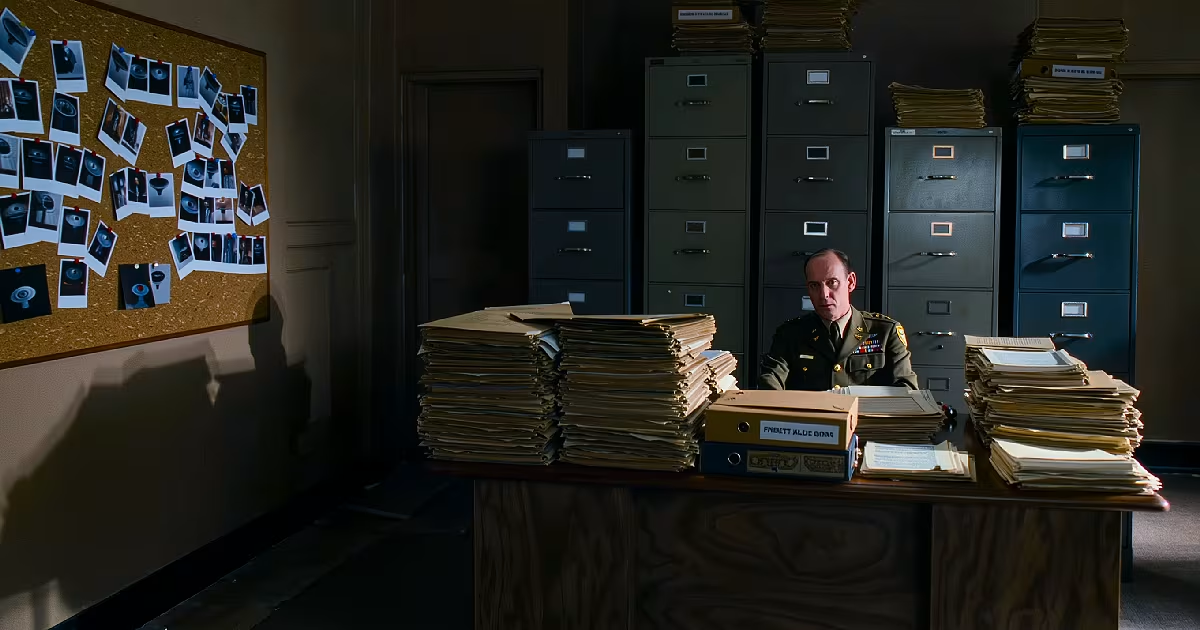
An Air Force officer behind stacks of Blue Book case files.
Illustration, not a photograph.
Opening
For seventeen years, from 1952 to 1969, the United States Air Force ran an official programme to investigate UFO reports. It was called Project Blue Book, it was based at Wright-Patterson Air Force Base in Ohio, and by the time it closed it had collected 12,618 reports. The Air Force explained most of them as balloons, aircraft, planets, meteors and hoaxes. It could not explain 701. Blue Book was where Edward Ruppelt coined the term "unidentified flying object", where J. Allen Hynek went from sceptic to believer, and where, according to a general's memo written as it closed, the most serious cases were never filed in the first place.
Timeline
1947. After Kenneth Arnold's sighting and the summer's wave of flying saucer reports, the Air Force sets up Project Sign at Wright Field to study them. Some of its staff come to suspect the objects are interplanetary.
1949. Sign is replaced by Project Grudge, which takes a much more dismissive line and is widely seen as having set out to explain reports away.
March 1952. Grudge is reorganised as Project Blue Book under Captain Edward J. Ruppelt, at the Air Technical Intelligence Center. Ruppelt takes the job seriously and introduces the term "unidentified flying object" in place of "flying saucer".
July 1952. Radar and visual sightings over Washington, D.C., on two weekends in a row, make front pages around the country. The Air Force holds its biggest press conference since the Second World War to explain them as temperature inversions.
January 1953. The CIA-sponsored Robertson Panel reviews the evidence for four days and recommends that the government work to reduce public interest in UFOs and "debunk" reports. Blue Book's role shrinks.
1953. Air Force Regulation 200-2 restricts public discussion of unsolved cases, and the military communications rule JANAP 146 makes reporting UFO sightings outside official channels an offence, punishable by prison and fines of up to $10,000.
1953 to 1963. Ruppelt leaves. Blue Book is run in turn by Captain Charles Hardin, Captain George Gregory and Lieutenant Colonel Robert Friend, with a small staff and a growing reputation for explaining things away.
May 1955. The Air Force releases Project Blue Book Special Report No. 14, a statistical study by the Battelle Memorial Institute of 3,201 cases. About 21.5 percent are unknowns. The better the quality of the sighting, the more likely it was to be unexplained.
1956. Ruppelt publishes The Report on Unidentified Flying Objects, a frank insider's account of his years at Blue Book.
August 1963. Major Hector Quintanilla takes charge, and leads Blue Book until its end.
March 1966. Hynek's "swamp gas" suggestion for the Michigan sightings becomes a national joke. Congressman Gerald Ford calls for hearings, and the Air Force agrees to fund an independent scientific study at the University of Colorado under physicist Edward Condon.
January 1969. The Condon Report concludes that further study of UFOs is unlikely to advance science.
20 October 1969. Brigadier General Carroll H. Bolender writes the memo recommending Blue Book's closure. It notes that reports of UFOs which could affect national security are not part of the Blue Book system, and will continue to be handled through standard Air Force procedures.
17 December 1969. Secretary of the Air Force Robert Seamans announces that Blue Book will end. Its last operations wind down in January 1970.
1970s. The files are declassified and transferred to the National Archives, with witnesses' names removed.
Key figures
Edward Ruppelt is remembered as Blue Book's best director: open-minded, organised, and the man who gave the world the word UFO. He died in 1960, aged 37. J. Allen Hynek was the project's scientific consultant throughout, and its most famous convert. Hector Quintanilla ran it longest and, in the eyes of most researchers, most dismissively. Edward Condon's study gave the Air Force its reason to stop. Carroll Bolender wrote the memo that raises questions to this day.
Outside the Air Force, Donald Keyhoe and NICAP spent years accusing Blue Book of covering up, and University of Arizona physicist James McDonald pressed Congress in the late 1960s, arguing that Blue Book's explanations often did not fit the facts.
Physical and documentary trail
Blue Book's files are one of the largest government UFO collections in the world, and they are public. The National Archives holds them on microfilm, and they have been digitised and posted online many times. Each case file typically contains a witness questionnaire, correspondence, investigators' notes and an evaluation. The 701 unidentifieds include some of the best-known cases in the field.
The most famous of them is Socorro, New Mexico, on 24 April 1964, where police officer Lonnie Zamora saw an egg-shaped craft on the ground and two small figures beside it, then watched it take off with a roar and a flame. Blue Book investigated and left it unidentified, and Hector Quintanilla, its sceptical director, called it the best-documented case on record. Other cases show the opposite problem. At Levelland, Texas, in November 1957, more than a dozen drivers said a glowing egg-shaped object made their engines and headlights fail as it passed. Blue Book's answer was ball lightning or St. Elmo's fire in stormy weather, an explanation many researchers have never accepted.
The Air Force's stated conclusions when the project closed were that no UFO it had studied was a threat to national security, that none showed technology beyond present scientific knowledge, and that there was no evidence any were extraterrestrial vehicles.
Things you might not know
- Blue Book gave us the word UFO. Edward Ruppelt introduced "unidentified flying object" because he thought "flying saucer" was misleading and made the subject sound silly.
- The best cases were the hardest to explain. Battelle's 1955 study found that about a third of the "excellent" sightings were unknowns, compared with fewer than one in five of the poorest. A real mistake should have worked the other way round.
- Unknown had a higher bar than known. In the Battelle study, a case could be labelled known if two analysts agreed, but every analyst had to agree before it was called unknown.
- The serious cases went elsewhere. The 1969 Bolender memo says outright that UFO reports which could affect national security were not part of the Blue Book system.
- Reporting a UFO to the press could land you in prison. Under JANAP 146, military personnel who reported sightings outside official channels faced prison and fines of up to $10,000.
- Gerald Ford pushed for the hearings. The future president, then House Republican leader from Michigan, called for a congressional inquiry after the 1966 Michigan sightings in his home state.
- Its toughest sceptic called Socorro the best case. Hector Quintanilla, who explained away more cases than anyone, left Lonnie Zamora's 1964 landing unidentified and called it the best-documented case on record.
- Its staff was tiny. For much of its life, Blue Book was run by a junior officer with a handful of staff, responsible for every UFO report in the United States.
Competing explanations
An honest, under-resourced study. In this view, Blue Book did its best with limited staff, explained most reports correctly, and the 701 unknowns are simply cases with too little information to solve.
A public front. Critics, from Keyhoe to modern researchers, argue that Blue Book was a public-relations exercise, there to collect reports and calm the public while the important cases were handled in secret. The Robertson Panel's debunking advice and the Bolender memo are their strongest evidence.
Both at once. Many researchers think the truth is in between: real, conscientious people at Blue Book, doing a job that the Air Force had already decided would lead nowhere, while the cases that mattered went through other channels.
Later life of the case
When the Pentagon's AATIP programme was revealed in 2017, and the government began releasing UAP reports again, Blue Book was the obvious comparison. Researchers have catalogued its unknowns, and AARO's 2024 historical report went back over the Blue Book era.
Finding
Blue Book did what it was set up to do: it took in reports and explained most of them. But its own statistics showed that the best-observed sightings were the hardest to explain, its own government advised it to debunk rather than investigate, and its own closing memo admitted that the cases that might matter most were never part of it.
What still will not resolve: the 701 unidentifieds, and where the national security reports went instead. The Bolender memo says those channels existed. Nobody has yet produced their files.