MILTON TORRES
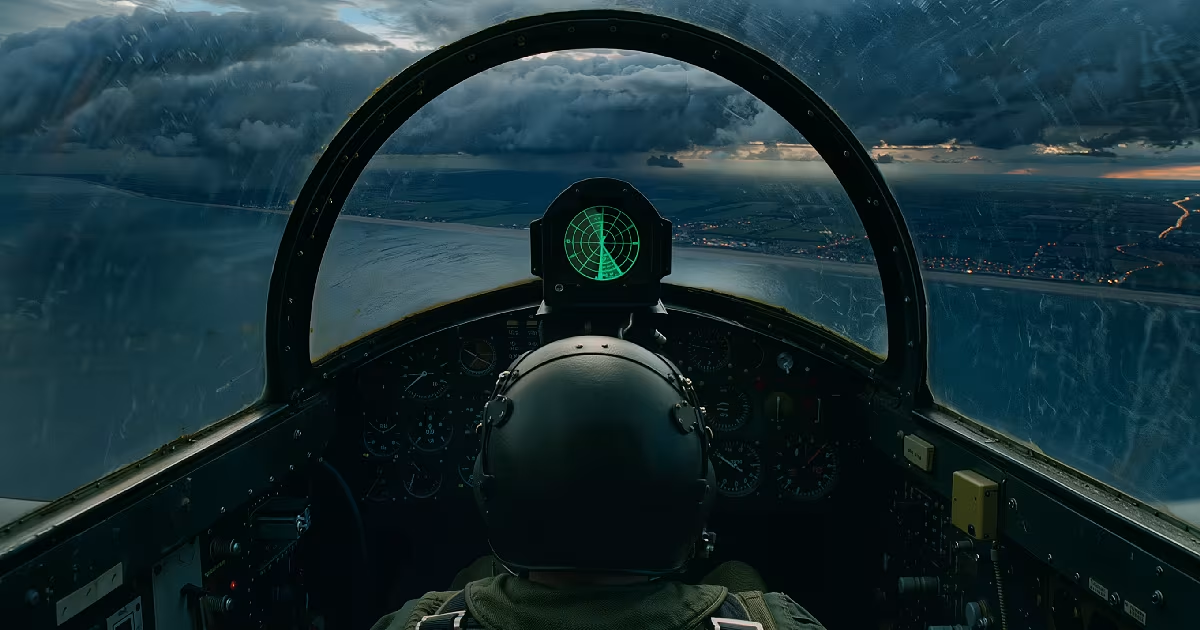
Night sky over East Anglia. Cockpit glow, empty radar sky.
Illustration, not a period photograph.
Opening
On the night of 20 May 1957, Lieutenant Milton Torres, a 26-year-old US Air Force pilot flying an F-86D Sabre out of RAF Manston in Kent, was scrambled after an unidentified radar target over East Anglia. A British ground controller ordered him to fire a full salvo of 24 rockets at it. Torres locked on at about 15 miles. It was, he said later, "the best target I could ever remember locking on to", as big on his radar as an aircraft carrier. Before he could fire, it broke the lock and left at a speed he estimated as at least Mach 10. The next day, he said, a man in civilian clothes warned him never to talk about it. He kept quiet for more than thirty years.
Timeline
August 1956. Nine months earlier, in the same region, RAF Lakenheath and Bentwaters radars and a Venom night fighter track unidentified targets for hours. The Lakenheath-Bentwaters incident becomes one of the best-known radar-visual cases in UFO history.
20 May 1957, night. Torres, of the 514th Fighter-Interceptor Squadron, and his wingman take off from Manston. The ground-controlled intercept station at RAF Bawdsey on the Suffolk coast, backed by RAF Neatishead radar in Norfolk, vectors them toward a target that has been behaving oddly, hanging motionless for long periods over the Ipswich area.
During the intercept. Torres is told to arm all 24 of his "Mighty Mouse" rockets and fire a full salvo. He asks for authentication of the order and receives it.
The lock. He locks on at maximum range. The return is huge. Then it moves away so fast that it breaks his radar lock, and vanishes from his screen.
The next day. A civilian in a dark trench coat debriefs Torres and warns that talking would be treated as a national security breach. Torres later believes the man was from the National Security Agency.
1988 to 1992. Torres first tells the story at a Manston reunion, then types a full account for British researcher Harry Harris in 1992.
October 2008. The UK Ministry of Defence releases UFO files that include Torres's account. The case becomes international news. Neither the MoD nor the USAF finds any contemporary record of the incident itself.
Key figures
Milton Torres was the pilot. He later flew combat missions in Vietnam and retired from the Air Force as a major in 1977. His accounts of the night have stayed consistent over decades.
The ground controllers at RAF Bawdsey gave the order to fire. They're not named in public accounts.
The man in the trench coat delivered the warning.
David Clarke, a British journalism academic who worked on the MoD's UFO file releases, has written about the case and its possible explanations.
Physical and documentary trail
On the paper: Torres's own accounts, and their appearance in the MoD files released in 2008. There's no contemporary radar log or record of the order in the public domain, and records from that period for the stations involved haven't been found.
The best target I could ever remember locking on to.
Competing explanations
A real unknown object. An experienced pilot followed a confirmed order, locked on to something huge that ground radar was also tracking, and saw it leave at impossible speed.
A radar spoofing test. In the late 1950s, the US was working on electronic warfare that could inject phantom targets into enemy radar. A secret test against British radar would explain the object's size, stillness, and sudden speed, as well as the security visit. The best-known programme of this kind, the CIA's Palladium, dates from the early 1960s, so it would need an earlier, still-classified version to fit. No document confirming a test on 20 May 1957 has been released.
A radar malfunction or atmospheric effect. Faulty equipment or unusual conditions could produce a false target. That's harder to square with both ground and airborne radar tracking it.
Later life of the case
The 2008 release made Torres one of the best-known Cold War UFO witnesses. His account is often paired with Lakenheath-Bentwaters, as evidence that East Anglia in the 1950s was an area where British and American radars regularly tracked things they couldn't identify.
Finding
A credible pilot was ordered to fire on something, and the order was confirmed. That much has never been challenged. What he was ordered to fire at is unknown. A secret radar spoofing test would explain it neatly, and nobody has ever shown that one took place.
What still will not resolve: the Bawdsey and Neatishead radar records for 20 May 1957, and who the man in the trench coat worked for.