BIG SUR
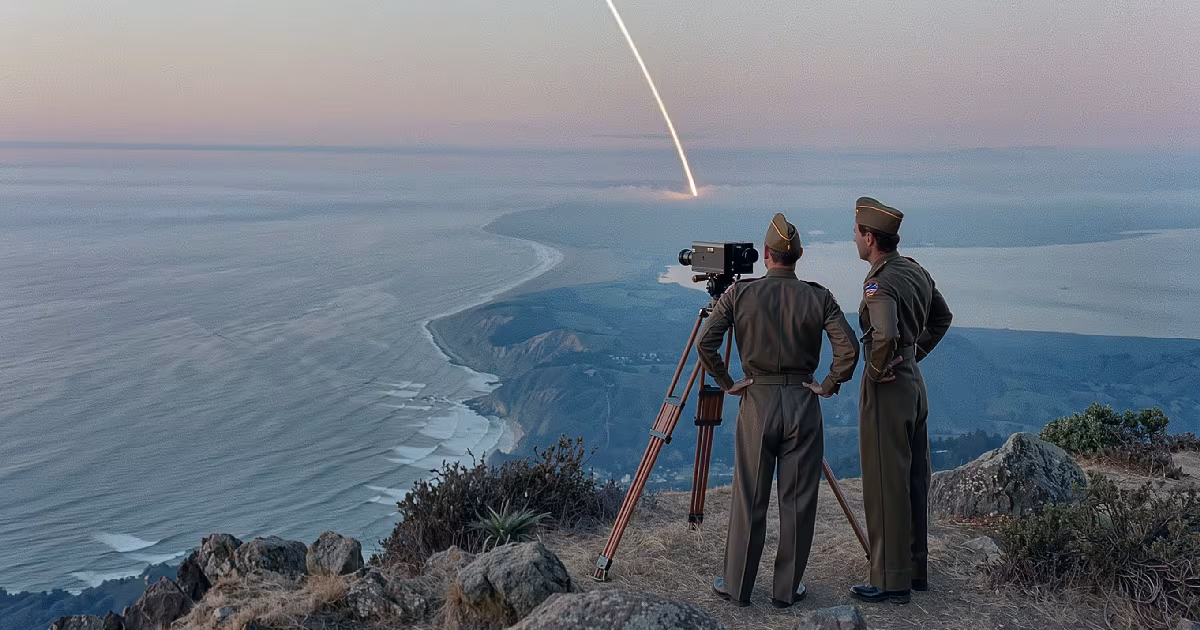
Big Sur coastline at dawn. Telescope dome, missile trail.
Illustration, not a period photograph.
Opening
In September 1964, a US Air Force team filmed an Atlas missile launched from Vandenberg Air Force Base, using a powerful telescope on a mountaintop above Big Sur in California. Lieutenant Robert Jacobs, the officer in charge of the camera team, later said the film showed something no one expected: an object flying up to the dummy warhead, circling it, and firing flashes of light at it, after which the warhead tumbled out of its path. He said his commanding officer showed him the film in private and then handed it to two men in civilian clothes, and that he was told the event had never happened. The film has never surfaced. The engineer who ran the project says it showed ordinary decoys being released. For once, the argument is between two insiders.
Timeline
1964. The Air Force is testing whether Atlas missiles can carry decoys to fool Soviet defences. To see the separation, it sets up a 24-inch telescope, built with Boston University, on Big Sur's coastal mountains, feeding an image orthicon camera, a sensitive TV-type tube, and a film recorder.
September 1964, dawn. An Atlas launches from Vandenberg. Sources give the date as 15 or 22 September. The Big Sur team, from the 1369th Photographic Squadron, films it from about 4,000 feet in the Los Padres National Forest, more than 100 miles from the launch pad.
A day or two later. According to Jacobs, he's called to the office of Major Florenz Mansmann, a senior officer in the 1st Strategic Aerospace Division at Vandenberg. Two men in civilian clothes are there. Mansmann runs the film on a projector and points out the object. The two men take the film. Mansmann tells Jacobs to treat it as if it never happened.
1982. Jacobs tells the story in the National Enquirer.
1980s. Mansmann, by then retired, confirms in writing to researchers that he saw the film, that it showed an unexplained object, and that it was taken away by the men in civilian clothes.
1989 and 1993. Kingston George, the project's engineer, publishes rebuttals in the MUFON journal and the Skeptical Inquirer. He says the film showed the reentry vehicle releasing decoys and debris, then classified.
Key figures
Robert Jacobs, the officer in charge of the camera team, gave the core account and repeated it for decades.
Florenz Mansmann, Jacobs's superior and the man who showed him the film, confirmed the story in later years. That makes it one of the rare cases where a senior officer backs a junior officer's account.
Kingston George, the project engineer who designed the telescope set-up, disputes it. Supporters of Jacobs question whether George ever saw the specific film Mansmann showed.
Physical and documentary trail
On the paper: Jacobs's and Mansmann's accounts, and George's rebuttals. The film itself has never been released or found.
George's key technical point: at more than 100 miles, the warhead and any nearby object would have been tiny on the camera tube, less than six thousandths of an inch long. Only glints of sunlight would show. He argues no shape, beam, or circling path could have been resolved. Jacobs's supporters reply that Mansmann saw a clear object, and that the camera was designed to see exactly this kind of event.
Competing explanations
A real interception. An unknown craft approached and disabled a dummy warhead, and the film was taken because of what it showed. Two officers, one senior, back this account, and the secrecy around the film fits.
Decoy release. The missile was testing decoys meant to confuse enemy defences. Small charges released false targets, with trailing packing material and debris, and on a small, bright, blurry image this could look like one object circling another and flashing. The test was classified, which would explain the secrecy without anything unusual. This is the project engineer's account.
Later life of the case
Big Sur became one of the best-known "UFOs and nuclear weapons" stories. It features in documentaries alongside Malmstrom 1967 and other missile-site cases, and has been raised in modern discussions of UAP and nuclear security.
Finding
Two officers say they saw a film of something disabling a warhead, and the engineer who built the camera system says it showed decoys that the camera couldn't have resolved in detail. Without the film, neither account can be tested. The decoy explanation fits the equipment. The officers' testimony, especially Mansmann's, is why the case stays open.
What still will not resolve: the film. Until it turns up, this is two memories against one engineer.