TEHRAN UFO INCIDENT
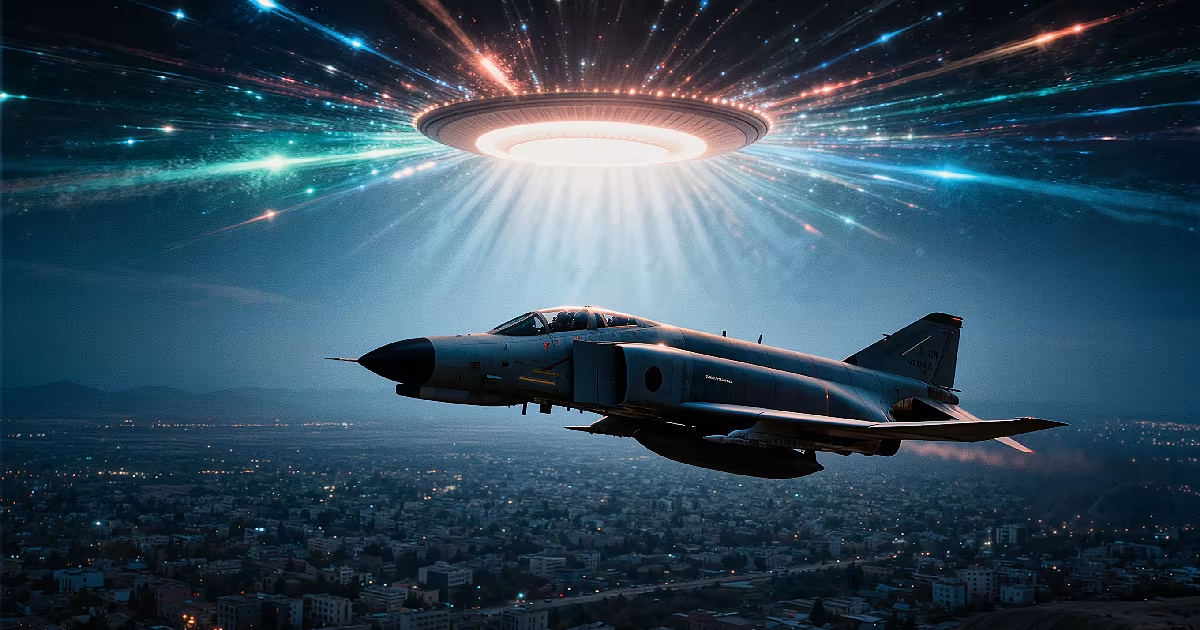
Tehran 1976 intercept.
Illustration, not a period photograph.
Opening
In the first hour of 19 September 1976 the command post of the Imperial Iranian Air Force in Tehran began taking calls from Shemiran. People said a bright object was over the north of the city. Some called it a bird. Some called it a helicopter. There were no helicopters up. Gen. Yousefi, assistant deputy commander of operations, told the first callers it was a star, then rang Mehrabad tower, then stepped out and looked. He saw a light larger and brighter than a star. He ordered an F-4 Phantom II off Shahrokhi Air Base at Hamadan.
The first jet left at 01:30. Forty nautical miles north of Tehran the crew flew toward a light they could see from seventy miles. As they closed, instruments and communications dropped. They turned away. The systems came back. At 01:40 a second F-4 went, flown by Maj. Parviz Jafari with 1st Lt. Jalal Damirian in the back seat. They took a radar lock at twenty-seven nautical miles. The return, they said, looked like a Boeing 707. When Jafari went for an AIM-9, the weapons panel died. A smaller, brighter object left the main body and came at the jet. He broke off. A second small object went to the ground and lit two or three kilometers of earth.
The spine of the file is the American cable written from the Iranian debrief the same morning. Lt. Col. Olin E. Mooy of the U.S. Military Assistance Advisory Group put it on a Defense Intelligence report. Maj. Roland B. Evans evaluated it. The pages went to the White House, State, the Joint Chiefs, CIA, and NSA. That distribution is why Tehran is not only an IIAF ready-room story.
Timeline
18-19 September 1976, about 00:30. Four civilian calls from Shemiran. No helicopters airborne.
After the tower check. Yousefi looks with his own eyes and scrambles the first F-4 from Shahrokhi, a long run from Hamadan into the Tehran sky.
01:30. First Phantom airborne. Visual on a brilliant object. Instrumentation and UHF fail on the approach. Restore after the turn.
01:40. Second Phantom airborne. Radar lock. Closing rate logged in the cable. Weapons-system loss when the crew prepares to fire. One object outbound toward the jet. One object down to the ground.
Descent into Mehrabad. Night vision ruined by the light. The crew orbits, then lands. Tower and crew mark a ground glow. A later civilian report of an object in a field sits in some retellings. The cable’s clean fact is the marked position and the landing trouble.
Morning of 19 September. IIAF debrief at Shahrokhi. Mooy writes the teletype that becomes IR 6846-013976. Evans adds the evaluation that later posters quote as “outstanding report.”
31 August 1977. The DIA pages begin to move in FOIA form. The public case is those pages plus Jafari’s later talks.
Key figures
Parviz Jafari is the second-scramble pilot and the name the later file keeps. In 1976 he is an IIAF squadron officer in an F-4. In 2007 he repeats the night at a National Press Club table. Those two Jafaris agree on lights, a lock, a dead weapons panel, and an object that came at him. The cable is still the better clock.
Jalal Damirian is the radar man. The lock and the 707-sized return are his trade. He is easier to lose in English writeups than Jafari is. The cable does not make the night a one-pilot story.
The first-scramble crew is unnamed in most public copies. Their failure-and-restore pass is the control experiment for the second jet.
Gen. Yousefi is the ground officer who looked, then launched. Without that look the file is four phone calls.
Olin Mooy and Roland Evans are the American clerks of the debrief. They did not fly the intercept. They did put it on a list that reached NSA and the White House.
Physical and documentary trail
On the paper, September 1976 gives you four hard objects.
One: civilian calls logged at the command post, then a general’s visual from the ground, then two official scrambles. That sequence is in the cable.
Two: two independent F-4 crews reporting avionics and comms loss near the object, with restore when distance opened. That is the interference claim in military language, not a magazine headline.
Three: the second jet’s radar lock and the weapons-panel failure at the moment of a planned AIM-9 shot. The cable says the radar picture resembled a 707. It does not give you a gun-camera still.
Four: Defense Intelligence Report IR 6846-013976 and Evans’s evaluation, distributed across the U.S. national-security desk in 1976 and released the next year. “Outstanding report” and “classic” are evaluation stamps on that packet, not a finding that names a manufacturer.
There is no public Iranian gun-camera frame. There is no wreckage from the ground glow. There is no posted Mehrabad radar plot a stranger can audit. Jafari’s later interviews add color. They do not replace the cable.
An outstanding report. This case is a classic which meets all the criteria necessary for a valid study of the UFO phenomenon.
Competing explanations
Astronomical body plus cockpit failure. Jupiter and a bright star have been offered for the ground visual. This reading has to carry two Phantoms losing radios and a weapons bus at close range, then getting them back when they turned. Independent electrical faults on two jets in the same hour are possible. They are not the simplest story the cable tells.
Misread tanker or airliner. A 707-class radar paint is exactly what a tanker looks like. This reading accounts for the lock. It does not account for a light seen seventy miles away, a ground splash two or three kilometers wide, or a weapons panel that dies as the crew squeezes the problem.
Electronic warfare or a test the IIAF was not read in on. 1976 Iran still hosted American advisors. A jamming run could explain radios and a weapons bus. It would also require someone to light Shemiran and Mehrabad and then stay off every later inventory. Possible. Not shown on the cable.
Unknown craft. This is the reading Evans’s stamp invites and that Jafari later carries to Washington. It accounts for performance, interference, and the small objects leaving the main body. It still has no piece of hardware on a bench.
Later life of the case
FOIA made the cable famous. NICAP and later archives keep the scans. Jafari’s 2007 press-club appearance is later life: useful as continuity of the pilot’s story, not as a new 1976 log.
Claims of an NSA intercept of the night, or of a satellite that “saw” the object, show up in secondary writeups. I do not promote a signals file I cannot point at. If NARA posts the raw addressee traffic with times, the finding can thicken. The public spine remains Mooy’s summary of an IIAF debrief.
Finding
Before dawn on 19 September 1976 people in Shemiran called about a bright object over north Tehran, a general walked outside and ordered fighters up, and two IIAF F-4 crews lost systems as they closed. The second crew took a radar lock and then lost the weapons panel as a smaller object came off the main body. A U.S. Defense Intelligence cable called the report outstanding the same morning. Believe the intercept. Those pilots were not writing for a magazine.
What still will not resolve: the Iranian radar film from that scramble, or a wreckage note from the ground the second object was said to approach. Either one would lock Tehran to a machine that could kill an AIM-9 panel on purpose. The cable is strong paper. The proving object is still the scope film those crews flew against.