VALENSOLE
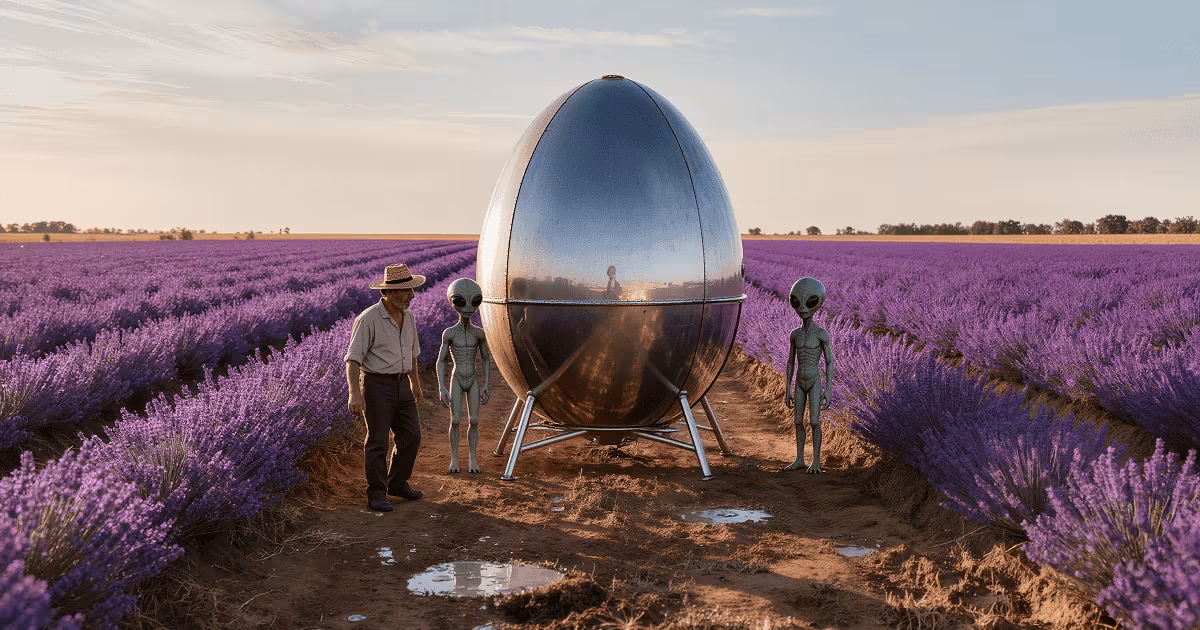
A farmer facing a silver egg-shaped craft and two small grey beings.
Illustration, not a period photograph.

Opening
Early on the morning of 1 July 1965, lavender farmer Maurice Masse was about to start work in his field near Valensole, in Provence, when he heard a whistling sound and saw an egg-shaped craft, about the size of a small car, standing on legs among his plants. Two small figures with large heads were beside it.
When he walked toward them, one pointed something at him and he found he couldn't move. The figures went back inside and the craft flew off. Where it had stood, the ground was hard and the lavender around it withered and struggled to grow back for years.
Timeline
1 July 1965, about 05:45Masse, 41, is in his lavender field on the Valensole plateau. He sees the craft on six thin legs with a central pivot, and two figures less than a metre tall, apparently looking at the plants. One points a tube at him. He is paralysed for some minutes. The figures board, and the craft rises with a whistle and disappears in seconds.
The same dayMasse tells a café owner in the village, and the story spreads. The gendarmerie opens an inquiry. Investigators find an impression in the soil with a central hole and marks from the legs.
Days afterMasse reports extreme tiredness and sleeping for long hours.
1965 onwardResearcher Aimé Michel and other French investigators interview Masse. The case becomes one of the classic French close encounters.
Years afterMasse says lavender plants near the landing site keep withering, and he won't let people dig there. He talks about it less and less, and hints that the experience meant something personal to him.
Key figures
Maurice Masse was the only witness. He was a respected local farmer, and he didn't seek publicity.
The local gendarmerie made the first official record and saw the ground marks.
Aimé Michel, one of France's best-known UFO researchers, gave the case its reputation among serious investigators.
Physical and documentary trail
The trail: the gendarmerie's report, photographs of the marks, and Michel's interviews and later write-ups.
The marks and the withered plants are the physical trail. As far as the public record shows, no soil analysis produced a clear result. The plants' failure to grow back rests largely on Masse's account.
Things you might not know
- The figures were child-sized. Masse described beings about the size of an eight-year-old, in tight grey-green clothing.
- They had large bald heads. His description adds slanted eyes and pointed chins.
- They made grumbling noises. He said the sounds they made meant nothing to him.
- A 1965 paper called it a rugby ball. Early press reports described the craft as shaped like a rugby ball; later accounts settle on an egg about the size of a car.
- Some said he made the marks himself. French sceptics argued the story was invented and the landing trace dug by hand.
- It became a film. A French feature called Valensole 1965 retells the encounter.
Competing explanations
A close encounter. A trustworthy witness, marks on the ground, and a same-day report fit his account.
A misidentified helicopter or experimental machine. Some have suggested a small military helicopter or experimental aircraft with crew in flight gear. Neither explains the paralysis, the whistle, or the speed of departure, and no such aircraft has been matched to the date.
A hoax. Masse had little to gain, he was reluctant to talk, and his reputation was solid. Nothing points to invention, though with one witness it can't be ruled out.
Later life of the case
Valensole is regularly placed alongside the 1964 Socorro landing in New Mexico, because the two reports are similar: an egg-shaped craft on legs, small figures, and a fast departure. That similarity cuts both ways. It could mean two witnesses saw the same kind of thing, or that the Socorro story, which had been widely reported, influenced how Valensole was told.
Finding
One credible witness, some ground marks, and a quick report to the police. Nothing in the record contradicts Masse, and nothing beyond him supports the craft. That leaves it as a strong single-witness case, not a proven one.
What still will not resolve: any independent witness to the craft, and a soil or plant analysis that clearly shows something happened on that spot.
Evidence signature
5/9 Solid
- Witnesses
- one person, or a tradition
- Instruments
- photo, film or physical traces
- Paper
- formal investigation, court or declassified file
How well documented the case is, not whether it's true. A strong record can still have an ordinary answer, and a thin one can still be real.
You decide · VALENSOLE
What do you think happened?
One vote per case, anonymous. You'll see how other readers voted once you've voted.