EXETER
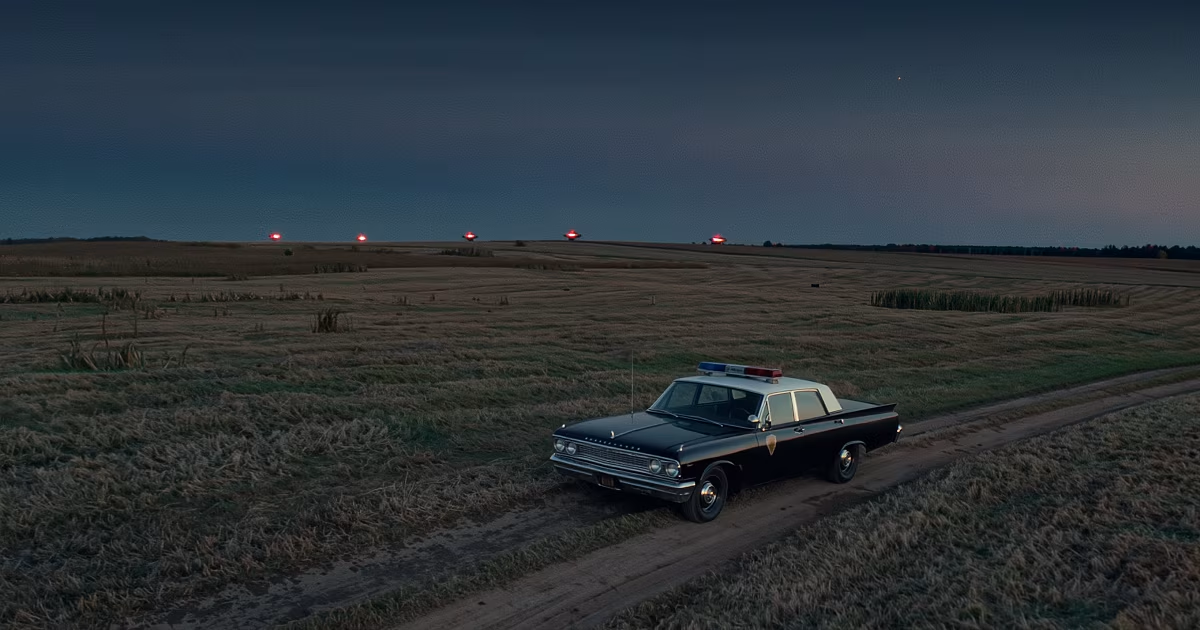
New Hampshire field at night. Police car on a farm track.
Illustration, not a period photograph.
Opening
At around 2 a.m. on 3 September 1965, eighteen-year-old Norman Muscarello, hitchhiking home to Exeter, New Hampshire, along Route 150 in neighboring Kensington, watched a silent, wingless object with brilliant pulsating red lights, which he estimated at eighty to ninety feet across, drift toward him over a field. He dove into a roadside ditch, flagged down a passing car once the object retreated, and ran into the Exeter police station pale and visibly shaken. What happened next is the detail that separates this case from most: two on-duty police officers drove back to the scene with him and watched the same thing.
The Exeter incident became, through journalist John G. Fuller's 1966 bestseller Incident at Exeter, one of the most widely read UFO cases of its decade, and it remains one of the small number of American sightings where uniformed, professionally accountable witnesses corroborated a civilian's account in real time, on duty, and filed it in writing the same night.
Timeline
3 September 1965, approximately 2 a.m. Muscarello, walking the last stretch of his route home after missing a ride from his girlfriend's house in Amesbury, Massachusetts, sees five flashing red lights near the Dining farmhouse in Kensington, initially assuming a police car or fire engine. As it approaches silently and hovers at low altitude, he dives into a ditch, then runs to a neighboring house, the Russells', pounding on the door; the family later admits they heard him but were too frightened to open it.
Same night, shortly after. Muscarello flags down a passing car, whose occupants drive him to the Exeter police station. He tells his story to night-desk officer Reginald "Scratch" Toland, who knows him personally and is struck by his genuine fear.
Same night. Toland radios officer Eugene Bertrand Jr., an Air Force veteran, who had earlier that evening separately encountered a frightened woman parked along Route 108 describing a similar object. Bertrand drives Muscarello back to the Kensington field. Both men watch an object hover roughly 100 feet away and 100 feet up, rocking back and forth, its pulsating red lights cycling in sequence, first right to left, then left to right, each cycle taking no more than two seconds. Nearby animals are described as agitated throughout.
Same night, minutes later. Bertrand radios for backup; officer David Hunt arrives and independently observes the same object before it finally rises over the trees and disappears. Shortly afterward, Hunt hears a B-47 bomber pass overhead and later tells Fuller plainly that there was no comparison between the bomber's sound and appearance and what they had just watched.
Same night. All three men return to the station and file separate written reports.
Following weeks. Fuller, then a Saturday Review columnist, arrives to investigate and interviews dozens of additional area residents describing similar lights in the weeks before and after the main event, material he later incorporates into Incident at Exeter.
Following the reports. Exeter's police chief contacts nearby Pease Air Force Base. Project Blue Book's public statements shift over time, first floating an misidentified advertising blimp, then attributing the sightings to an Air Force exercise in the area. In a February 1966 letter to the officers, Lieutenant Colonel John P. Spaulding privately concedes the Air Force was "unable to identify the object that you observed on September 3, 1965," and the case remains formally classified by Blue Book as unidentified.
2011. Skeptical Inquirer publishes a proposed explanation for the sighting drawing on the eyewitnesses' own reported details, part of the long-running effort by CSI-affiliated researchers to fit the case to conventional military aerial activity known to have been underway in the region that night.
Key figures
Muscarello is the case's originating witness, a recent high school graduate three weeks from Navy service, with no prior involvement in UFO reporting and no evident motive to fabricate a story that, by his own later account, he found embarrassing to keep repeating for the rest of his life.
Toland, Bertrand, and Hunt are the case's defining feature: three on-duty, professionally accountable police officers, one an Air Force veteran, who independently corroborated the sighting the same night and put their names to written reports rather than only later interviews. Bertrand's own prior, separate encounter with a frightened motorist earlier that evening adds a second, independent thread predating his involvement with Muscarello specifically.
Fuller is the case's principal chronicler, whose bestselling book both brought the case to national attention and, by his own account, involved extensive taped interviews with dozens of area witnesses, a level of documentary effort unusual for a UFO case of this era.
Spaulding's February 1966 letter is the case's most quietly significant document: an Air Force officer, writing directly to the involved police officers rather than to the press, privately admitting the object remained unidentified even after the shifting public explanations.
Physical and documentary trail
On the paper, this file has three separately filed same-night police reports, a private Air Force letter conceding the case remained unresolved, Fuller's extensive contemporaneous interview record, and a formal Project Blue Book classification of "unidentified" that has never been revised to a specific conventional cause.
There is no photograph or physical trace, consistent with an aerial light phenomenon witnessed at night from a public roadway. The Air Force's own shifting public explanations, first a blimp, then an unspecified exercise, without a single consistent conventional account being formally adopted, is itself a notable feature of the documentary record: the case was never closed with a stated cause the way most Blue Book files eventually were.
You could tell the difference. There was no comparison.
Competing explanations
Misidentified military aircraft, specifically B-47 bombers or a refueling exercise operating out of Pease Air Force Base that night. This is the direction Blue Book's public statements eventually leaned, and it has the advantage of real air traffic having genuinely been present in the area, evidenced by Hunt's own report of hearing a B-47 shortly after the sighting ended. Its weakness is Hunt's own direct comparison: he explicitly distinguished the sound and appearance of the passing bomber from what the three men had just spent several minutes watching hover, rock, and cycle its lights at close range.
A temperature inversion producing a mirage of distant lights. Raised as an alternative Air Force explanation, this reading struggles against the object's reported proximity, apparent solidity, and the animals' agitation, details not well accounted for by an optical distortion of a distant light source.
The 2011 Skeptical Inquirer reconstruction, built from the witnesses' own described details to fit a conventional military-activity explanation, represents the most recent serious attempt to close the case, though it has not produced the kind of universally accepted resolution that ended cases like Fort Belvoir.
A genuine unidentified object. This remains the reading supported by the case's own formal Air Force classification, never revised from "unidentified" to any specific conventional cause, and by the direct, on-the-record testimony of three professionally accountable men who distinguished what they saw from a conventional aircraft they were independently familiar with.
Later life of the case
Fuller's book made Exeter one of the most widely known UFO cases of the 1960s, and the town has marked the anniversary with an annual UFO Festival since the 2010s, drawing researchers, skeptics, and the merely curious alike. Muscarello gave a rare extended public interview in 1990, twenty-five years after the event, maintaining his account without significant change; he died in 2003.
Finding
Three independent, on-duty, professionally accountable witnesses corroborated a civilian's account of a hovering, light-cycling object at close range the same night, filed separate written reports, and one of them directly distinguished the object from a bomber he heard minutes later. The Air Force's own investigation never settled on a single stated conventional cause and the case remains formally classified as unidentified.
What still will not resolve: a specific, universally accepted conventional identification matching every detail the officers reported, particularly the close-range hovering, rocking motion, and rapid, structured light-cycling that both proposed military-aircraft and mirage explanations have struggled to account for in full. Until one does, Exeter stays what Blue Book itself left it: officially open.