TULLY
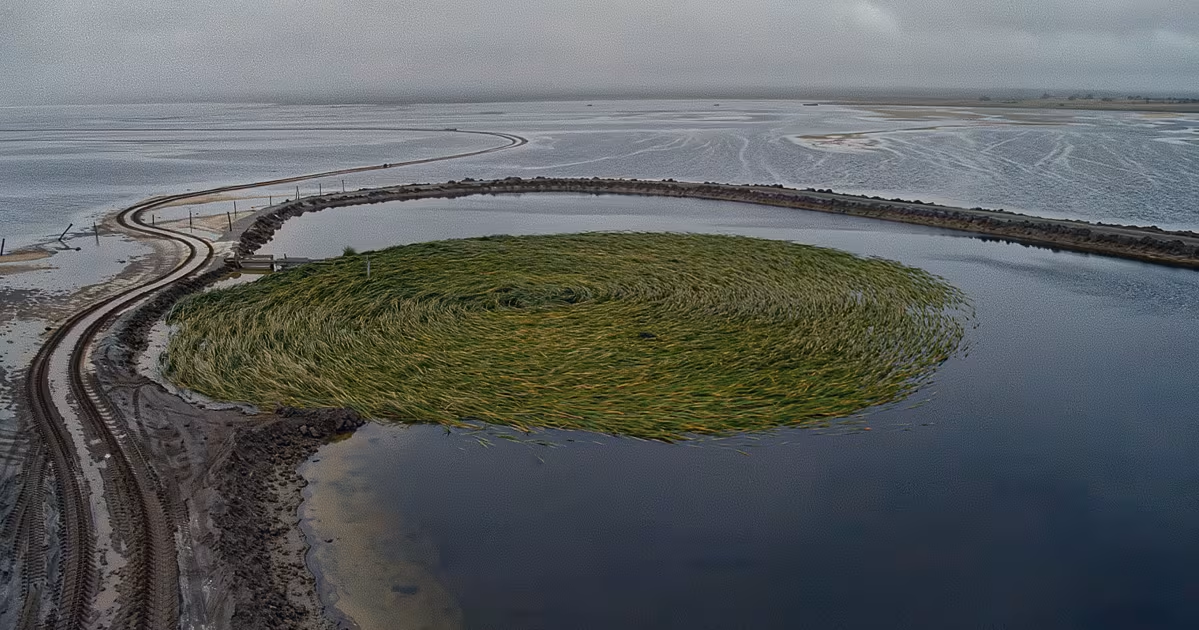
Queensland lagoon. Swirled reed mat and wet season light.
Illustration, not a period photograph.
Opening
On the morning of 19 January 1966 George Pedley was driving a tractor toward Horseshoe Lagoon on a cane property near Tully, in far north Queensland, when he heard a hiss. Over the lagoon a rising disc cleared the paperbarks, spun, and went up into cloud. He walked the bank. A roughly circular stand of reeds was laid down clockwise on the water, still green, still attached, a nest the size of a room.
Police and the Queensland University people came. Photographs were taken while the reeds still held the swirl. Cattlemen said they had seen lights over that swamp on other mornings. Pedley was a worker, not a lecturer. The lagoon is real. The laid reeds were real. The disc is his sentence.
The spine of the file is a hiss, a rise, and a circle in living reed. Tully is a nest on water. It is not a kept disc in a Cairns hangar.
Timeline
Early 1966 the Tully district had already been talking about lights over the cane and the swamps. 19 January, about 09:00. Pedley on the tractor, Horsehoe Lagoon ahead. Hiss like air escaping. A grey to silver object, some twenty-five feet across in his first telling, rising off the water, spinning, climbing into low cloud toward the south-east. Duration short. He is alone.
He goes to the bank. Reeds flattened in a clock-wise raft, circular, floating, roots still in. He tells the property. Police attend. Measurements and pictures that day and the next, while the nest still looks like work rather than weather. Samples of reed and water are talked up. They do not become a type in a lab the file can close.
Newspapers in Queensland run the nest. Similar swirls are claimed on other lagoons that season. Some look like wind. Pedley's has the hiss and the rise attached. He does not recant.
Later saucer-nest catalogues swallow Tully as the type specimen. That catalogue is later life. The lagoon on the 19th is first.
Pedley had been on that property long enough to know a bird off the lagoon and a tractor fan. The object he timed was not either. After the rise he sat on the bank before he fetched anyone, which is why the nest was still a swirl and not a wind-flattened mat when the first extra pair of eyes arrived.
Police from Tully and the district took measurements in feet, not in atmosphere. Queensland papers ran the circle while it was still green. University talk of samples did not produce a type that closed the hiss. Pedley went back to cane. The lagoon kept its name.
Key figures
George Pedley is the only man on the tractor. A cane worker with a morning job. His hiss and his nest are the exhibit.
The property owners and the local police own the first walk around the raft and the photographs while it was still green.
Queensland officers and university visitors own the samples that did not become a machine.
Other district lights sit in supporting talk. They do not sit on Pedley's tractor.
Physical and documentary trail
On the paper, 19 January 1966 gives you four hard objects and no disc.
One: Pedley's same-morning account of a hiss, a spinning rise off Horseshoe Lagoon, and a climb into cloud.
Two: the circular raft of living reeds, photographed and measured while still attached and green.
Three: police attendance and contemporary Queensland press.
Four: later claims of other nests in the same season. Queensland police and press record of the Tully lagoon nest, January 1966, is the originating tray.
There is no photograph of the object over the water. There is no fragment with a 19 January chain. There is no second tractor on that bank at 09:00.
The nest photographs are the hard stay-behind. Whatever left them had to spin living reed on water and then be gone before noon. That is a narrower trick than a story told at smoko.
It rose off the water, spinning, and went up into the cloud.
Competing explanations
A craft that sat on the lagoon and left a swirl. This is Pedley's morning. It has a nest. It has no machine.
A dust devil or willy-willy laying reeds, a bird or a plane for the hiss. Possible on a tropical lagoon. Has to carry a witness who watched a disc climb.
A hoax laid for the papers. Poor fit for a man who still had cane to cut.
Hybrid caution. Something laid a circle on that water. Pedley said he watched it leave. Morning had no guest in the paperbarks.
Later life of the case
Australian nest catalogues and replica swirls. I keep those on the later-life shelf. The hiss and the green raft stay first.
Finding
George Pedley heard a hiss over Horseshoe Lagoon on 19 January 1966, watched a disc climb into cloud, and walked a circle of living reeds still spinning on the water. Police photographed the nest the same day. Believe the canecutter. A man on a tractor does not invent a lagoon.
What still will not resolve: a frame of that rise, or a sample from the raft that a lab still owns with a 19 January chain. Either one would pin the swirl to a machine. The proving object is still the thing that left the reeds, held by someone who was not on that bank.