PLAINS OF SAN AGUSTIN
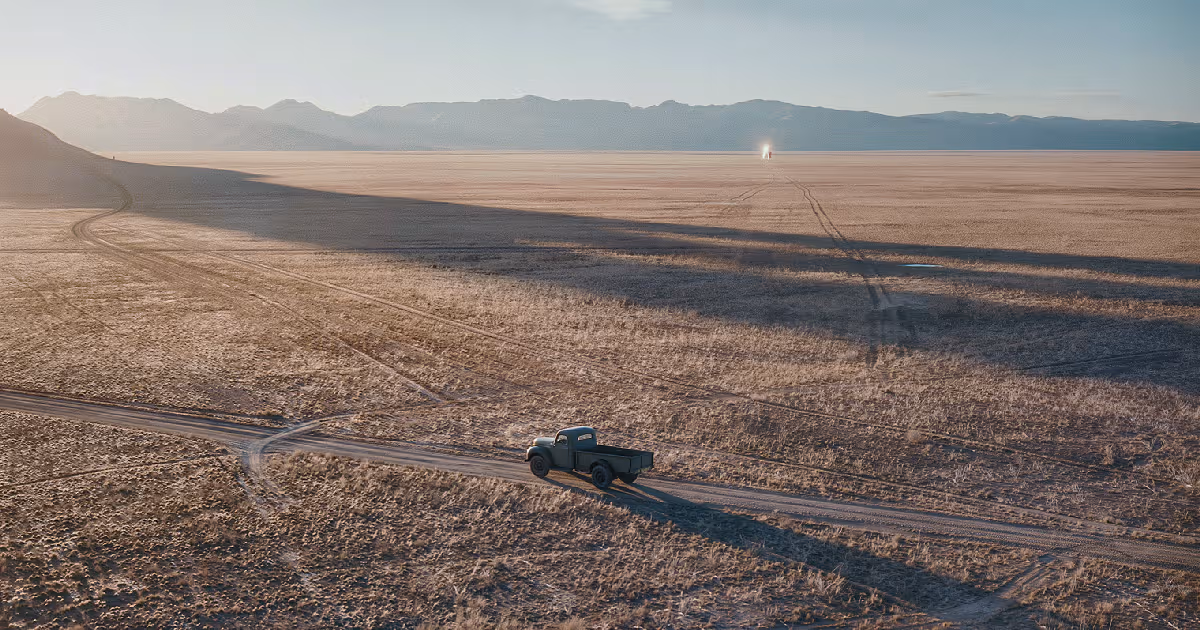
A pickup truck on a track across the wide, dry Plains of San Agustin, with a small glint far out on the plain.
Illustration, not a period photograph.
Opening
The Plains of San Agustin are a high, flat basin west of Socorro, New Mexico, now home to the Very Large Array radio telescopes. The story says that in early July 1947, the same week as Roswell, a civil engineer named Barney Barnett came across a crashed disc here with small dead crew beside it, alongside a party of archaeologists, before the military arrived and swore everyone to silence. Barnett died in 1969. Every word of the story reached researchers second-hand.
Timeline
1947. Grady L. “Barney” Barnett works as a field engineer for the Soil Conservation Service out of Socorro. His wife Ruth keeps a diary.
February 1950. According to their later account, Barnett tells his friends Vern and Jean Maltais about finding a crashed saucer and bodies. They recall no date.
1969. Barnett dies.
1978. The Maltaises tell Stanton Friedman the story after one of his lectures in Bemidji, Minnesota.
1980. The Roswell Incident by Charles Berlitz and William Moore includes Barnett’s story and ties it to the Roswell events.
1990. Gerald Anderson comes forward after a TV broadcast, claiming he saw the crash as a five-year-old. Barnett’s niece Alice Knight finds Ruth Barnett’s 1947 diary.
February 1992. A conference in Chicago hosted by the Center for UFO Studies and the Fund for UFO Research sets the two camps side by side. Friedman and Don Berliner’s Crash at Corona backs a Plains crash the same year.
Key figures
Barney Barnett, the source, remembered by everyone as honest. Vern and Jean Maltais, who carried the story for nearly thirty years. Fleck Danley, Barnett’s boss, who said Barnett told him something about a saucer. Gerald Anderson, the only claimed eyewitness. Stanton Friedman, the case’s main advocate, and Kevin Randle and Don Schmitt, its main critics.
Physical and documentary trail
On the paper: there is no debris, no photograph and no official record of anything on the Plains in 1947. The one document from that summer is Ruth Barnett’s diary. It has no mention of a crash. Its entries for early July put Barney at home working on the house on 3 July and back in the field after the holiday, which leaves the key days hard to fit. Danley’s memory also shifted: to one researcher he placed the story in early summer 1947, but he later told Randle he had no clear memory of when or where, and that Barnett said nothing about bodies. The archaeologists have never been identified. Herbert Dick, who arrived to excavate nearby Bat Cave in mid-July, reported seeing nothing unusual.
Competing explanations
A second crash, separate from Roswell. Friedman’s position. Barnett was a steady man with no reason to invent it, and he told it years before Roswell became famous. Against it: no date, no firm place and no second first-hand witness.
Barnett’s story, but not the Plains. Randle and Schmitt suggested Barnett may have seen the Roswell-related site north of Roswell and the Plains location was added later by others. This fits the lack of a date but relies on the same second-hand account.
A story that grew in the retelling. Thirty years passed between Barnett telling it and anyone writing it down, and the key details came through friends of friends.
Later life of the case
Gerald Anderson nearly took the case with him. He named an archaeologist, “Dr. Buskirk”, who turned out to be Winfred Buskirk, a real anthropology teacher at Albuquerque High School, where Anderson himself had been a student. Buskirk showed he was on the Fort Apache reservation in July 1947. A diary Anderson said belonged to his uncle Ted was tested and found to be written in an ink not available before 1974. Anderson was set aside, but the damage stuck to the Plains story.
Finding
Barney Barnett told a strange story to people who trusted him, and nothing suggests he was a liar. The data points to a real memory of something, told at least second-hand and without a date, that later researchers placed on the Plains in July 1947. The only document from that summer doesn’t support the timing, and the only claimed eyewitness was shown to have fabricated evidence.
What still will not resolve: what Barnett actually saw, where, and when. Those answers died with him in 1969.