TAIRE MOUNTAIN 1978
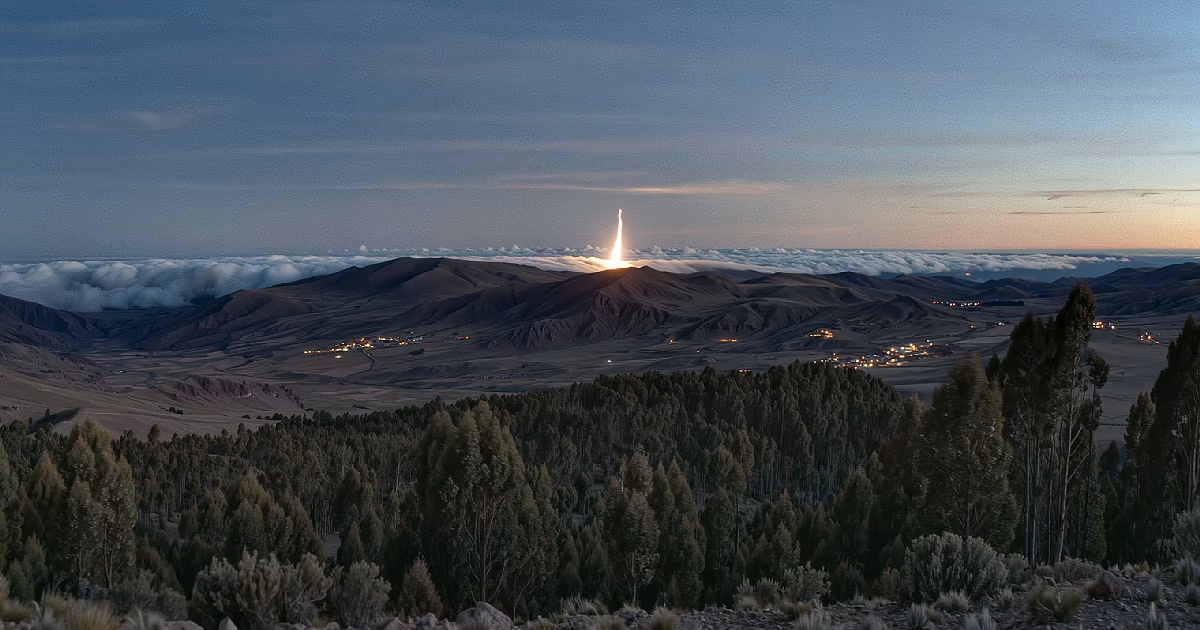
A bright streak falling behind a ridge in the forested hills near the Bolivia-Argentina border at dusk.
Illustration, not a period photograph.
Opening
On 6 May 1978, people on both sides of the Argentina-Bolivia border reported something falling out of the sky behind the mountains near Bermejo, in Bolivia’s Tarija department, followed by an explosion that shook the ground. Within days the South American press had a crashed object: egg-shaped, metal, about four metres across, found on a hill called Taire and taken away under guard. Over the next three weeks the US Embassy in La Paz sent cables about it to Washington. Those cables are real, and they are why this is sometimes called the Bolivian Roswell.
Timeline
6 May 1978. Witnesses in southern Bolivia and northern Argentina describe a falling object, likened to a football, and a blast. Reports of formations of lights come in from San Luis and Mendoza in Argentina around the same time.
15 May, morning. Bolivian papers carry a story from a correspondent in Salta, Argentina: an object has been found near Bermejo.
15 May. The US Embassy in La Paz cables the Secretary of State under the heading “Report of Fallen Space Object”. It passes on the newspaper description, says the Bolivian Air Force plans to investigate, and asks Washington to check with the right agencies. It adds that the region has had more than its share of UFO reports that week.
15 to 16 May. The Foreign Broadcast Information Service, the CIA-run office that monitored and translated foreign media, logs Argentine and Uruguayan radio reports. They say the object is on Taire mountain, that the area has been declared an emergency zone, that Bolivia has asked NASA for help, and that the object has been taken to Tarija. One item opens with a radio station saying it has had another phone call from its audience asking whether the story is true.
18 May. The State Department replies that it can find no match with any known space object re-entering around 6 May, and points the embassy to Airgram A-6343 of July 1973, the guidance on recovering fallen space objects.
24 May. The US Defense Attaché in La Paz reports what he has been told by Bolivian officers. The Air Force chief of staff says planes flew over the area and found nothing. The Army commander says a search party on the ground found nothing. The Army concludes there may or may not be an object.
Key figures
The US Embassy in La Paz, which reported what the papers said and asked for help. The Defense Attaché’s office, which checked with the Bolivian military. Leonard Stringfield, who later collected claims about the case. An Argentine researcher, Nicholas Ojeda, who told Stringfield in 1979 that a C-130 had carried “something” out of the area. No local witness to the object on the ground has ever been named.
Physical and documentary trail
On the paper: four official US documents, the State cables of 15, 18 and 24 May and the media summaries from FBIS, later released through Freedom of Information requests. They are a real record of official interest, and they show exactly where each claim came from. Every detail about the object itself, the egg shape, the four metres, the cordon, the move to Tarija, traces back to newspaper and radio reports quoted in those papers. The only first-hand official statement, from the Bolivian Army and Air Force, is that they searched and found nothing. There is no photograph, no fragment and no named person who saw the object on the hill.
The Army has concluded that there may or may not be an object, but to date nothing has been found.
Competing explanations
A crashed craft, quietly recovered. This is the reading in Majic Eyes Only, which leans on the C-130 story and treats the FBIS items as CIA intelligence reports. Against it: the FBIS items are summaries of what Argentine and Uruguayan radio were saying, and the C-130 story reached print through Stringfield from Ojeda and from an unnamed CIA source of the researcher Bob Barry, who reportedly confirmed a flight but said “no comment” about its cargo. No crew member or document has been named.
A bright meteor. A fireball with a sonic boom fits the 6 May reports well: a fast, glowing object seen across a wide area, falling “behind the mountains”, with a blast felt on the ground. Meteorites that fall in mountain country are often never found. Against it: the newspaper description of a four-metre metal egg. Nothing in the record shows anyone actually saw that.
Space debris. This was the first thing Washington checked, and its answer was no known match. Debris from classified launches wouldn’t necessarily appear in that check, so this can’t be ruled out entirely.
Later life of the case
The embassy’s reference to Airgram A-6343 ties the case to what researchers call Project Moon Dust, the US effort to recover fallen Soviet and other space hardware abroad. That link is often presented as proof of a recovery. In fact it shows the embassy was following the standard procedure for any reported fallen space object. The cables themselves do not describe anything being recovered.
Finding
The data points to a real event on 6 May 1978, most likely a bright fireball, which set off a week of press reports that grew in the retelling. The US government took the reports seriously enough to ask questions, and the documents that prove this are genuine. What they don’t show is an object: the only people on record as having gone to look, the Bolivian Army and Air Force, said they found nothing.
What still will not resolve: who first described a four-metre metal egg to the Salta correspondent, and whether anyone flew a C-130 out of southern Bolivia that month.