DEL RIO 1950
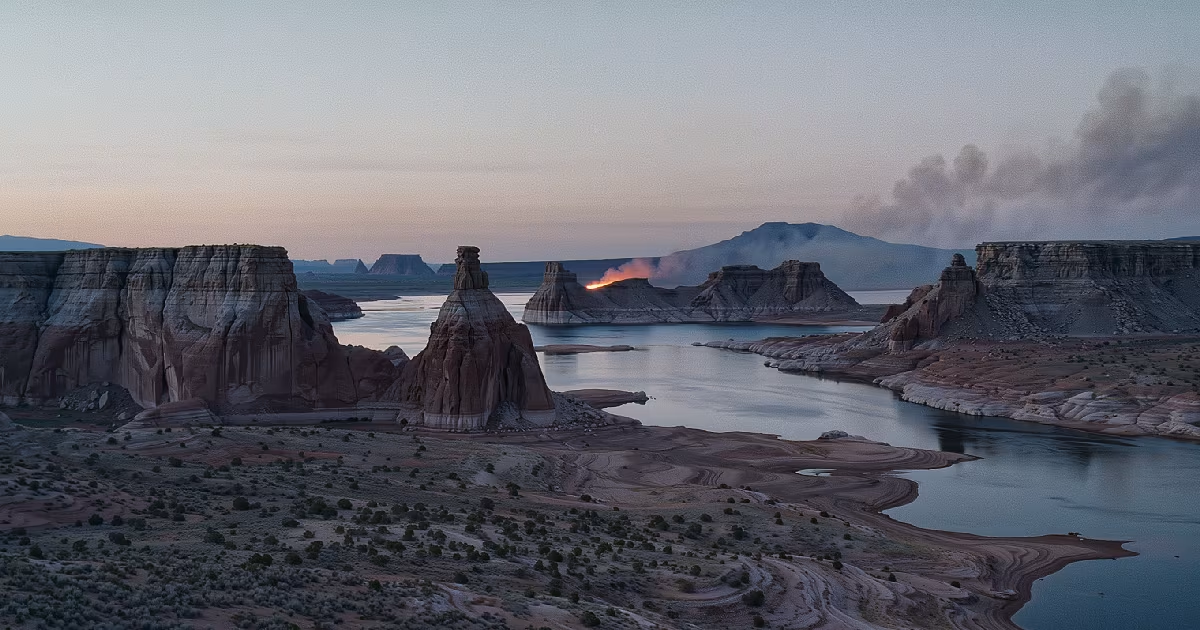
A fire burning among canyons and mesas beside the water at dusk.
Illustration, not a period photograph.
Opening
The Del Rio crash is said to have happened on the Texas-Mexico border in December 1950: an object tracked on radar, a fireball across the Rio Grande, a crash site in Mexico sealed by armed men, and a scrap of metal that would not melt. It is often called “the other Roswell.” Almost all of it comes from one man, Robert B. Willingham, and the story changed shape every time he told it.
Timeline
6 December 1950. A real air defence alert in Washington. Unidentified formations reported in the northeast trigger calls between Deputy Defense Secretary Robert Lovett and Secretary of State Dean Acheson. The tracks fade within the hour. One target off Maine is later matched to a transport aircraft.
8 December 1950. An FBI teletype from Richmond reports that Army counterintelligence there has been put on high alert for any information about flying saucers.
1968. Willingham’s first account appears in Skylook, the newsletter that became the MUFON Journal. He describes pacing an object in an F-94 near the border and dates it to 1948. No place is named.
1977 to 1978. Researcher Todd Zechel takes a signed statement from Willingham, attaches the story to December 1950 and puts the site about 30 miles inside Mexico, across from Laredo. Zechel later says he flew there with Willingham and a Japanese TV crew.
1984. The “Eisenhower Briefing Document”, part of the Majestic 12 papers, surfaces. It says a second object crashed on 6 December 1950 in the “El Indio-Guerrero area” and that what was left went to the Atomic Energy Commission at Sandia.
1990 to 1994. Dennis Stacy and Tom Deuley search the El Indio area, interview locals and sweep a depression with metal detectors. They find nothing.
2008. Noe Torres and Ruben Uriarte publish The Other Roswell, working with Willingham. The event now falls in 1954 or 1955 and the jet is an F-86.
Key figures
Robert B. Willingham, presented for years as a retired Air Force colonel and fighter pilot, is the only witness. Todd Zechel shaped the 1950 version. Leonard Stringfield and Bruce Maccabee carried it into the crash-retrieval literature. Kevin Randle, who looked for a second witness for more than twenty years, found none.
Physical and documentary trail
On the paper: the FBI teletype of 8 December 1950 is genuine. So is the Washington alert of 6 December, which Acheson and Truman both recalled in their memoirs. Neither mentions Texas, Mexico or a crash. The metal sample Willingham said he carried away is gone: he said it went to a Marine Corps laboratory and was never returned. No radar log, unit record or Mexican report of a crash has surfaced. When researchers obtained Willingham’s service record, it showed about thirteen months of Army service in 1945 to 1947, ending as an enlisted man. His colonel’s rank was in the Civil Air Patrol, a civilian auxiliary.
This office very confidentially advised by Army Intelligence, Richmond, that they have been put on immediate high alert for any data whatsoever concerning flying saucers.
Competing explanations
A real retrieval, covered up. Supporters point to the alert, the teletype and the Eisenhower Briefing Document, which seem to agree on the date. Against it: the teletype and the alert concern the northeast, and the date was attached to Willingham’s story by Zechel, not by Willingham.
A fireball or re-entry. Local people near El Indio did remember a fireball and a brushfire at some point. If something fell, a meteor fits better than a craft. Nobody has dated that memory.
An invented story. The 1977 statement uses names that did not exist in 1950: “Dyess Air Force Base” dates from 1956, and the DEW Line and NORAD from 1957. Willingham later said he was in Korea in December 1950, which clashes with his own crash date. He also claimed to have seen six other crashes.
Later life of the case
The Eisenhower Briefing Document is the reason the case matters beyond Texas. The National Archives found no record of it, and the FBI marked its copy of the MJ-12 papers “bogus”. Randle argues that because the document repeats a crash that traces back to one unreliable witness, the document itself was assembled from UFO literature, not government files.
Finding
The strongest reading is that there was a real alert in Washington in December 1950 and a story about a crash in Texas, and that researchers later joined the two. The alert has a documented cause in the northeast. The crash has one witness whose rank, dates, aircraft and location all moved, and a field search that found nothing on the ground.
What still will not resolve: what set off the fireball memory at El Indio, and whether anyone ever saw the metal sample outside Willingham’s own telling.