ISLE OF LEWIS
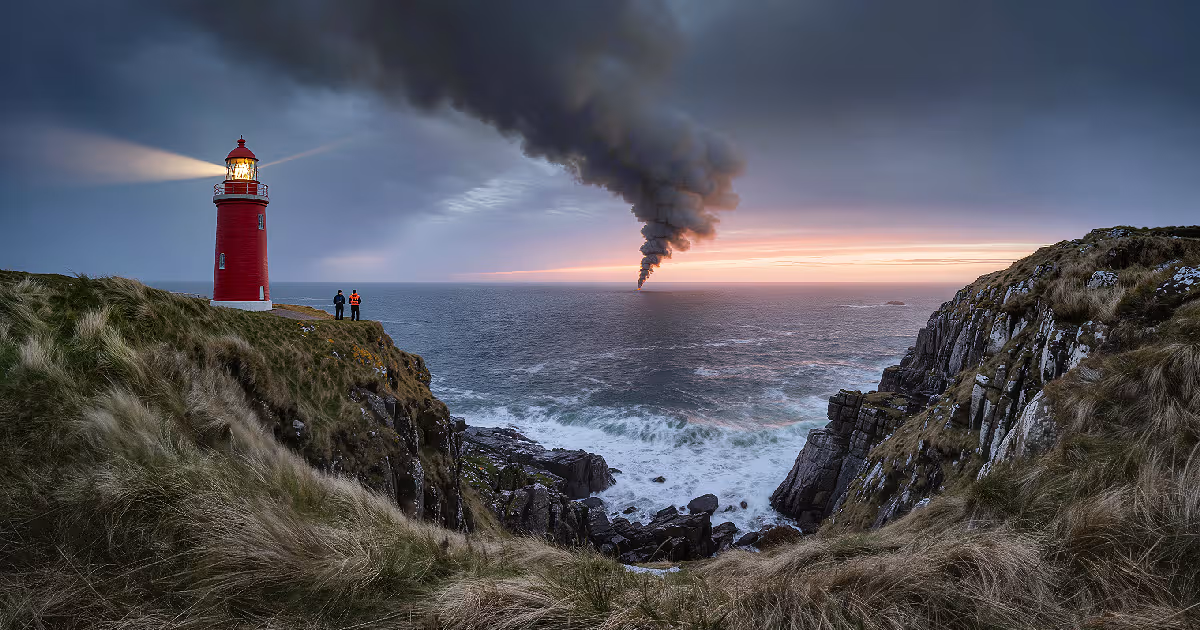
Two people by the Butt of Lewis lighthouse watching a column of smoke rise from the sea.
Illustration, not a period photograph.
Opening
At about 4:00 p.m. on Saturday 26 October 1996, people in Ness, at the northern tip of the Isle of Lewis in the Outer Hebrides, heard bangs and saw flashes over the sea. Several described something falling toward the water under a trail of smoke. Within hours the police and the RAF had taken a run of emergency calls, and an air and sea search was under way off the Butt of Lewis. It found nothing.
Timeline
26 October 1996, about 4:00 to 4:10 p.m. Witnesses in Ness report flashes, bangs and a smoke trail over the sea. Later summaries add a vapour trail 15 to 20 miles west of Lewis and debris seen falling into the water.
That evening. Calls reach the Northern Constabulary and the RAF. The search begins.
Following days. An RAF Nimrod flies two sorties totalling more than ten hours. The Stornoway Coastguard helicopter flies two operations of about four and a half hours each, and an RAF helicopter joins from Lossiemouth. The tug Portosalvo, lifeboats from Lochinver and local fishing boats work the water while Coastguard and police patrol the Ness shoreline.
4 November 1996. The Scotsman reports the case, with witness accounts and Coastguard comment.
Shortly after. Press reports say Sandia National Laboratories in New Mexico has made inquiries with British authorities and asked Armagh Observatory in Northern Ireland to help establish exactly when the event happened.
December 1998. French trawlers are reported to have brought up helicopter parts in the same area.
Key figures
Norman Macdonald, a joinery contractor at the Port of Ness, is the main named witness. He brought shop staff and customers outside, and they saw the smoke too.
Simon Riley, District Staff Officer for Stornoway Coastguard, spoke for the search. He said the Coastguard had “not ruled out space debris” and called the case “very puzzling”, adding that part of the problem was getting a fix on where it happened. A Northern Constabulary spokesperson called it “a real mystery”.
Nick Pope, who handled UFO reports at the Ministry of Defence from 1991 to 1994, commented on the Sandia inquiry and on rumours of a prototype aircraft. Defence Secretary Michael Portillo is reported to have said there was no evidence the military was involved. The MoD later told journalist Jonathan Dillon the search was called off once it was clear no aircraft was overdue.
Physical and documentary trail
On the paper: the best source is The Scotsman of 4 November 1996, which I know through quotations in Ryan S. Wood’s Majic Eyes Only (2005). I have not seen the article itself. The search figures disagree: Wood gives 300 square miles at a cost of nearly $400,000, while another account gives more than 1,000 square miles at about £200,000. The Portillo statement and the 1998 trawler find appear only in enthusiast summaries, with no newspaper named. No MoD file on the event has surfaced, no radar data has been released, and nothing from 1996 was recovered.
At first, I thought it was a firework. Then I saw three flashes and heard two further bangs. I rushed into a local shop and took the staff and customers outside. They also saw the dense smoke spiral. That was about 4:10 p.m.
Competing explanations
An aircraft went down. Burning debris falling into the sea is exactly what a crash looks like from the shore, and it is why the search was so large. Against it: air traffic control accounted for every civil and military aircraft, nobody was reported overdue, and no wreckage was found.
A bright meteor. A fireball breaking up high over the Atlantic can give flashes, delayed bangs and a lingering smoke trail, and it often seems to fall into the sea just short of the horizon. Sandia’s interest fits this reading. Its scientists had worked on detecting meteor fireballs with US satellite optical sensors, published by Tagliaferri, Spalding and colleagues in 1994, and that work starts with an exact time. Against it: no satellite detection for this date has been published.
Space debris. The Coastguard kept it open. I have not found a catalogued re-entry matched to that afternoon.
A secret aircraft or missile. Pope passed on rumours of a prototype aircraft or drone, of the kind called Aurora. There is no evidence beyond the rumour, and the Defence Secretary reportedly denied any military involvement.
A crash retrieval. Wood includes the case in his catalogue of crash retrievals, but his own account ends with nothing found. Nothing in the record describes anything being recovered in 1996.
Later life of the case
The 1998 trawler find is the thread that keeps the case alive. The parts reportedly included a rotor head, blades and a gearbox. The RAF is said to have accepted they may have been made by Westland but insisted no UK helicopter had been lost there in decades. If that is accurate, a helicopter nobody reported missing went into the sea off Lewis at some point. Nothing yet ties it to October 1996.
Wood also links Sandia to the “Eisenhower Briefing Document”, part of the Majestic 12 papers. That document is widely regarded as a forgery and has no bearing on what people saw from Ness.
Finding
The data points to a real event seen by several people: flashes, bangs and a falling smoke trail off Ness late on 26 October 1996, serious enough to put a Nimrod, two helicopters and a small fleet on the water. No aircraft was missing and no wreckage was found. The strongest reading is a bright fireball or re-entry breaking up over the sea, and Sandia’s request for an exact time supports it, but nothing published confirms it. “Crash retrieval” isn’t supported. Nothing was retrieved.
What still will not resolve: what Sandia found when it had its time, and whether the helicopter parts dragged up in 1998 have anything to do with that afternoon.