TRINITY 1945
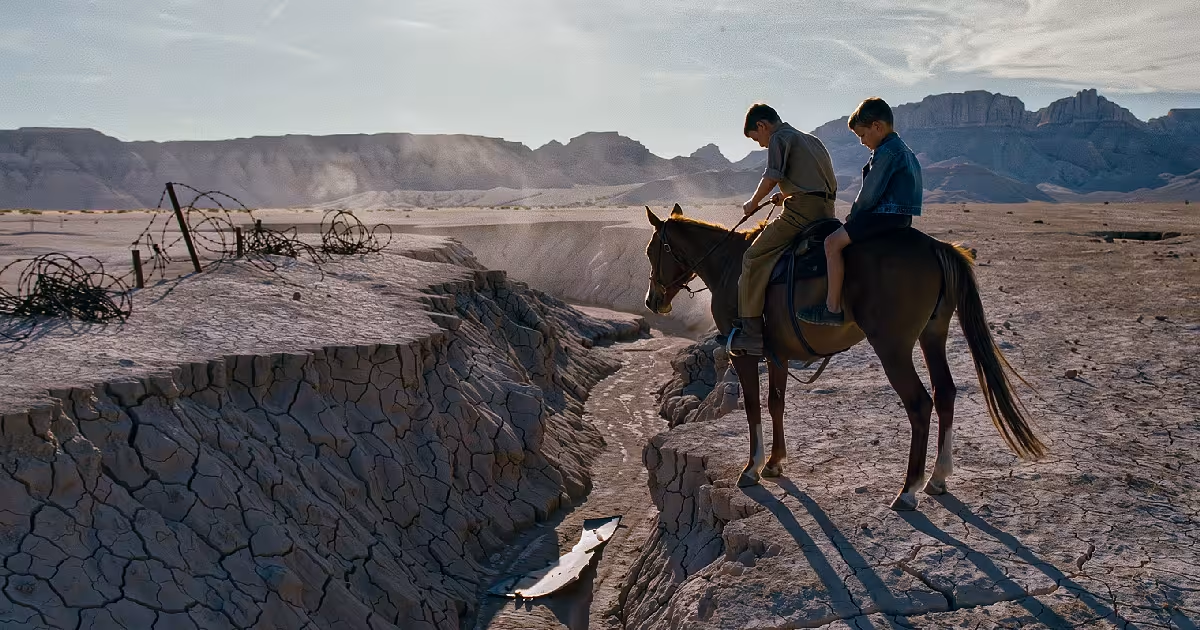
New Mexico desert gully, 1940s. Dust, low sun, fence line.
Illustration, not a period photograph.
Opening
In August 1945, a month after the world's first atomic bomb was tested at Trinity site in New Mexico, two boys looking for a lost cow near San Antonio, New Mexico, said they came across a crashed, avocado-shaped craft in a gully. Around it, they said, small, child-sized beings moved and made high-pitched sounds. Days later, they watched soldiers recover the wreckage, and took a piece of metal themselves. The boys were Jose Padilla, 8, and Reme Baca, 6. They told no one publicly for almost sixty years. In 2021, the computer scientist and UFO researcher Jacques Vallée, with Paola Harris, made their story the subject of a book. It's been fiercely disputed ever since.
Timeline
16 July 1945. The Trinity atomic test takes place in the New Mexico desert.
August 1945 (as told, often given as 16 August). Padilla and Baca find the crash site. They see the craft and the beings. Later they watch soldiers, including a state police officer, deal with the wreckage and haul it away on a flatbed truck. They take a small piece of metal.
Following days. Padilla's father, they say, is paid by the Army for damage to his land and a fence.
2003. The story first appears publicly in a local newspaper, the Mountain Mail, based on interviews with Padilla and Baca.
2013. Baca dies.
2021. Vallée and Harris publish Trinity: The Best-Kept Secret, presenting the story as a major crash retrieval.
2021 onward. Researchers, most prominently Douglas Johnson, publish detailed critiques of the witnesses' accounts and of how the story developed.
Key figures
Jose Padilla and Reme Baca are the only witnesses. They were young boys at the time.
Jacques Vallée is one of the most respected figures in UFO research, which gave the story weight it might not otherwise have had.
Paola Harris, a journalist and researcher, conducted many of the interviews.
Douglas Johnson is the story's most detailed critic.
Physical and documentary trail
On the paper: the witnesses' accounts from 2003 onward, Vallée and Harris's book, and critical research. Metal fragments said to be from the site have been analysed, with inconclusive or ordinary results.
What isn't on the paper: any record of the event before 2003, any military or police document, or any other witness. Critics point to changes in the story over time, and to parts that echo well-known Roswell accounts.
Competing explanations
A real crash, near the most secret site in America. The boys saw something the military recovered and hid, at a time and place where secrecy was at its peak. Vallée found the witnesses credible, and their memories of the landscape and the period are detailed.
A real military crash, remembered as something else. A crashed aircraft, test vehicle, or balloon from the heavily militarised area may have been recovered, and the boys' memory of it grew over sixty years.
A story built later. Critics argue that the account took shape from 2002 onward, shaped by interviews and by Roswell lore, with no event behind it.
Later life of the case
Vallée's reputation made Trinity a major topic in UFO circles, and the argument between his supporters and his critics has become one of the most heated in modern ufology.
Finding
Two witnesses, both young boys at the time, told a detailed story nearly sixty years later, and one of the field's most respected researchers believed them. Nothing from 1945 confirms it, and critics have found real problems in how it developed. It stays open, and it rests on the memory of two men recalling their childhood.
What still will not resolve: whether anything crashed near San Antonio, New Mexico, in August 1945, and if so, what the Army took away.