AREA 51 CALLER
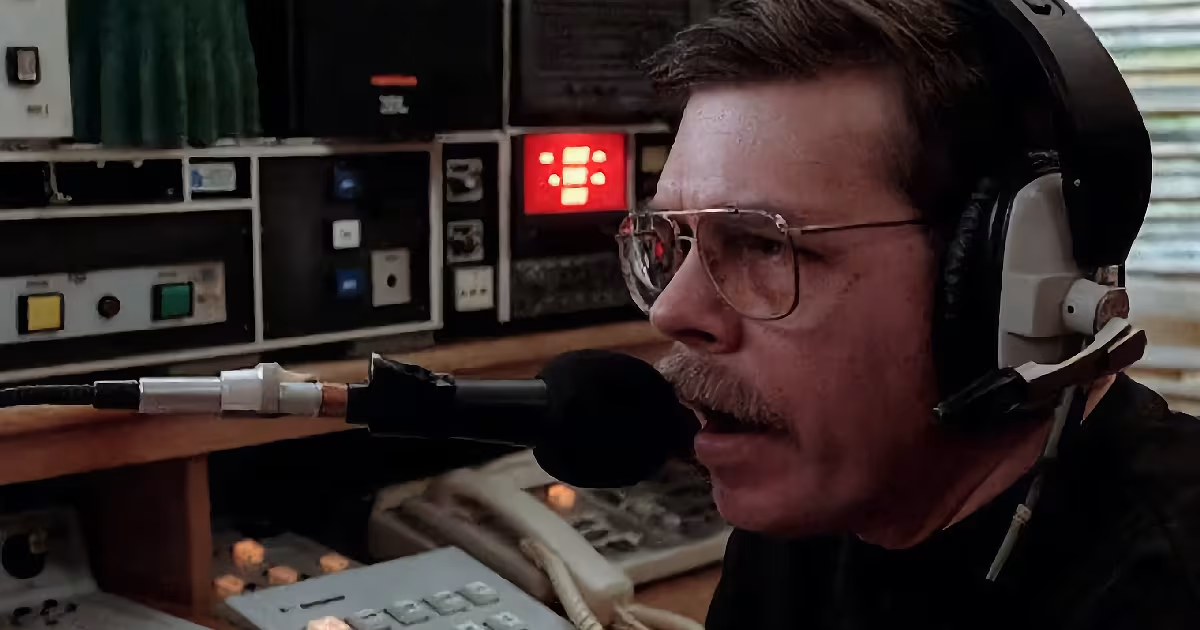
the GOAT Art Bell in his 1990s radio studio at night. RIP Art, you are missed.
Illustration, not a period photograph.
Opening
On the night of 11 September 1997, Art Bell was hosting Coast to Coast AM, the late-night radio show heard across America, when he opened a line he'd set aside for a special purpose: Area 51 employees, or former employees. A man came on, audibly panicked, out of breath, and often close to tears. He said he'd worked at Area 51 until he was let go on medical grounds, and that he was now being hunted. He began to explain that the "aliens" the government talked about weren't from another planet but were "extradimensional beings," and that the military knew of a coming disaster and was preparing for it. Then the call dropped. Moments later, the satellite carrying the whole show to the nation went down.
Timeline
11 September 1997, night. Bell announces the Area 51 line. The caller gets through and speaks rapidly and fearfully, saying there isn't much time before they triangulate his location.
The call. He describes extradimensional beings, a government that knows more than it admits, and a disaster that major population centres could be evacuated for. He says he's ill and can't be traced for long.
The cut. The line goes dead mid-sentence. Soon after, the satellite feed carrying the broadcast to affiliates across the country fails. The network's engineers restore it after a gap. Bell says on air that the timing is strange.
28 April 1998. A caller who says he's the same man phones the show. He says the first call was part of a test and his earlier account was false. His voice doesn't obviously match, and listeners argue about whether he's the same person.
After. The recording spreads widely, first among listeners and then online, where it's been played millions of times.
Key figures
Art Bell was the host of Coast to Coast AM, then the most popular late-night radio show in the US for paranormal topics. He never claimed to know who the caller was.
The caller has never been identified.
The 1998 caller claimed to be the same man, and his account contradicted the first.
Physical and documentary trail
On the paper: the broadcast recording, including the call and the break in the feed, and the 1998 follow-up call. No identification of either caller, and no official statement about the satellite outage beyond it being a technical problem.
Competing explanations
A real whistleblower silenced. A frightened former worker got through, and the call and the broadcast were cut to stop him. The 1998 call was a cover story.
A hoax, and a coincidence. A caller acting out a dramatic story, followed by an unrelated technical failure, perhaps triggered by the huge number of calls or by an ordinary fault. Satellite outages happen, and the timing can't be proved to be linked.
A hoax, with a prank second call. Both calls may have been performances by different people.
Later life of the case
The Area 51 caller is one of the most famous moments in American radio. It's been dramatised, analysed, and discussed on podcasts ever since, and it helped make Coast to Coast AM a cultural landmark.
Finding
A frightened voice on live radio, a dropped call, and a national satellite outage minutes later. Nobody has ever identified the caller or explained the outage in detail. It could be a hoax and a coincidence, and nothing can prove otherwise. What happened that night is still a mystery.
What still will not resolve: who the caller was, and what took the satellite down.