MEL'S HOLE
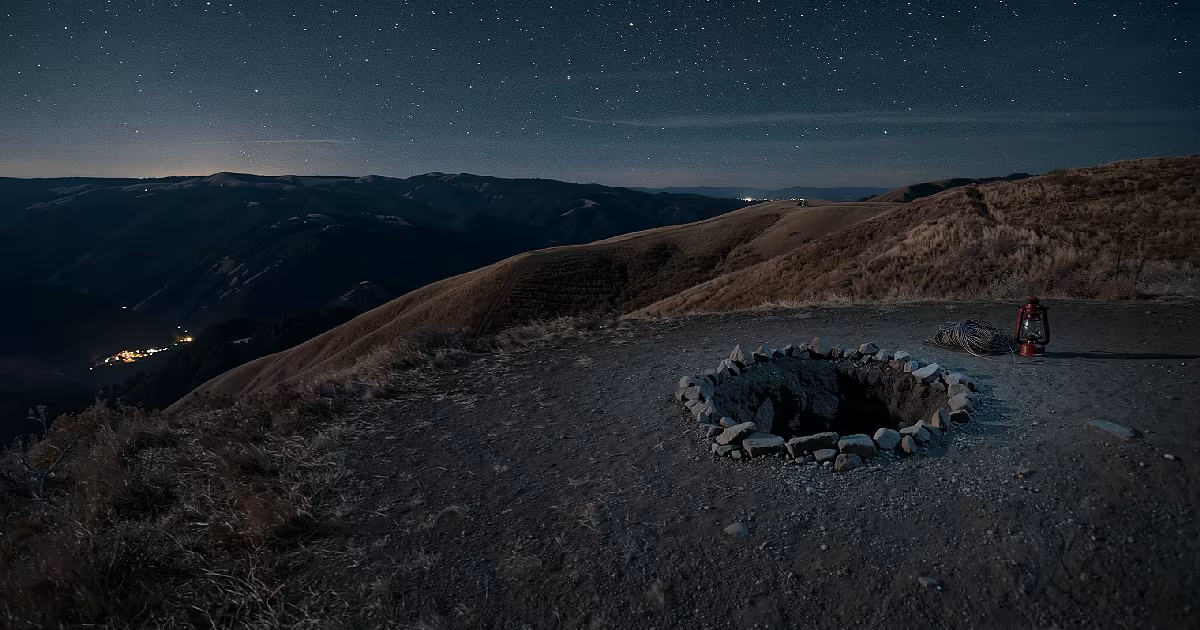
A stone-ringed hole on a dry ridge at night, a lantern beside it.
Illustration, not a photograph.

Opening
On 21 February 1997, a man who gave his name as Mel Waters called Art Bell's late-night radio show Coast to Coast AM, then one of the most popular programmes in America for listeners interested in the strange. He said he owned rural land about nine miles west of Ellensburg, in Kittitas County, Washington, and that on it was a hole with no bottom. He had lowered a weighted fishing line into it, he said, and run out 80,000 feet of line, about fifteen miles, without touching anything.
Over that call and later ones, the story grew. A neighbour's dead dog thrown into the hole had been seen alive again. Strange things happened around it. Then federal agents had taken the land and paid Waters to move to Australia. The calls were replayed for years, and Mel's Hole became one of the great legends of late-night radio. Nobody has ever found the hole, and nobody has ever found Mel Waters.
Timeline
21 February 1997Mel Waters first calls Coast to Coast AM and describes the hole and the fishing-line test.
24 February 1997He calls the show again with more detail.
2000 and 2002Waters makes further appearances on the show, adding to the story, including the government seizure of the land and his move abroad.
14 April 2002The Seattle Times reports on an expedition of about thirty people led by a local man, Gerald Osborne, known as Red Elk, who says he has visited the hole since 1961. They do not find it.
2008The Grand Central Art Center in Santa Ana, California, mounts "Aspects of Mel's Hole", an exhibition of work by 41 artists and collectives inspired by the legend.
2 June 2009The Skeptoid podcast examines the story.
2012Ellensburg's newspaper, the Daily Record, looks into the legend and finds no public record of anyone named Mel Waters living or owning property in Kittitas County. Red Elk, asked again to lead the way, still cannot find the hole.
Key figures
Mel Waters is the only source for the original story. He has never been identified, and no record of him in the county has been found.
Art Bell hosted the show that made the legend, in an era when Coast to Coast AM reached millions of listeners overnight.
Gerald Osborne, or Red Elk, later claimed his own knowledge of the hole, including a secret government site with "alien activity", and led searches that found nothing.
Geologists from Washington's Department of Natural Resources gave the scientific answer.
Physical and documentary trail
The sources: recordings of the radio calls, which have been replayed and shared for decades; newspaper reports on the searches; and the Daily Record's 2012 check of public records. That is all.
What is missing is everything that would make it real: a location, a landowner, a photograph, a measurement anyone else saw, or a person called Mel Waters. The Daily Record found no sign that a Mel Waters lived in the county, that his wife worked at the local university as he had said, or that he owned land there.
The fishing-line claim also runs into basic physics. Geologists pointed out that no natural hole in that kind of rock could go that deep, and that the heat deep inside the Earth would have destroyed a nylon line long before it reached 80,000 feet. For comparison, the deepest hole ever drilled, in Russia, reached about 40,000 feet and found rock hot enough to stop the drill.
Things you might not know
- It became an art show. The 2008 exhibition in California filled a gallery and a 146-page catalogue with work inspired by a hole that may never have existed.
- The location kept moving. Searchers could only narrow it to Manastash Ridge, nine or ten miles southwest of Ellensburg.
- It has an ordinary candidate. One local explanation is that old abandoned mine shafts on private land in the area may have inspired the story.
- It is a regular hike now. Manastash Ridge is a popular walk for its wildflowers and views, and some walkers go partly in hope of the hole.
- It is in the Library of Congress. "Mel's Hole (Wash. : Legendary place)" is an official Library of Congress subject heading.
Competing explanations
A radio tall tale. The most likely reading: a caller with a good story told it well to an audience and host who loved such stories, and kept adding to it as it grew popular. No part of it has ever been confirmed.
A real hole, exaggerated. There may be an old mine shaft or natural pit on Manastash Ridge that someone once dropped a line into. That could explain how the story started, but not the depth, the dog or the government.
A real hole, hidden by the government. This is the story's own explanation for why nobody can find it. It explains the absence of evidence by making the absence part of the story, which is why it cannot be tested.
Later life of the case
Mel's Hole has outlived Art Bell's original show to become a staple of podcasts, videos and lists of the world's strangest places. Its fame shows how a single anonymous voice on late-night radio could create a legend with no physical trace at all, years before the internet made that easy.
Finding
Mel's Hole is a story told on the radio in 1997 by a caller who has never been identified, about a hole that has never been found, on land that has never been located. Public records show no sign of the man, the geology rules out the depth, and searches led by believers came back empty. The strongest reading is a tall tale that found the perfect audience.
What still will not resolve: who Mel Waters really was, and whether there is an ordinary hole somewhere on Manastash Ridge that gave him the idea.
Evidence signature
2/9 Thin
- Witnesses
- one person, or a tradition
- Instruments
- nothing on record
- Paper
- press and later accounts
How well documented the case is, not whether it's true. A strong record can still have an ordinary answer, and a thin one can still be real.
You decide · MEL'S HOLE
What do you think happened?
One vote per case, anonymous. You'll see how other readers voted once you've voted.